Mechanical advantage for the windlass disadvantaged
Issue 79: July/Aug 2011
For about 19 years, we have anchored Mystic without benefit of bow rollers or a windlass. When we were weekend sailors, we only had to bring up the anchors a couple of times per outing, but after we started cruising for longer periods, anchoring began to take on greater significance because we were doing more of it.
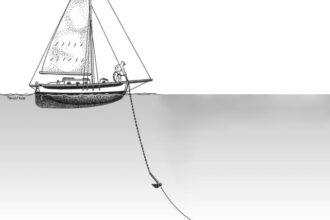
We use lightweight aluminum anchors most of the time and, so we can lift them off the bottom, we don’t have a lot of chain on them. That’s fine as far as it goes, but the actual task of lifting the anchor and chain is not very ergonomic. We’re now going to fit Mystic with an anchor windlass, but by the time I began to give in to that kind of thinking, we were on our long cruise in the middle of the Canadian wilderness on the east shore of Lake Superior. No windlass for Mystic that season. We did, though, devise a way to spare our backs while bringing in the anchor.
We almost always motor up to the anchor until it is underfoot. Karen then cleats off the rode and I back down to rip the anchor out of the bottom. After it was out, we used to lift the rode, anchor, and chain up over the side. That was the real work and the part that was hard on our backs (mostly Karen’s back).
The halyard solution
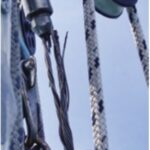
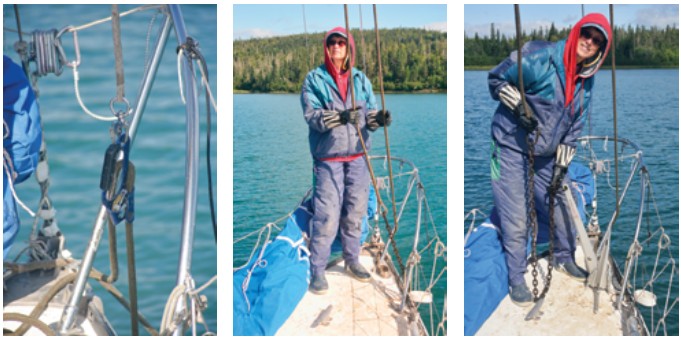
For most of last summer we tried a variation. We brought the anchor underfoot and cleated it off as before, but then we snapped an ascender onto the jib or spinnaker halyard and clipped it to the rode. I then used the halyard winch to pull the anchor out of the bottom and hoist it aboard. It took a little coordination, but we got pretty good at it. While I cranked the winch, Karen guided the rode, chain, and anchor aboard so it didn’t drag along the hull. Once everything was aboard, I lowered away and Karen stowed it all and mopped around a bit to get the mud off the deck.
You can do this with an ascender, which is a rock-climbing device, or you can simply do it with a short piece of line bent to the halyard and tied with a rolling hitch to the rode. If you use a line, make it one or two sizes smaller than the rode. The smaller, more flexible line will work better. We carry two ascenders to allow me to climb the mast when I am alone, so they’re aboard anyway. The ascenders will not fit the larger-diameter rodes, so you’d have to use a rolling hitch if your rode is much larger than climbing line. If your rode is that big, you probably have a windlass anyway.
I’m looking at windlasses and thinking about how to fit one on Mystic. Maybe next season or maybe not but, either way, we’re done lifting the chain and anchor over the side. Now our backs can age more gracefully.
Jerry Powlas is co-founder and technical editor of Good Old Boat. His engineer’s training helps him in his efforts to live by the Princess Principle aboard Mystic.
Thank you to Sailrite Enterprises, Inc., for providing free access to back issues of Good Old Boat through intellectual property rights. Sailrite.com