The trailersailer’s answer to low-water launch ramps
Issue 37 : Jul/Aug 2004
With its shoal-draft keel/centerboard combination, my trailersailer draws only 22 inches. However, if I want to float it off or onto its trailer, I need approximately 3 feet of water. This is because the trailer raises the boat an additional 14 inches. Normally this is not a problem. Proper scouting of the launch ramp, combined with the fact that my trailer has rollers instead of bunks, usually overcomes any potential launch ramp perils. With a push/pull effort, I can roll the boat on or off in water around 2 feet deep. However, in the past three years, below-normal precipitation in my sailing grounds has left many lake levels, including the Great Lakes, well below their norms.
After struggling to retrieve my boat on two occasions and witnessing the towing eye of one boat being unceremoniously pulled out while the owner was attempting to winch it onto its trailer, I vowed to do something to improve my launching and retrieval ability. If I could get the boat and trailer farther out into deeper water, my problem would be solved. Unfortunately, my tow vehicle isn’t equipped for submarine service. What I needed was a tongue extender.
Over the years, I have seen all manners and configurations of tongue extenders and associated trailer modifications. Having benefited from this, I elected to follow the KISS principle . . . Keep it Simple, Sailor. In selecting my materials, I made certain that all were commonly available.
Square steel box
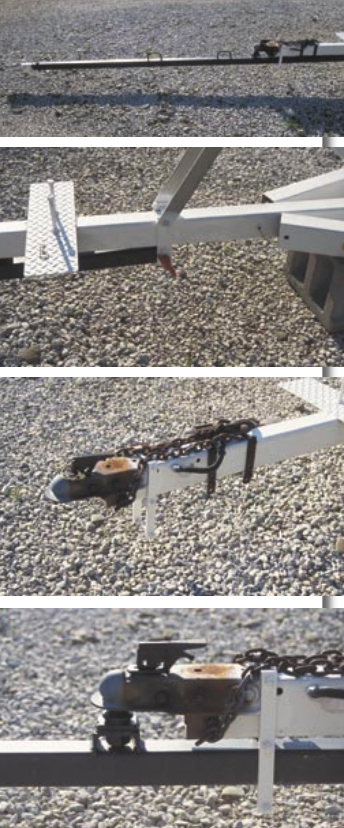
The end result is a 12-foot length of 2 1⁄2- x 2 1⁄2-inch square steel box with a coupler bolted to one end and a 3⁄4-inch hole drilled horizontally through the other. Four feet from the end with the hole, a hitch ball is welded in place. To make handling easier, two handles are welded to the top of the 12-foot extension, one at 5 feet from the end with the hole and another at 7 feet. Modifications to the trailer are minimal. Using two 6-inch lengths of 1⁄2- x 2-inch flat stock, one pair of the trailer’s brackets now extends 2 inches below the tongue. A 3⁄4-inch hole drilled horizontally through both straps mates with the hole in the tongue extender. To guide the extender into place, a pair of 10-inch long 1⁄2- x 1-inch bars are fastened with three 4 1⁄2-inch bolts just behind the trailer’s hitch, forming a box.
In operation, the tongue extender is slid through the trailer tongue’s new guide box and back until the hole in the extender matches with the holes in the newly lengthened trailer bracket. Once achieved, a 5⁄8-inch hitch pin is inserted and clipped into place. The extension is then lifted up by its handles, engaging the ball on the extension with the trailer’s coupler. Once the trailer’s coupler is locked, the extension’s coupler is connected to the tow vehicle’s ball, and the wheel jack is raised, the extension is ready for use. For stowage, I simply bungee the tongue extender beneath the boat to the trailer’s frame.
Thank you to Sailrite Enterprises, Inc., for providing free access to back issues of Good Old Boat through intellectual property rights. Sailrite.com