A sailor’s ingenuity (and a little labor) stops those annoying drips
Issue 37 : Jul/Aug 2004
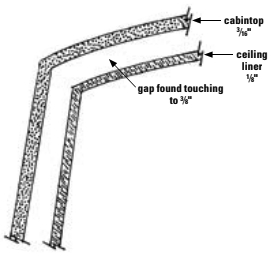
In 1970 I purchased a new Columbia 36 that came with a very good dealer discount because I agreed to handle all small warranty problems myself. The windows leaked immediately, and I repaired them during the first winter. The boat has since been sold, so I am relying on my memory regarding dimensions. With the windows removed, I found the thickness of the cabintop to be approximately 3⁄16 inch and the thickness of the ceiling liner to be approximately 1⁄8 inch (see Sketch 1). The gap between the two surfaces varied from nothing to as large as 3⁄8 inch.
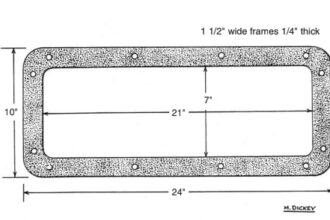
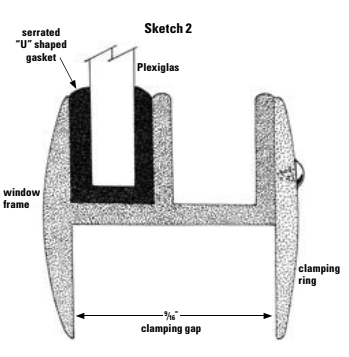
I assembled the portlight outside the boat and found a gap of 9⁄16 inch between the frame and the clamping ring (see Sketch 2). The minimum thickness for the frame to clamp onto was a mere 9⁄16 inch. With these conditions, the portlight cannot be made tight in the window cutout. It was being held in place by sealant alone. Flexing of the hull eventually breaks the sealant, resulting in a leak. I also found an insulation-type material between the cabintop and the ceiling liner.
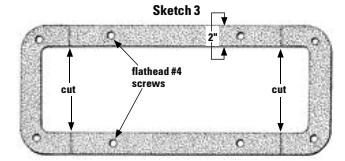
I first cleaned out the insulation material to a depth of 2 inches around the cutout. Next I made up a plywood frame or shim, 2 inches by 1⁄4 or 3⁄8 inch, which I installed in the gap between the cabintop and ceiling liner. To aid in installation, I cut the frame into four pieces: top, bottom, and sides (see Sketch 3). These pieces were held in place with 8 flathead screws, #4 or #6. They were installed through the ceiling liner into the plywood and did not go into the cabintop.
The portlights were installed dry, and they fit perfectly with the shape of the cabintop. No bending or adjusting of the portlight flange was required. I disassembled and cleaned the portlights. Then I reinstalled the serrated gaskets on the Plexiglas with clear silicone sealant.
After the gasket and sealant had cured, I installed the Plex and serrated gasket in the frame using clear silicone sealant. The portlight frame joints were also sealed with the sealant.
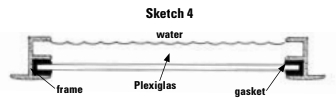
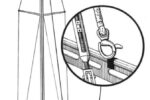
I subjected the assembled windows to a water test by laying the window and frame flat and filling them with water to the top of the frame rim (see Sketch 4). There were no leaks. I reinstalled the reassembled windows in the boat using white silicone sealant. This repair was successful. I sold my boat to new owners in 1999. I believe the repair is still good to this day.
Thank you to Sailrite Enterprises, Inc., for providing free access to back issues of Good Old Boat through intellectual property rights. Sailrite.com