Issue 12 : May/Jun 2000
Most of the people I talk to, including many boating professionals, don’t know the difference between brass and bronze. Many use the words interchangeably. Although brass and bronze have the same base metal, copper, there is a substantial difference between the two.
Others think there is only one brass and one bronze. In fact, there are dozens of alloys of each. Most were designed for specific uses. Only a few types of each alloy are in general use and readily available.
Brass is an alloy of copper, zinc, and (usually) lead. Bronze is an alloy of copper and tin. It’s zinc and lead that cause problems in boats. The zinc and lead are added not, as most people think, to reduce the cost of the raw materials, but to make it easier to machine brass in rod and bar form.
By far the most common alloy of brass is alloy #360, free-cutting brass. This alloy contains approximately 60 percent copper, 36 to 37 percent zinc, and 3 to 4 percent lead. Several years ago, while I was working for the nation’s second-largest producer of brass rod, my sales of this alloy were in the range of 18 to 20 million pounds per year. It’s an alloy I know well. The company I worked for produced 180 million to 200 million pounds per year.
Most of this product is used by screw machine shops to make everything from automotive parts to electronic components. The reason that it is so popular is that machines cut it like butter. The screw machines can be run at higher speeds and feeds and therefore turn out more pieces per minute, which means a lower cost per piece.
It is not unusual for a screw machine shop to generate 60 to 70 percent scrap when machining components. Free-cutting brass scrap is therefore plentiful and, because of its low copper content, also inexpensive. From the viewpoint of a manufacturer of marine fittings, brass scrap is an ideal material. Many makers of boat fittings now use it to cast their products. Unfortunately, it is one of the worst metals to use on a boat.
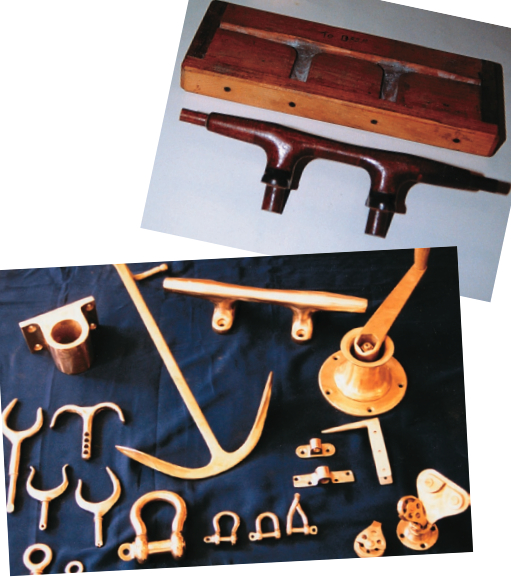
The addition of the zinc and the lead reduces the strength and the corrosion resistance of alloy 360. The addition of the lead also makes the metal fracture readily when it’s bent. You don’t necessarily intend to bend your fittings, but accidents do happen. It’s much better to sail home with bent fittings than to be towed home with broken ones.
Copper and zinc do not like each other as metals. Over time, the zinc will leave the metal in a natural process called dezincification. Salt water acts as a catalyst, and what would take 200 to 300 years ashore will happen in 30 to 40 years on a boat. The zinc leaves the alloy as a white powder called zinc oxide. The zinc oxide is acetic and will attack and rot any wood the metal is attached to.
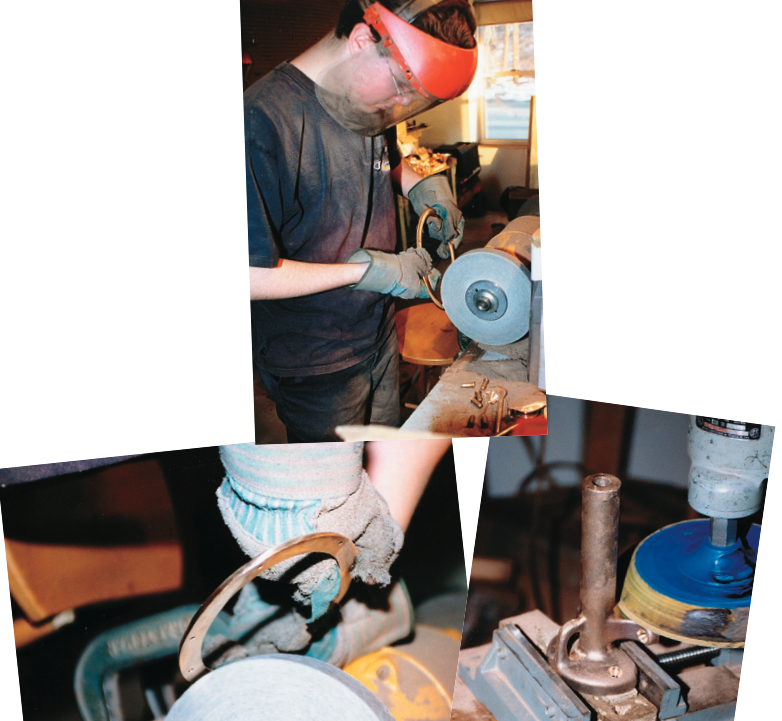
Few bronze alloys contain lead, and most have little or no zinc. As a rule, they are stronger than brass, more corrosion resistant, and less prone to fracture when bent. But because they contain more copper, they also cost more. In addition, bronze is more difficult to machine and polish. Free-cutting brass has a machinability rating of 100 percent. The bronze I use most frequently, silicon bronze (alloy 655) has a machinability rating of only 30 percent. It is a nasty alloy that concentrates heat at the work face of the tool and quickly dulls it. Nevertheless, it is good and strong, and stands up well in a marine environment.
A few years ago, I made all the fittings for the reproduction of the schooner, America. One of the alloys that we used for her was a high-tensile manganese bronze that had a machinability rating of only 8 percent. Boy, was I glad when all of those fittings were done!
For much of the history of boating, marine fittings were made of bronze, and they lasted very well. After World War II, in an effort to remain competitive with offshore manufacturers, many American manufacturers switched from bronze to brass. At first, they used a red brass (alloy 230) that looked like bronze. With no tin, and a high zinc content (15 percent), these fittings did not last long. I have seen many boats from the 1960s and 1970s with badly deteriorated fittings. Just about all of these fittings were of red brass. My own boat is hull #858 from the Herreshoff Manufacturing Company, in Bristol, R.I. She was built in September, 1920. Her fittings are of bronze and most are still fine.
More recently, many suppliers began to import fittings. Worse yet, they are now using a yellow brass, usually alloy #360. If you look closely at these fittings, you will find that not only is the alloy a poor choice but the casting quality is poor as well. Go into most gift shops, and you will find candlesticks and doorknockers made from the same material.
How can you tell the difference between brass and bronze? Often, it’s difficult for the layman, but the switch to the high-lead, high-zinc brass has made it easier. If the fitting is a yellow “brassy” color, then it probably is our old friend, alloy 360. If the fitting has a deep, rich, golden color, then it probably is a bronze.
Over the past 20 to 30 years, many boatbuilders have switched to stainless-steel fittings. In many cases, this was due to the difficulties experienced with the “bronze” (red brass) fittings of the time. The early stainless-steel fittings were all right, although nowhere near as aesthetically pleasing as the pre-World War II bronze pieces. Many of the stainless fittings were made as stampings from sheet metal, while most bronze fittings are castings.
In the early 1990s, the EPA cracked down on the chemical process known as passivation that kept stainless steel from rusting. With passivation no longer available, many of the more recent stainless-steel fittings now bleed rust. We’ve all seen boats only a few years old with rust stains on their decks and sides. Now you know why.
So now the process has come full circle. The better boatbuilders are seeking to switch from stainless and brass back to good old bronze. A lot of the people with boats the age of mine or older are wondering what all the fuss was about. We have known all along that a good bronze was the best way to go.
Roger learned to sail when he was 10 and has owned his Herreshoff S-Boat, Resolute, for 30 years. A sales engineer for the brass and copper industry for more than 30 years, he founded Bristol Bronze in 1989.
Thank you to Sailrite Enterprises, Inc., for providing free access to back issues of Good Old Boat through intellectual property rights. Sailrite.com