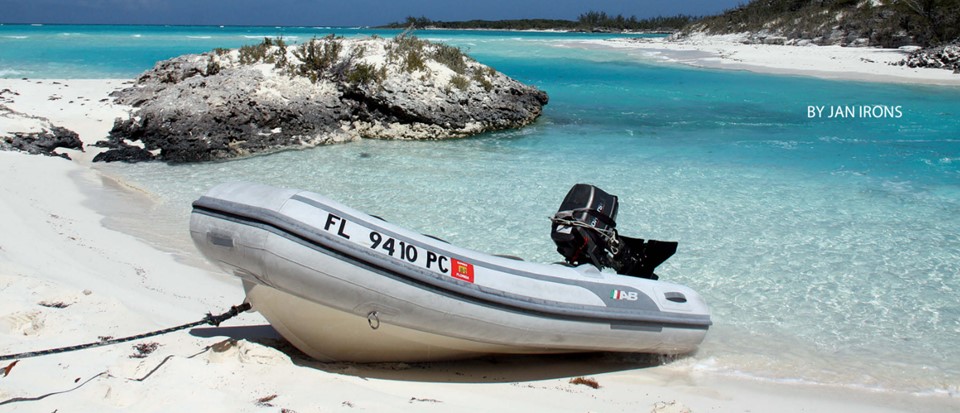
It’s everything from taxi to truck
Issue 98: Sept/Oct 2014
Selecting a dinghy is a critical step in outfitting a cruising boat, but amid the onslaught of outfitting decisions about whether to add solar, wind, a generator, an electric windlass, or a watermaker, choosing a dinghy often gets lost. Making the choice harder, there are almost as many dinghies to choose from as there are cruising boats.
While cruising, we’ve too many times heard the refrain, “We can’t go to a distant snorkeling spot or land on that shell beach because our dinghy isn’t up to it.” The most common reasons are “The outboard’s acting up,” “Our 4-horsepower motor won’t go that far,” or “Our dinghy’s leaking.” Would anyone remodel the kitchen in a land-based house and then buy a beat-up car that only started half the time? For whatever reason, a family car gets much more consideration than a dinghy.
But, while cruising, a dinghy is the family car! Fifteen years ago, when we bought our 1985 Passport 37, Winterlude, a dinghy was not included. After spending a great deal of our budget outfitting the boat, we gave little thought to a dinghy. Our principal consideration was that there was no good place to store it on board when we went offshore, so we limited ourselves to a roll-up inflatable dinghy.
A friend sold us his 8-foot Caribe roll-up inflatable. We had no idea if this was the dinghy we needed for our cruise to the Western Caribbean, the San Blas Islands, and Colombia, we just went with it because we didn’t have much money left for a dinghy. We added an 8-horsepower Tohatsu 2-stroke outboard for $1,350 from a dealer in Annapolis. For a total of $1,750 we had a family car.
Although we successfully used this combination all the way from Annapolis to the Bay Islands, Honduras, it was not necessarily the best selection for us and we replaced it in Honduras. We had a 9-foot aluminum RIB (rigid-hull inflatable boat) shipped from the States to Roatan, which was supposedly a “free zone” for yachts in transit. Never forget that third-world countries don’t always know their own “rules.” There was no “free zone.” It’s best to buy your dinghy before leaving the U.S.!
Narrowing the field
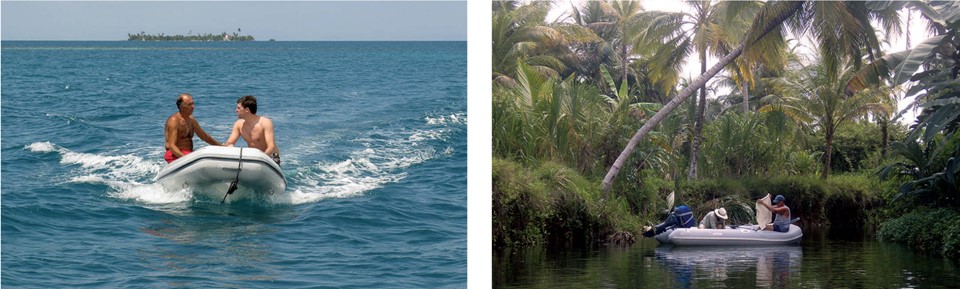
A “cruising-capable dinghy” will have as many varied forms as there are types of cruiser. For a marina-to-marina coastal-only cruiser, a dinghy won’t be a major consideration. But for those who will live at anchor, it is important to consider all the options, especially now that more alternatives are available.
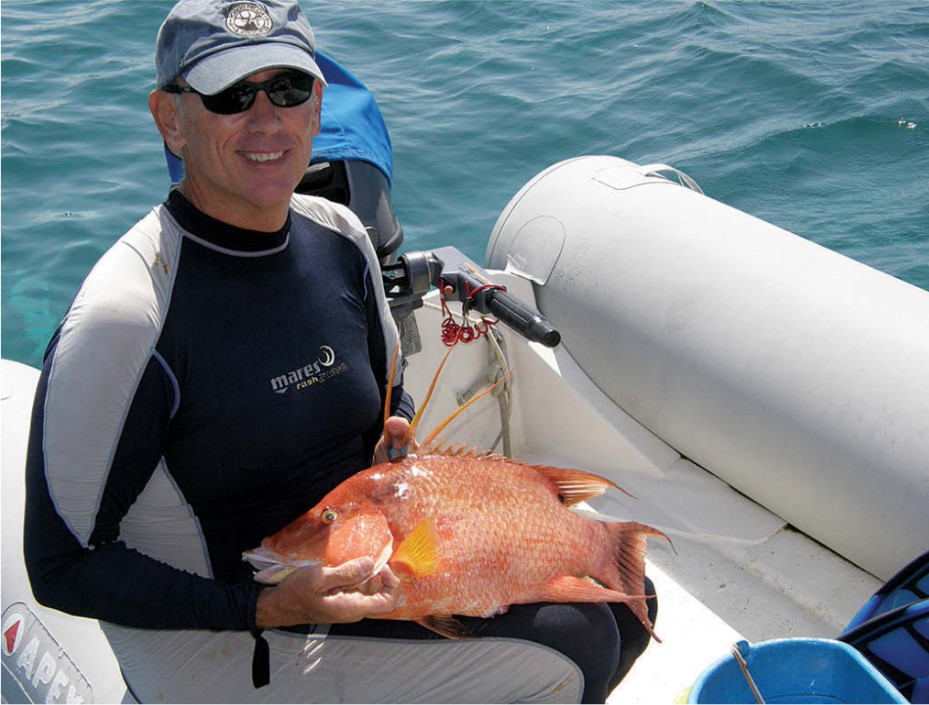
Step 1 – Carefully consider what you want your dinghy to do and, more important, ask yourself whether there will ever be a time when you might want it to do more. When we bought that first dinghy, we never imagined we’d be taking it miles to reach the best spearfishing reefs in the Western Caribbean; initially, we had no ambitions of spearfishing and no speargun.
Will you want to land on a shell beach to go shelling? If so, a soft-bottom dinghy might not be durable enough.
Will you need to carry a full load of provisions or gas, diesel, or water jerry jugs?
If you have dreams of sailing in the Pacific, you’ll need to be able to land a dinghy safely through the surf and you might want to consider dinghy wheels.
Step 2 – Once you have a good idea of what you might want to do with your dinghy, make a list of the pros and cons of each type as it relates to your needs. You might want a roll-up, an air floor, a RIB, a folding type, a rigid rowing dinghy, or one that sails. Kayaks are also increasingly popular as dinghies.
Step 3 – Consider where and how you plan to store your dinghy. We chose our starter 8-footer because we had no deck space for a RIB, but we found it too much trouble to deflate it and roll it up for storage, so we never did. When it was not in use, the roll-up dinghy lived upside down on the foredeck, right in the way. When we decided to get a new dinghy, we opted for a 9-foot lightweight aluminum RIB because it was still light enough for us to hoist onto the foredeck but the bottom was sturdier for beach landings. It also allowed us to travel faster, even with our old 8-horsepower Tohatsu.
Step 4 – Balance how much power you need in an outboard versus how much it weighs. Keep in mind that, outside of the U.S., outboards are the most likely items to be stolen; you’ll want to keep it safe. For us, this means hoisting it onto the boat’s rail and securely locking it each evening. Thieves want the outboard but not the dinghy. Separating the outboard from the dinghy makes it harder for someone to steal the outboard. Ironically, an outboard can be replaced in almost any country; it’s much harder to replace a stolen inflatable or, for that matter, any dinghy.
Our 8-horsepower 2-stroke outboard, at approximately 60 pounds, is light enough for us to manage hoisting it daily. A 15-horsepower outboard would be too heavy. If our 2-stroke ever dies, a 4-stroke Tohatsu 8-horsepower is more than 20 pounds heavier. That increase in weight would force us to add more purchase to our outboard motor hoist to help us lift it.
Step 5 – Decide on power. The choices are a 4-stroke outboard, a 2-stroke outboard that is lighter but not available in the U.S. (the nearest place to buy one is the Bahamas), a trolling motor, oars or paddles, a sail, or — the newest option — a propane-fueled outboard.
Budget
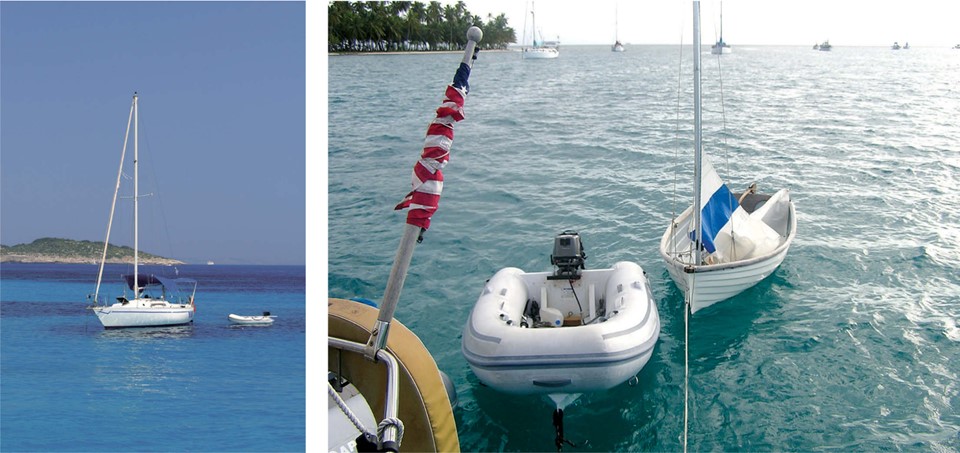
How much should you budget for a dinghy and outboard? Their prices range widely. Replacing our current rig, an 8-horsepower Tohatsu outboard and a 9-foot AB Lammina aluminum RIB, would cost approximately $5,600: $2,000 for the outboard and another $3,600 for the dinghy.
At the low end, prices for inflatables start near $1,000 for a PVC or other dinghy. Adding a 5-horsepower outboard for $1,300 or less brings the total to about $2,300.
If you are looking for a dinghy bigger than 9 feet or an outboard larger than 15 horsepower, prices go up dramatically. For example, a 10-foot Achilles RIB at Defender is $3,200 and a 15-horsepower Yamaha is around $3,200, for a total of $6,400.
You can save money by going with a hard dinghy or Porta-Bote.
A 10-foot Porta-Bote is approximately $1,800 — significantly less than an inflatable. A 4- to 6-horsepower 4-stroke outboard would add $1,300 to $1,700 for a total of $3,100 to $3,500.
Hard dinghies, such as the 10-foot Walker Bay, start at around $1,000. This boat is rated for a 3-horsepower outboard that can be added for less than $1,000 to bring the combination price to around $2,000.
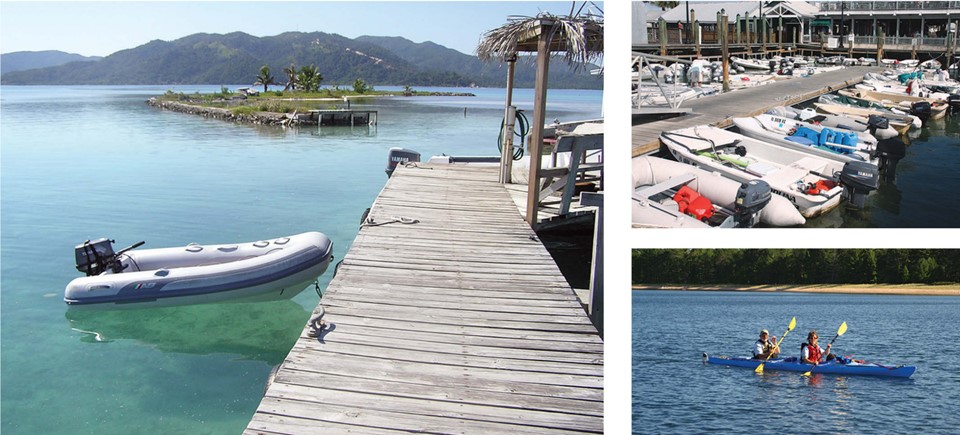
Advantages and disadvantages
Each dinghy type comes with its advantages and trade-offs, from durability to weight and cost.
Inflatables – Inflatables are generally made of PVC or Hypalon. PVC is less expensive and less durable, especially when it comes to UV deterioration. Hypalon is more durable and resistant to UV but is also more expensive. We prefer Hypalon despite the extra cost. Once you leave the U.S., it’s difficult to replace an inflatable, and Hypalon’s durability becomes more important.
Bigger-diameter inflatable tubes mean a drier ride and allow an inflatable to carry more weight. Unfortunately, they make the boat more difficult to row. However, this is somewhat true of all inflatables and, besides, rowing may not be something you’ll want to do . . . except as a last resort!
If you plan to fish, another disadvantage is the need to keep fishhooks, speargun tips, and anything else sharp away from the inflatable tubes.
The RIB handles heavy laundry days and major re-provisioning with ease. One of the disadvantages can be weight. At 79 pounds, our aluminum hull is considerably lighter than a comparable fiberglass hull at 95 to 106 pounds. We learned recently that AB Inflatables now makes a 9-foot ultralight aluminum RIB that weighs only 68 pounds, so shop around!
Within the family of inflatables are the lighter weight roll-up and air-floor models, but you have to be careful when landing on rocky or shell beaches with these. A roll-up or air-floor dinghy will be a wetter and slower ride than a RIB and they generally don’t plane as easily. Overall, though, transporting laundry or provisions in these boats is not a problem unless it’s really windy.
Another member of the inflatable family has a rigid floor, usually made of fiberglass (or more recently, aluminum). These boats are considerably sturdier for landing and going ashore than roll-ups or air floors but they are heavier and bulkier, and the floor makes storage more difficult unless you have davits. These dinghies are very stable and forgiving around docks, they plane easily, and they are generally drier and better for traveling longer distances.
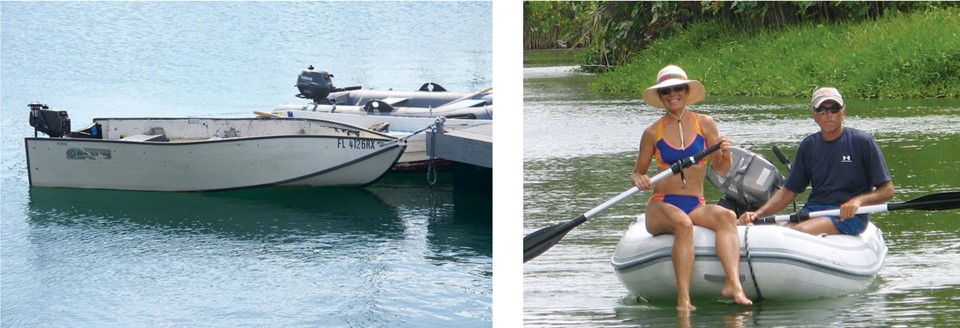
Hard dinghies – Hard dinghies are less stable than inflatables but far more durable, and easily outperform all other types of dinghies when being rowed. Weight could be an issue for stowing a hard dinghy unless you have davits. A hard dinghy with a sail rig (Like the Fatty Knees –Eds.) is popular in harbor locations like Marathon, Florida. It’s also great for laundry, provisioning, and all things dinghy-like, and speargun tips or fishhooks are not a problem! Climbing back aboard a hard dinghy after snorkeling or diving is a challenge but can be managed with a ladder.
Porta-Botes – Cruisers who use Porta-Botes swear by them. They’re lightweight and stable. Within their weight capacity, they can be fully loaded with provisions or swimming gear and dive equipment. Boarding from the water requires a different technique than is used to board an inflatable, but it can be done, as evidenced by our friends who snorkel frequently.
Porta-Botes row easily and will take an outboard, but online specs limit the outboard to 56 pounds, which would allow some 6-horsepower models. (According to the company, the outboard weight is limited by the total weight capacity of the boat.) The capacities of the 8-feet 9-inch and 10-feet 8-inch Porta-Botes are 445 pounds and 585 pounds. Keep in mind that this includes outboard, people, and cargo. Generally, these dinghies are folded on board when under way and must be reassembled for use, but this doesn’t take long.
Kayaks – When used as the primary dinghy, a kayak can only handle a limited amount of cargo. Kayaks are not good for ferrying people or supplies out to your boat. Any fresh laundry you transport had better be in a dry bag! Our kayaks provide hours of fun and exercise, but they also function as a backup in case anything ever happens to our dinghy. But the dinghy wins every time it’s blowing like stink and we know the ride will be wet.
Motor choices
More power will get you to distant beaches more quickly but comes at a cost in dollars and weight.
4-stroke outboard – The only dinghy-sized outboards currently sold in the U.S. are 4-stroke. Advantages are easier starts, better gas economy, and no need to mix oil in the gas. For us, however, the increased weight makes a 4-stroke outboard more difficult to store on board, so we’ll stick with our 2-stroke until it dies.
2-stroke outboard – While they use more gas than 4-strokes, 2-stroke outboards are lightweight and reliable. However, they require oil to be mixed in the gas, are harder to start with the pull cord, and are “less green.” While cruising, we stock extra pull cords as well as an extra gas hose and tank since these parts are proprietary to the manufacturer and difficult to get outside the USA.
Propane outboard – Propane outboards are just starting to become a viable choice for cruisers. Since propane is available everywhere, they are worth consideration when you purchase a new outboard. One satisfied owner living on a mooring in Boot Key Harbor in the Florida Keys told us he loves his and no longer carries combustible gasoline aboard his boat. Propane outboards seem to be priced similarly to 4-stroke gasoline outboards but are slightly heavier. The new 9.9 propane model weighs about 5 pounds more than a comparable Mercury 9.9 gasoline model. These engines are also available in 2.5-horsepower and 5-horsepower models, both of which can use small propane canisters designed for camping or be converted to a regular 10-pound propane bottle.
Oars/paddles – Boats that you can row offer good exercise, but not if it’s blowing 20 from the direction you need to go. Still, as a safety precaution, every motorized dinghy should carry oars aboard at all times. You never know when your outboard may sputter. If the tide is going out, this could result in serious trouble.
Sailing dinghies – Dinghies you can sail are also great fun. There is no better way to while away an afternoon at anchor when the perfect breeze is blowing. But choosing a small sailing dinghy as the primary mode of transportation is not so practical on an everyday basis. There is a middle ground however. We have known several cruisers who had a sailing rig on a hard dinghy and made use of a small outboard when the wind didn’t want to cooperate.
While there is no right or wrong answer to the question of which dinghy is “cruising-capable” for your needs, giving adequate consideration to dinghy selection before you set out may help you avoid a great deal of frustration later.
Jan Irons and her husband, David, cruised the northwest and southwest Caribbean for six years aboard their 1985 Passport 37, Winterlude, and now spend their winters cruising the crystal-clear waters of the Exumas and Florida Keys. Jan writes practical tips and information for part-time cruisers at http://commutercruiser.com. She and Carolyn Shearlock are co-authors of The Boat Galley Cookbook, published by International Marine and available from Amazon.
Thank you to Sailrite Enterprises, Inc., for providing free access to back issues of Good Old Boat through intellectual property rights. Sailrite.com