Innovative design and a voluminous interior

Issue 93 : Nov/Dec 2013
Hunter Marine builds enough boats, about 2,000 a year, to make it one of the leading producers of sailboats in the world. The company was established by John and Warren Luhrs in Alachua, Florida, and was acquired last year by David Marlow. It is now called Marlow-Hunter. This company is not known for its allegiance to traditional methods of design and construction in the marine industry — it is known for technical innovation and novel thinking about what sailboats should look like.
Some departures from convention stem from Hunter’s imaginative design team; others reflect the company’s ability to integrate owner feedback into the design process, sometimes producing significant changes during a model’s production run. Deriving inspiration as much from industrial design and modern architecture as from traditional small-boat design, the Hunter team creates sailboats rich in ideas, such as rigs without backstays and interiors with few bulkheads and spaces with unusual shapes.
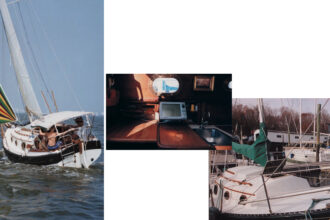
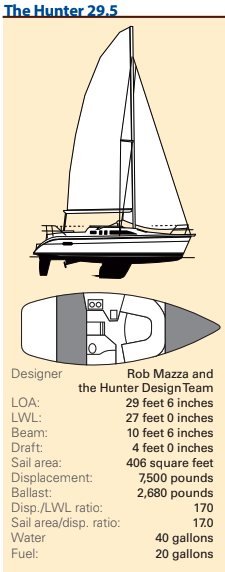
The Hunter 29.5 is a good example. Our review boat is Wind Dancer, whose owner, Dick Osborn, was a willing and active accomplice in this review. Hunter 29.5s were built between 1993 and 1997. Wind Dancer was built in 1995 and Dick bought her in 2005. She was his second sailboat. He had previously sailed a Schock 23. The pre-purchase survey pronounced the boat to be “in generally average condition for her age” and, seven years later, she seemed that way to me. We scheduled sea trials and underway photography for a late October morning. Unfortunately, light winds diminished to about 1 or 2 knots, but as we followed Wind Dancer in light air, I was surprised at how well she moved with her sails barely full. However, we decided to set the sea trials for a day with more wind in it.
The rig
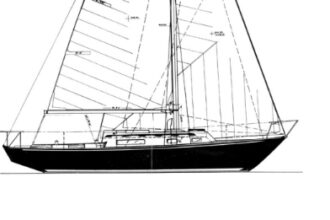
The Hunter 29.5 has a fractional rig with a single set of spreaders swept back at 30 degrees so the shrouds and forestay combine to form a sort of tensioned tripod that supports the mast fore and aft as well as transversely. This eliminates the need for a backstay, which allows for a markedly larger roach that increases mainsail area and in turn allows for a smaller foresail. It’s estimated that the larger mainsail with little more than a lapping jib can provide as much drive as a smaller mainsail and 150 percent genoa.
There is much to be said for a small headsail with a larger mainsail. In gusty conditions, a lot of wind can be dumped in a hurry by reefing the main, and there’s no complicated hassle (and expense) involving two heavy headsail winches, movable blocks, and so forth in getting a big genoa from one side to the other. However, there’s a limit to how far the boom can be let out before the mainsail becomes impaled on those swept-back spreaders. Rather than sail dead downwind with the sails more or less at right angles to the centerline of the boat, it’s better to broad reach and jibe downwind, which many skippers prefer to do anyway because it eliminates the need for a whisker pole and reduces the danger of an accidental jibe.
Because of the lower jibsheet loads, the only winches are two Lewmar 16STs mounted one each side of the companionway. Lewmar 30ST spinnaker winches can be mounted on the coaming beside the helmsman, but Wind Dancer isn’t equipped with this option. An outhaul with a 3:1 purchase and two reefing lines run through the boom and back to the cockpit. The boat is rigged with a topping lift and a boomvang tackle.
Construction
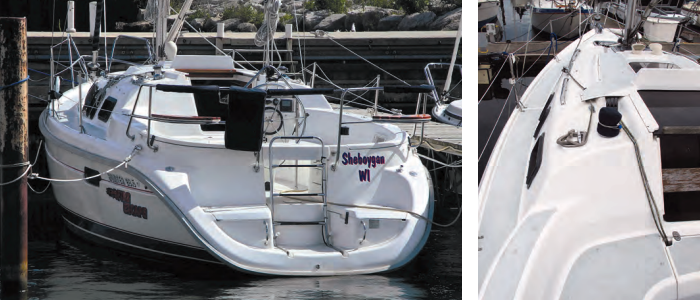
The hull, deck, structural grid below the sole, and interior components are molded separately and assembled with structural adhesives or secondary bonds of fiberglass. The hull is laid up of solid fiberglass while the deck is of balsa-cored sandwich construction. The hull-to-deck joint is through-bolted and well bedded.
The keel is molded with the hull and receives a cast lead insert. A lead bulb/wing casting with a recess to accept the lower end of the fiberglass keel is attached to the molded keel, but no keel bolts are visible inside the boat. The lead shoe is intended to absorb the impact of grounding.
On deck
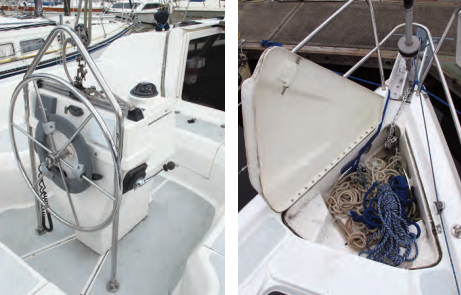
In spite of rather narrow sidedecks — a concession to the voluminous interior — moving fore and aft is fairly easy. It helps that the chainplates are located at the deck edge, but stanchion supports intruding into the walkway can be tripping hazards. I prefer a less-rounded toerail to brace against. A shallow anchor locker at the bow holds a limited amount of anchor warp. Two mooring cleats are fitted inside it where they are hidden from view and out of the way but awkward to use. Dick belays his starboard bow line to the sturdy stemhead fitting that contains two large bow rollers.
The cockpit is large but has limited storage, due in part to the berth below. There is under-seat storage with a “gull wing” hatch to starboard and a similar hatch in the bridge deck that’s intended to contain running rigging brought back to the cockpit. The mainsheet is attached to a short traveler forward of the helm. One end of the 3:1 purchase can be controlled there with a camcleat. The other end leads to the mast and back to a winch on the cabintop.
Two seats are built into the stern pulpit on either side of the helmsman where they’re out of the way and well positioned for non-sailing crew. They bring crew weight aft but the fun and convenience they add may be worth it. At the stern is an excellent swim platform with an integral ladder and two small hatches built into steps at the lower level. This is also a good way to launch a dinghy. The downward-plunging sheerline produces voluptuous curves at the stern.
Belowdecks
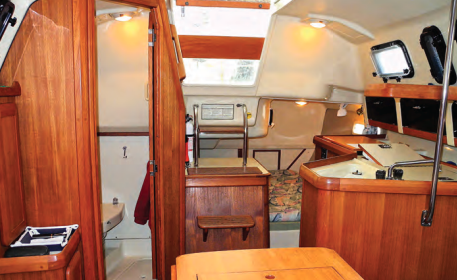
As with other Hunters, the most striking impression of the 29.5 belowdecks is the absence of bulkheads and the configuration of spaces. Saloon settees resemble sectional sofas, large windows take the place of portlights, and the quarter berth has grown into a queen-sized bed. Few exposed fittings, such as nuts and backing plates securing deck hardware, are visible. Black-plastic or teak-fronted doors cover storage bins located almost anywhere opportunity allows.
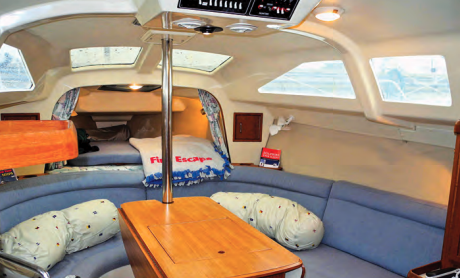
The forward berth is open to the saloon, making a fine place for the kids (or more nimble adults) to lounge about or sit peering into the cabin with legs dangling over the edge of soft furniture. Some privacy is achieved with curtains. A 40-gallon water tank and a 6-gallon water heater are located under the berth.
U-shaped seating in the saloon surrounds a large teak drop-leaf dining table. Dishes and cutlery are stored under a hinged panel on top. The table can be lowered and special cushions, that stow on a shelf in the after sleeping area, convert it to a large double berth. A stainless-steel compression post for the deck-stepped mast is located at the forward end of the table and is unobtrusive. Four hatches under the seat cushions give access to general storage. There’s a small but convenient teak locker for foul weather gear just aft of the starboard saloon settee.
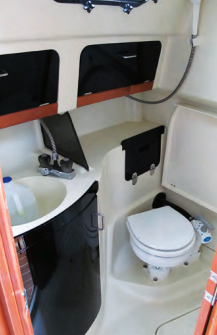
The head is to starboard of the companionway ladder where it’s handy to the cockpit. It’s well laid out and well ventilated and contains a toilet, lavatory, shower, and good storage behind black plastic doors. A hinge-down shower seat or baby-changing table covers the toilet and a prominent curved black plastic Art Deco locker door adds a stylish touch to the compartment.
The L-shaped galley is to port of the companionway and contains a two-burner non-pressurized alcohol stove, a microwave, a very large icebox, and a sink that’s angled toward the centerline of the boat. A convenient counter-long bin is located at counter height just under three large storage cupboards. The area is well lighted and ventilated by three opening ports.
Lying athwartships abaft the galley is a large double berth that measures almost 5 feet wide by 8 feet long. The space is achieved by raising the cockpit sole a bit and wrapping the berth around the small engine compartment. Although getting in and out of the berth is a bit awkward, the area is adequately lit and there is provision for storage in several cupboards. I think some string hammocks would serve well for additional storage here.
The engine
The Hunter 29.5 is equipped with the Yanmar 2GM diesel with a Kanzaki transmission. Dick reports it to be trouble-free with plenty of power and a good match for the boat. It’s contained in a sound-insulated box with service access from the front, behind the companionway ladder. Additional service access is via doors to port and aft in the rear berth. Fuel is stored in a 20-gallon tank located under the cockpit. The Yanmar turns a Martec 15 x 12 folding prop.
Under way
For the rescheduled test sail, the Yanmar started without any fuss and ran quietly. I stuffed the shorepower
cord into the anchor locker and we cast off. Dick backed out of the slip and we motored out of Apple Tree Cove into Puget Sound, where we found 10- to 12-knot winds and a light chop in the shipping lanes. Heading into the wind, we hoisted the mainsail and quickly unfurled the small jib. Dick pulled the engine-stop knob and we slipped away under sail without any noticeable loss of speed. Wind Dancer’s main was pretty well blown out but she still pointed acceptably. When clear of the Kingston ferry landing, we eased the sheets and settled into a reach. I was surprised at how well the tails of the several running rigging lines were contained in the bridge-deck locker, making for a tidy cockpit. The short traveler just forward of the binnacle proved very handy to the helmsman as we came about.
The increased sound of our wake told me the boat had accelerated quickly. She was very responsive to the helm, which was particularly smooth. The boat was well balanced on all points of sail.
With darkening skies, we furled the jib, started the Yanmar again, and headed into the wind to drop the main. The lazyjacks helped gather in the billowing sail as Dick tied in a good harbor furl. Under power, the boat seemed very maneuverable, turning sharply and surely as we pointed for home.
Conclusion
The PHRF rating for the Hunter 29.5 is 192 seconds per mile. In comparison, a Beneteau 305 is 168, and an old Pearson 30 is 174.
This boat does everything a coastal cruising sailboat of its length and type might be expected to do and then some. It sails well with an easily handled rig that is ideally suited to the shorthanded or solo sailor. At the same time, the saloon is lavish and the cockpit is large enough for several guests whether entertaining under way or at dockside.
Dick Osborn feels the Hunter 29.5 was a good choice for him and his family. They’re all happy with the boat and enjoy it.
An Internet check shows prices of used Hunter 29.5s to be about what Dick paid for Wind Dancer seven years ago: a few thousand either side of $35,000, depending on condition.
Richard Smith, a contributing editor with Good Old Boat, is an architect. He specializes in designing and building very small houses and has built, restored, and maintained a wide variety of boats. He and his wife, Beth, sail their Ericson Cruising 31, Kuma, on the reaches of Puget Sound.
Thank you to Sailrite Enterprises, Inc., for providing free access to back issues of Good Old Boat through intellectual property rights. Sailrite.com