Dedicated downwind headsails offer better control
Issue 73 : Jul/Aug 2010
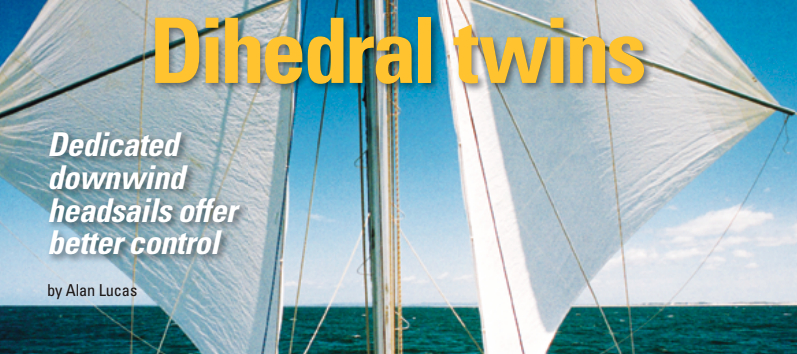
The twin-headsail rig, once commonly seen on boats running in the trade winds, has become a dinosaur in today’s fleet of roller-furled and autopiloted yachts. Even a few hemp-and-tar shellbacks have sacrificed this tried-and-true system on the altar of electronic advantages. But just how advantageous is it to ignore a traditional rig that does not block the view ahead, promises no deadly jibes, will never chafe against leeward rigging, and, into the bargain, produces a natural windvane effect that resists yawing and broaching?
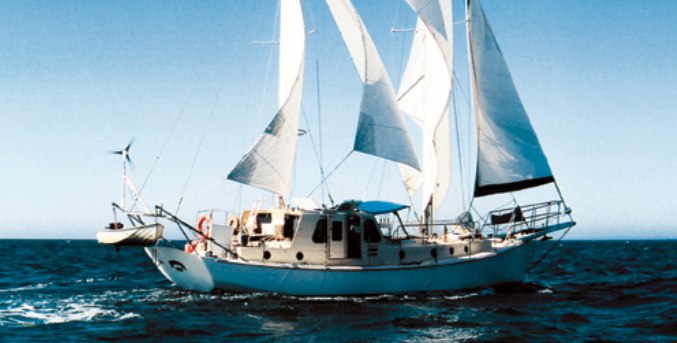
Since the dihedral-angled, twin-headsail rig offers all this, why has it virtually disappeared? Probably because pushbutton sailing is so additive that we willingly bumble our way downwind with unbalanced fore-and-aft rigs. When designing the rig for Soleares, our 50-foot skipjack-based ketch, I took a page out of my less complicated cruising past and committed her to a boom-less, loose-footed, fore-and-aft rig that suited the various angles of reaching but collapsed when running off the wind. To compensate, I added poled-out, dihedral-angled twin headsails for exclusive use before following winds. Having used twins in the past, I was well aware of the extra work involved in setting up a dedicated running rig, but I also knew it to be a wonderfully docile arrangement with all the above-mentioned advantages.
When Patricia and I built Soleares in the late 1990s, we had visions of going offshore again, and this colored our thinking. However, our commitment to self-publishing two Australian cruising guides limited us to coastal cruising. This meant that the twins would be used for daysailing only, a task for which they were never intended. Yet now, 10 years later, we still willingly go through the ritual of swapping rigs according to wind and course and find the effort well worthwhile.
A system for setting
We so love our twin headsails that we never begrudge them the 10 minutes it takes to set them up, especially as we have developed a system whereby Soleares is never completely naked during the changeover. As we pay off to run square — just prior to the boom-less sails collapsing and being progressively dropped — we hoist the leeward twin under the lee of the fisherman. Then we drop the fisherman and hoist the opposite twin. The reduction in speed during the change-over is irrelevant to non-racers and, once set and filling, the twins more than compensate with their friendly, peaceful habits.
Contrary to popular assumption, the modern Bermudan rig is not well-balanced when squared away because a boomed mainsail sheeted right out easily overpowers a poled-out headsail set on the opposite side, producing a broaching moment. A boomed mainsail readily reacts to poor helming with an accidental jibe, with the possible consequences of rig and sail damage and injury to crewmembers. Preventers and vangs offset this tendency but they can let you down when least expected.
An erroneous term
The popular term “wing-and-wing sailing” is erroneously applied to a Bermudan rig running off the wind; a bird that badly balanced would never take off or, if it did, would glide like a brick.
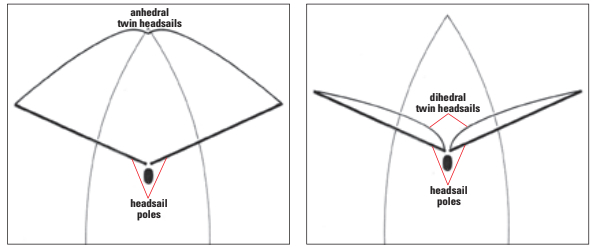
Wing-and-wing should apply exclusively to dihedral-angled twins because they are truly balanced in the way their clews reach forward of their luffs and their entire sail area is forward of the mast, guaranteeing that the center of effort is ahead of the center of lateral resistance. This configuration ensures that a vessel trying to round up has to fight hard against strong natural correcting factors.
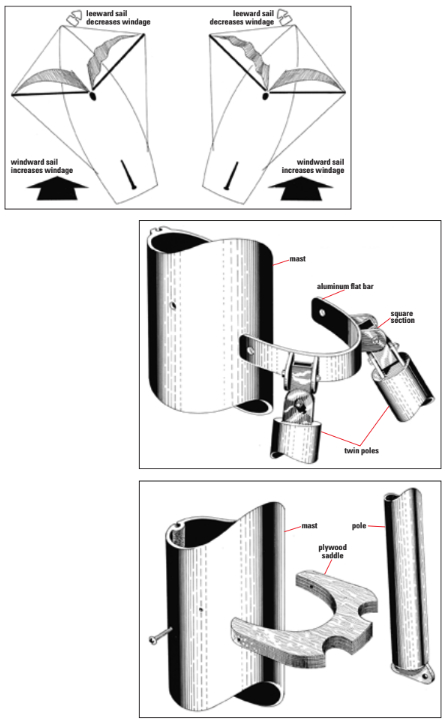
If rounding up starts to occur, the windward twin immediately experiences increased pressure while the leeward twin loses pressure and the rapid imbalance of forces brings the vessel back on course. Despite these constantly active dynamics, the course remains remarkably true with very little wandering or dependence on extreme rudder angles for correction. Indeed, the course can be so true and strong that the greatest single danger dihedral twins pose is their resistance to sudden course changes in the face of imminent collision.
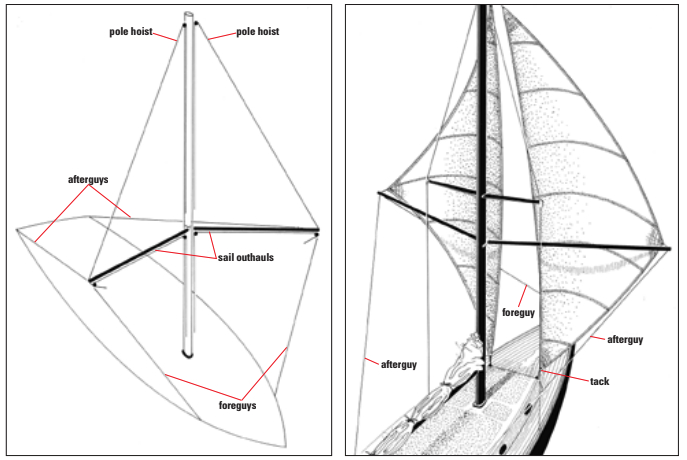
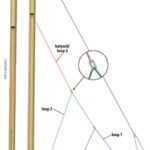
Free-setting twins are OK on very small rigs. Otherwise, permanent stays are mandatory, the poles setting behind them and in front of the shrouds. The stays run from the masthead to points forward of and outboard from the mast by about 10 degrees, typically to the sides of a trunk cabin. The inverted “V” gap that results is important for wind flow, at right.
Permanently hung poles
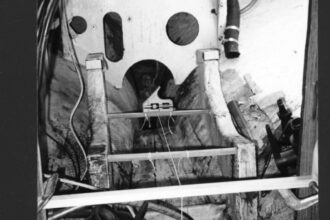
Whether employed as a long-distance ocean-crossing rig or just for daylong coastal cruising, the rig needs to be easy to set and handle, making the permanent hanging of the two poles virtually obligatory. Ours are plain aluminum pipes, foam-filled and hung from goosenecks welded to aluminum strap bent around and bolted through the mast. When not in use, the lower ends of the two poles are lashed into an easily fabricated plywood saddle that’s fixed to the mast with a sealant adhesive and metal threads.
There are two ways to set the poles into their working positions, and boat size will affect the method chosen. One way is to hoist them out on dedicated topping lifts, secure them in position with fore-and-aft guys, then hoist the twins and outhaul their clews to the pole ends; the other is to clip the bottom ends of the poles directly to the twins’ clews and let the sails take the poles with them as they are hoisted (sometimes helped by shoving the poles outboard to overcome inertia). Aboard Soleares we use the second method, but lifts and outhauls would be necessary with big rigs.
Dedicated stays
Dihedral-angled twin headsails are best set on dedicated stays to prevent the sails from blowing off when being hoisted or handed in blustery conditions. Because it’s a downwind rig, always decreasing its apparent wind, the stays can be around two-thirds the diameter of normal stays with the poles passing between them and the shrouds in their working positions. In this position the poles are held firm at an angle that will keep the sails’ clews forward of their luffs. This is the opposite of normal poled-out headsails whose clews reach aft of their tacks at anhedral angles.
Twin-headsail stays should run from the masthead to points on deck about 10 degrees from the vertical, forward of and out from the mast. This keeps the sails’ tacks well apart. The resulting inverted “V” gap between luffs increases their leverage over the ship’s centerline and vents wind that may otherwise encourage rolling.
To digress a moment, it should be noted that some modern sailors deploy their sails from double-tracked roller-furling gear set on a single dedicated stay — rather like a jackstay — close in front of the mast. They say the absence of air space between the sails makes no behavioral difference. They argue that having both sails roll out from a common stay makes them child’s play to handle and much easier to reef.
A more common method is to deploy the above-noted roller-furled twins from the standard stem-head forestay. This allows one twin to be removed whenever the other is needed for conventional reaching as a number-two jib. Such versatility is a powerful argument in favor of this variation. However, when running downwind, these twins are obliged to form anhedral angles that are detrimental to self-steering qualities (although superior to mainsail and poled-out genoa). If this rig wanders off course, pressure in the windward sail reduces while the leeward sail increases and thus denies the immediate windvane effect of the dihedral rig.
Dihedral is superior
According to Frederic Fenger, who published his experiments with dihedral twins on model yachts in 1932, it is vital that the dihedral angle be 23 degrees to the athwartships plane. I have followed this advice on most of my twin rigs over the decades but I confess to never actually measuring the angle, being quite satisfied with guesstimates. There is, however, one thing I can state with certainty: the dihedral angle beats the pants off the anhedral angle for its vastly superior natural self-steering influence and docility under way.
Because dihedral-angled twins produce a natural windvane effect, some vessels will steer themselves for days on end while requiring no attention from helmsman or autopilot once their rudders are locked amidships. Aboard Soleares, we leave the autopilot on and are content in the way its workload is reduced to the level of occasional murmurs rather than constant groans. Yes, changing from one rig to another on a daily basis is inconvenient compared to easing a Bermudan rig’s mainsheet and poling out its jib, but the results are so superior that we wouldn’t have it any other way.
Alan Lucas, an Australian from New South Wales, has been cruising for 50 years, primarily south of the equator. He’s authored several Australian cruising guides.
Thank you to Sailrite Enterprises, Inc., for providing free access to back issues of Good Old Boat through intellectual property rights. Sailrite.com