Mainsail control for less than $100

Issue 73 : Jul/Aug 2010
The previous owner of our Catalina 30 had installed lazy-jacks to handle the fully-battened mainsail. The system was rigged so the lazy-jacks were always set up and the owner even had slots cut in the mainsail cover to accommodate them.
We tried to use the system for a couple of seasons. When raising the sail, a batten would get caught about a third of the time and, sometimes, when we were lowering the sail, it snagged the lazy-jack line. Furthermore, the sail foot was too long for the two-legged system installed, so the lazy-jacks allowed the sail to spill while I was flaking it onto the boom.
When searching the Internet and marine-supply catalogs, I found some costly alternatives. Most of the systems I saw used several blocks; one even used shock chord. Some used stainless-steel rings to connect the legs of the lazy-jack. Instead of these, I designed and assembled a system that has worked quite well for three seasons.
To eliminate most of the blocks or the eye-splice to stainless-steel rings, I decided to use the stainless-steel Quick Links available at big-box stores so the loops of the lazy-jack could run free. I figured the only time there is pressure on the system is while dropping the sail, so expensive blocks would be overkill. Furthermore, a Quick Link can be opened easily (when it’s time for winter storage, for example).
Lazy-jacks need little strength, so I used an inexpensive 1/4-inch double-braid. My initial sketch showed 100 feet of line but, as assembling it required 10 eye-splices, I ordered 120 feet of double-braid. I cut it into six segments (three on each side). Then I made splices in one end of each halyard and in both ends of the four secondary loops. The loop-end eyes are connected to the boom with stainless-steel eye-straps.
On the underside of each spreader, about 12 inches out from the mast, I fastened a small stainless-steel eye-strap to suspend a block. I fitted six more small stainless-steel eye-straps to the boom, three each side, to hold the spliced eyes in the ends of the lazy-jack lines. To mount the eye-straps, I drilled and tapped holes for #10-32 stainless-steel machine screws, because that was the smallest tap I had. I used blue liquid Loctite on the threads.
Measurements
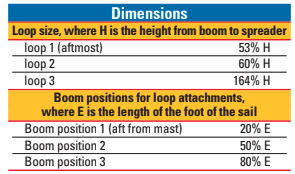
The dimensions I used are for a tall-rig Catalina But the design is triangular and proportional to two measurements: the mainsail foot dimension and the boom-to-spreader measurement, as shown in the table below.
The actual final positioning of the connection points has to be adjusted around fittings already installed on the boom, such as reefing gear, bails, and cleats.
The loop lengths are proportional to the distance from the top edge of the boom to the spreader. For my Catalina 30, this distance is 18 feet. (This distance could be measured with a length of line attached to the main halyard.) The loops are 9.5 feet and 10.75 feet, and the lazy-jack halyard is 29.5 feet.
Retracted position
At the dock, with the sail flaked and held by sail ties, I retract the lazy-jacks. On each side, I gather the loops, pull them forward, and loop them around a cleat on the mast. I use the original halyard cleats for this since we now have internal halyards led aft to the cockpit. When looped under the cleat in this way, and with the lazy-jack halyard snugged, most of the lazy-jack is positioned below the boom.
With the lazy-jacks stored in this position, the mainsail cover needs no modifications. With the mainsail cover in place, only the lazy-jack halyard along the mast is visible.
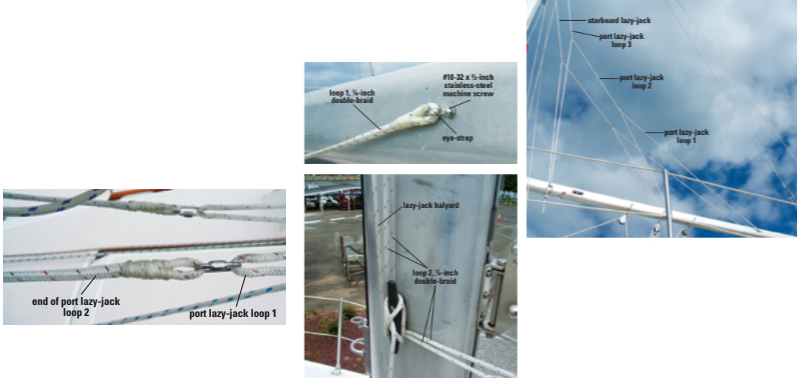
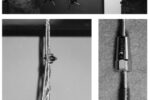
jack runs through a
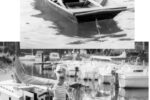
Quick Link supported by the loop forward of it, at bottom of facing page. These let the loops self adjust when the lazy-jacks are deployed above. The lazy-jacks attach to the boom with spliced loops in eye-straps, top at left. To retract the lazy-jacks, Joe tucks them under mast cleats and takes up on the halyards, bottom at left.
Deployed position
When we’re preparing to sail, we remove the sail cover and sail ties. We leave the lazy-jacks in the retracted position when we raise the sail and while we’re sailing.
When it’s time to lower the sail, we release the lazy-jacks from under the mast cleat, raise them to the deployed position, and cleat them off. We can then drop the mainsail in the normal way. We flake the sail on the boom and secure it with sail ties. Once we’re finished, we pull the lazy-jacks back to the retracted position.
In fresh wind conditions, the lazy-jacks can be left deployed while sailing. The smooth line and Quick Links pose no serious threat of abrasion. In this deployed position, the lazy-jacks are ready when we want to reef or lower the mainsail.
Enjoyable project
Making the 10 eye-splices was a satisfying off-season project. I use a New England Ropes Unifid. If you don’t like this sort of project, perhaps you can persuade an amenable sailor, a Boy Scout, or a local rigging shop to do it for you.
Our lazy-jacks work pretty well for us. When needed, they do their job. When retracted (such as when we’re sailing or when the mainsail is covered), they are invisible.
Joe Orinko has sailed the waters of Presque Isle Bay and Lake Erie for more than 25 years, 20 of them in his O’Day 23, Unicorn, and for seven seasons on his second Unicorn, a Catalina 30.
Thank you to Sailrite Enterprises, Inc., for providing free access to back issues of Good Old Boat through intellectual property rights. Sailrite.com