The ins and outs and aftermath
Issue 73 : Jul/Aug 2010
Flash — BANG! My eyes flew open. I had been sound asleep, so it took me a second to orient myself. I was sleeping in the V-berth, the hatch above me was open, and it was eerily quiet. Then the sky lit up a second time and I prepared for the next thunderclap.
My first thought was whether I had left anything out on deck. My wife, Theresa, stirred next to me, smug in the realization that the 20 or so pieces of teak trim she had been refinishing had been brought below before we turned in for the night. I, on the other hand, had left three portlight trim rings hanging in the rigging after their last coat of paint. I had finished the painting at 10 a.m. the previous day. The can said 16 hours must pass before the paint is wet by rain or dew. I looked at the clock through blurry eyes: 2:15 a.m. Made it by 15 minutes; but I’d better get them in. Another flash and crash brought me to full alert status. Those strikes were close!
Coquette, our 44-foot Van de Stadt cutter, is one of the largest sailboats in our small marina tucked away in a creek off Chesapeake Bay. The VHF antenna is 61 feet off the water — one of the tallest objects around — and I waited for the simultaneous flashbang of a direct hit. This thunderstorm was spewing lightning at an alarming rate. No sooner had one flash imprinted on my eyes than another streaked across the sky. Working at BoatU.S. as an editor for Seaworthy, the marine insurance damage-avoidance magazine, I knew what to expect if we were struck by 200,000 amps from the sky. I also knew the odds were pretty high, since 29 percent of all lightning claims arise in the Chesapeake Bay area. Only Florida, with 33 percent, sees a higher number.
Prelude to a strike
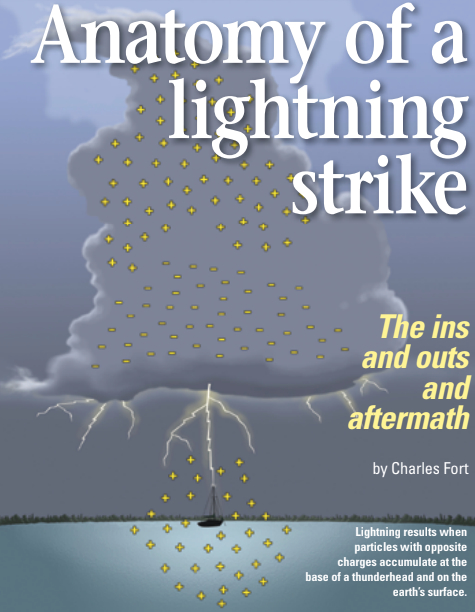
As ice particles collide with hail in the violent updrafts of a thunderhead, the smaller ice particles become positively charged while the falling hail inherits a negative charge. This separation of charges causes the upper areas of the cloud to be positive while the lower areas become negative with respect to the earth. As a thunderhead passes overhead, positive charges also build up on objects below the cloud. Since these positive charges are doing their best to hook up with the negative charge in the cloud, they tend to congregate at the top of the highest object around. A huge amount of negative charge in the cloud’s lower regions and a huge amount of positive charge at the earth’s surface now want to equalize, in a bad way. What happens when a sailboat mast is the closest target?
The invitation
First, a stepped leader finds its way to an attachment spark sent up a couple of hundred feet from the boat — usually from the highest point on the boat, the tip of a VHF antenna. This isn’t the actual strike, just an advance party paving the way by ionizing the air between cloud and mast. Ionized air is a much better conductor than your average air and, with the help of a spark from the antenna, the entire 6-inch-wide charge (NOAA estimates it at 30 million volts) takes a leap to the puny wire of the antenna, vaporizing it on its way and leaving small molten pieces of metal on the deck as a souvenir.
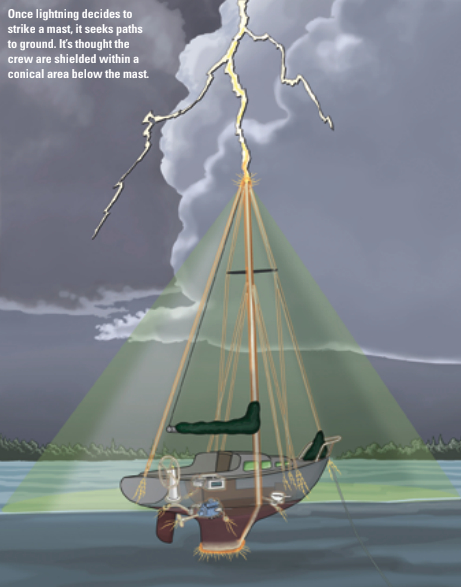
Once the lightning has arrived at the mast, it has several options. Some of the charge will travel down the coax cable and rattle around inside the VHF radio, melting components, but the rest has to decide whether the standing rigging looks like the fastest way to ground via the water or if a direct path down the mast would be best. Aluminum is a better conductor than stainless steel, but sometimes it goes both ways and other times it changes its mind halfway down and all or part of it jumps from the mast to the stays (or vice versa) through whatever is in its way — a dangerous side flash.
The aluminum of the mast conducts so well that there is very little heating except at the point of contact. The stainless-steel stays, which are less conductive, can heat up a bit, but standing rigging is rarely damaged in a strike. However, on its trip down, the charge is likely to induce currents in anything metallic, destroying circuit boards, wires, and components with abandon. Mast-mounted units, such as radar domes and wind instruments are prime targets.
A forced exit
The most painful part of the trip is probably the jump to water. When the strike makes it to the mast heel on a keel-stepped mast, the strike may meet with a few thousand pounds of lead. Lead is only a tenth as conductive as copper, and the charge really wants to get out. If there’s no direct connection between the mast and keel and the outside water, there is a problem — but not for the lightning. A lightning bolt that’s just traveled a couple of miles through the sky won’t have any problem going another 3/4 inch through solid fiberglass and leaving a gaping exit wound (a burn mark or a hole).
Then again, it may decide that the nearest through-hull makes a great getaway. The problem there is that the lightning bolt might be a bit too large to get through the fitting, but if that’s where the lightning’s going, it will take out the fitting if necessary. Observant readers will deduce that, with the removal of one of its through-hulls, a boat will be left with a sizeable hole. Unfortunately, the strike might also have destroyed the batteries and anything attached to them, including the bilge pump.
Lightning has other tricks too. A nearby strike can induce a current into the shorepower system and deliver a slug of voltage to anything connected. An induced current can also be generated through a boat’s electrical system from a strike several boats away. With luck, breakers or fuses will prevent serious damage from this type of near miss. Lightning’s best and, alas, rarest performance is to hit and run — and strangely leave nothing damaged.
Damage assessment
What’s the first thing to do if you know or suspect that your boat’s been hit? Grab your insurance policy and, while you’re dialing the claims department, look for a leaking through-hull and any other leaks. Lightning has been known to leave multiple exit wounds in the hull, both above and below the waterline. Some insurance companies, such as BoatU.S., will pay to have the boat immediately short-hauled. They know that the only thing more expensive to fix than a lightning-struck boat is a sunk lightning-struck boat.
Chances are that most, if not all, of the boat’s electronics will be smoldering. The most common electronics to be toasted are battery chargers, autopilots, radar, refrigeration controls, alternators, and, of course, the VHF and SSB radios. The more sensitive the electronics (fluxgate compasses, radios, transducers, and radar), the more likely they are to be damaged. Sometimes, the steering compass gets wacky and may or may not return to normal. It may have to be re-swung.
With luck, some of the fuses will have blown (in fact, if you arrive at your boat one day and find some fuses blown, suspect a strike). Sometimes electronics can be repaired, but more often than not they’ll be far gone. Typically, wiring that carried a significant amount of current — such as the VHF and radar cables — will be damaged but, strangely, sometimes it’s not. It should usually be replaced regardless.
If the hull has been breached, the repairs are straightforward fiberglass work but, if the boat sank, the repairs for the hull, water damage, and electronics could exceed the value of the boat. A rare occurrence is that if a hull laminate (or core) is very wet, the strike can weaken the structure. In that case, hull samples may have to be cut out and analyzed for strength.
Prevention theories
Why not just try to prevent a strike? That’s a nice thought, but you can’t. At least, that’s what many experts believe. Ewen Thomson, a well-known lightning researcher based in Florida, says current research shows promise in mitigating strike damage, but nothing is effective at preventing a strike.
Many people agree. The American Boat and Yacht Council (ABYC) has lightning bonding standards that can help lessen damage, but the standard itself contains this statement: “The probability of a lightning strike varies with geographic location and the time of the year, but, when the conditions that create an electrical charge between clouds and the earth exist, there is nothing that can be done to prevent the lightning discharge.” Since building a boat to the ABYC lightning protection standards is an expensive and rather difficult job, very few manufacturers do it.
How about fuzzy mast-head dissipaters — do they work? Most experts believe they don’t. Lots of boats that have them don’t get struck, but plenty of boats did have them when they were struck. Ewen Thomson doesn’t have one on his boat.
Should you take up cave diving? Maybe it’s best to take comfort in the fact that sailboats really don’t get struck that often; the average rate is only four strikes per 1,000 boats, unless you own a multihull. These, oddly, are struck twice as often. If your neighbor owns one, it might just distract a bolt or two from hitting your boat. It might be somewhat comforting to know that most marine insurance companies are well versed in handling lightning claims and the damage is repairable.
Be calm in a storm
What should you do if you’re caught in a lightning storm? Don’t panic. Injuries due to lightning on sailboats are rare and fatalities are almost non-existent. A sailboat mast provides a cone of protection roughly equal to its height and, since sailboats are nearly always struck at the top of the mast, the cone is usually bigger than the boat. But, because lightning can sideflash as it comes down the mast and rigging at the same time and can jump through the hull near a fitting, it makes sense to not get in the way of a belligerent strike. Stay down below, if possible, keeping away from the mast, chainplates, or anything grounded. If you have to be in the cockpit, don’t touch grounded metal (such as the wheel or throttle controls). Lightning storms are usually short-lived and have more bark than bite.
Coquette was struck, not during the storm mentioned here but a couple of years before we owned her. All her electronics were replaced afterward and, fortunately, she suffered no hull damage. But part of the strike traveled down an upper stay to our stainless-steel lifelines where the deck-mounted spinnaker pole lay against a stanchion. Scorch marks are still visible on the stanchion, a reminder that, if lightning wants us, it knows where to find us.
Charles Fort cruised extensively with his family in another life and is currently living aboard and sailing his 45-foot Van de Stadt cutter on Chesapeake Bay. When not sailing, he works as an editor for BoatU.S.
Thank you to Sailrite Enterprises, Inc., for providing free access to back issues of Good Old Boat through intellectual property rights. Sailrite.com