. . . with a duo of double-ended classics
Issue 78 : May/Jun 2011
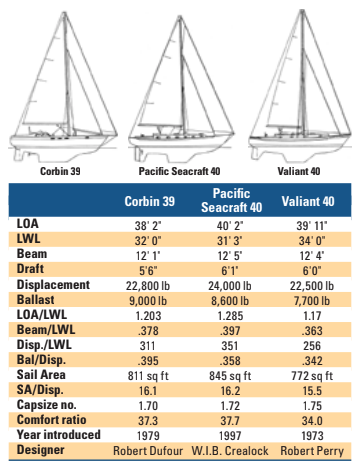
Because the Corbin 39 has some rather unusual features for a production yacht, it was easy to select two boats for comparison. Very few fin-keel, skeg-rudder, double-ended cutters have been built in series production, so the Pacific Seacraft 40 and Valiant 40 were logical choices. All three yachts are husky, beamy vessels with good draft, and all have a long proven record of bluewater passages and circumnavigations.
What’s most interesting about the three designs is how alike they are. The differences are mainly in style. The Corbin has a somewhat flat sheer, Baltic-style stern, flush deck, and a fairly long bowsprit. The original Valiant had a perkier sheer, Baltic stern, traditional boxy cabin trunk, longer waterline, and an all-inboard rig. The Pacific Seacraft has nicely balanced ends with a British-style stern, a perky sheer, and a short sprit. Their similarities are more in the numbers.
Robert Perry’s Valiant 40 was the first of the breed. Rather than copy the full-keel double-enders, such as the Westsail 30, that were popular at the time, Bob designed her with a Baltic stern and gave her the underbody and rig of a performance cruiser. The Valiant’s fin keel and skeg-hung rudder greatly reduced wetted surface, her long waterline assured a moderate displacement/length ratio, and her generous sail area gave her the drive she needed for good performance. A Valiant 40 was the first U.S. boat to cross the finish line in the 1980 Singlehanded Transatlantic Race.
Six years later, Robert Dufour (no relation to the French boatbuilder) designed the Corbin 39 to be built in Quebec. I have no idea if he was influenced by the Valiant or if the style and general dimensions were dictated by the builder, as often happens, usually to the chagrin of the designer. Other than style, the main differences appear to be the Corbin’s shorter waterline, slightly shallower draft, longer fin, and heavier ballast. It is very possible that the general style and shallower draft were set by the builder. If so, Robert Dufour may have increased the fin length and ballast to ensure adequate lateral plane and provide excellent stability for ocean voyaging.
Twenty years after the Corbin 39 appeared, Pacific Seacraft came out with the Crealock-designed 40. Having a bit more displacement and the shortest waterline, she might have slightly more resistance than the other two, but she spreads more sail area to make up for it. Her fin is shorter but she has a ventral fin running aft to the skeg, probably to ensure directional stability in heavy going and to counter any tendency to excess weather helm.
Assessing cruising performance is not simple with these three. Despite her smaller sail area, the Valiant has an efficient high-aspect-ratio mainsail that may give her more punch to windward. However, the first Valiants had a single-spreader rig and the double-spreader rigs of the others may allow closer genoa sheeting. A tossup? Off the wind, all three have long foretriangles that allow large genoas to be set, and they should easily make hull speed and more in brisk conditions. The Valiant’s 34-foot waterline may tilt the scale, but the difference in hull speed between the shortest and longest waterlines is only .3 knot. The Pacific Seacraft’s longer ends will pick up a bit of length as she heels, so the overall performance difference is slight and, on a long cruise, will depend on the winds.
I have to note here that good designers and builders make changes as designs age. The original Corbin 39 had an all-inboard rig and the bowsprit was added later. On talking with Bob Perry, I found that the latest Valiant 40, now called the 42, is quite a different yacht from the boat we are looking at here.
For the sailor looking for a good old boat capable of rounding Cape Horn (in summer!) and carrying her crew from Maine to New Zealand and on around the world, any of these three will do nicely. They were designed to take you there and bring you back in comfort and safety through fair weather and foul and, given good seamanship, they will!
Ted Brewer is a Good Old Boat contributing editor. His contributions to the world of sailing as a yacht designer are legion and most of them are still afloat, carrying sailors to destinations in worlds real and imagined.
Thank you to Sailrite Enterprises, Inc., for providing free access to back issues of Good Old Boat through intellectual property rights. Sailrite.com