Building a boat while building lives

Issue 78 : May/Jun 2011
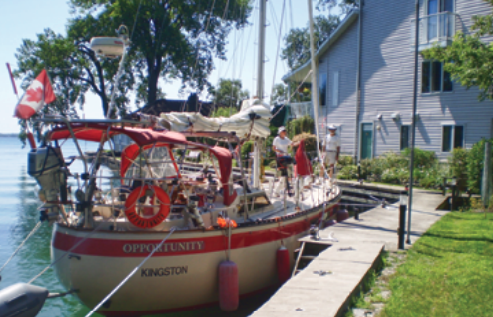
David Salter is meticulous. You know that the moment you step on the boat, named Opportunity, he and his wife, Eileen, keep moored behind their home in Bath, Ontario. Every sheet, halyard, line, switch, tool, and valve is clearly labeled in bold print. Anyone with a bit of sailing experience could board this boat and sail her by following the clearly marked labels.
For me, opportunity knocked when Good Old Boat editor, Karen Larson, asked if I could write a feature article on David and Eileen’s boat. I thought about it . . . drive for two hours through Ontario’s scenic Prince Edward County on a brilliant summer day, meet nice sailing folks, go sailing on the beautiful blue waters of the Bay of Quinte, probably moor in a secluded bay to enjoy a sumptuous lunch and cold beverage . . . and decided to make the sacrifice.
The stately Salter home is situated on a small cove that opens into the North Channel of the Adolphus Reach. These are some of the best sailing waters in the Great Lakes. The reach is a part of Lake Ontario’s Bay of Quinte and, because it’s protected on all sides by land, the catch phrase for sailors is “all the wind and none of the waves.” When I arrive, David and Eileen take me from their front door on a quiet cul de sac through to the back door and out to the cove. There she sits . . . Opportunity . . . a 39-foot Corbin double-ender looking spanking bright and shipshape in the summer sun. I ask David how they found such a paradise. His reply is classic Salter: “We didn’t find it. We built it.”
“For me,” says David, “it’s important to know how things work, inside and out. The best way to do that is to build it yourself.”
He’s fortunate Eileen shares his unconventional and labor-intensive philosophy. While living in Oakville, Ontario, the Salters purchased a 28-foot steel hull and, over a period of three years, methodically built her from the ground up: bulkheads, interior, cockpit, engine, mast, rigging . . . everything. All this while they were raising children and working full time. David, an engineer, was working for Shell Oil and commuting to Toronto every day. Eileen was teaching eighth-graders in the Oakville School system.
“We eventually named her Day By Day,” says Eileen, “because that’s how we built her . . . day by day.”
David enjoyed his career, which included flying to the Arctic Circle to observe how fuel reacts to extreme cold, but he also loved sailing the boat he and Eileen had built and made plans for an early retirement. Eileen was reluctant to leave her students, but their son and daughter were already of university age; it was time to start thinking of the future.
The future lay in a property on a small cove near Bath, Ontario, on which sat a rather large derelict building that had once been the home of Bath Fisheries.
“Long ago, fishing was a major industry in this region,” David says. “To preserve the fi sh in the warmer months, they’d cut huge chunks of ice from the channel in the winter and throw sawdust on them.” Unfortunately, the years of damp had compromised the wood of the ice house and the Salters had no option but to tear down the entire building. Over time, working with contractors, they built the two-story home and the docks in the back, knowing their boat would be moored outside and they’d be able to sail away any time they wanted.
Thoughts of blue water
“We’d lived in Trinidad for two years and many of our friends sail south for the season,” says Eileen, “so we were always thinking of an oceangoing vessel. Our 28-foot Day By Day wasn’t quite up to the comfortable voyage we had in mind. That’s when we started thinking of something bigger.”
Originally, David was considering a larger steel hull similar to Day By Day. He discussed this with a designer named Robert Dufour in Montreal (no relation to the builder of Dufour sailboats), who had designed the J E Bernier II that sailed through the Northwest Passage in 1977. Robert showed him the Corbin 39, a double-ender he’d designed for Corbin Marine. Corbin built the boat between 1979 and 1990 and sold it in three configurations: the completed boat, the bare hull and deck with just the engine installed, and the bare hull and deck. Guess which option David and Eileen took.
“Sure, I like to build things from the ground up,” notes David, “but, in all honesty, it was a financial decision as well. We just couldn’t afford that much money in one lump sum. Better to buy the shell and invest in parts as you go along.”
Eileen says David began by keeping track of every expense incurred during the building of Opportunity but stopped as the total approached what it would have cost to buy a completed boat. “No sense beating yourself up,” says David. “Besides, I was overbuilding. I’d been blue-water sailing. I wanted this boat to be strong enough to take the rough going.”
The bare hull of the Corbin 39 and its cradle arrived at the Salter home in Oakville in 1980. Fortunately, they could sail Day By Day on Lake Ontario whenever they needed a rest from building the Corbin.
“The children were grown, but our parents were aging and still living in England, so there were long summer vacations back home,” says Eileen. With their move to Bath, Ontario, in 1987, the Corbin was trucked to its new home. It took 10 more years of carpentry, machining, planning, and working before Opportunity was launched in July 1997.
A custom layout
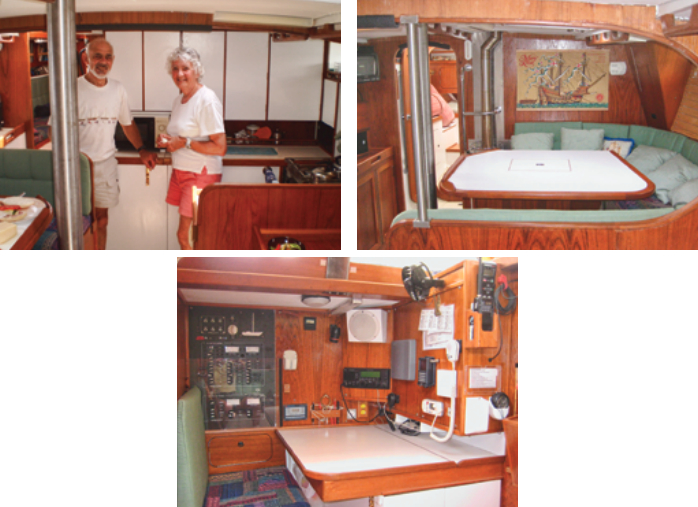
David researched the project carefully. There were some things he liked about a finished Corbin 39 and some things he didn’t like. He ended up with a unique interior and, as we go aboard, he proudly points out Opportunity’s prominent features.
The two private sleeping cabins, one forward to starboard and one aft to port nestled beneath the cockpit, each have a double bunk and head. The forward head also has a shower.
The aft cabin is aft of the wheelhouse. David says he made the companionway ladder leading from the cockpit into the wheelhouse steep to gain room for the comfortable navigation booth on the port side with radios, radar, GPS, and chart table. Directly ahead is a large steering wheel, a windshield looking out along the deck, and a photo with Opportunity’s motto, “Don’t wait for your ship to come in . . . swim out to it.”
“Steering from the wheelhouse is tricky and visibility is limited,” says David. “But, on a long ocean stretch with heavy rain and winds, it would be a dry and comfortable alternative to the open cockpit.”
Aft on the starboard side is a roomy closet housing the hydraulic steering system. It was recommended by Corbin, and David agrees it provided the best helm control. Neatly labeled drawers containing nuts, bolts, clamps, fuses, and other parts line the starboard side of this closet.
On the starboard side of the wheelhouse are a settee and a shelf for books. A step down takes you forward into the large main saloon. “We like to cook and prepare elaborate meals while aboard,” says David.
“We like to sit around the table and talk with friends. The main saloon is really a cooking and entertainment center.”
The raised eating area has lots of comfortable seating and ample headroom. A small pilot berth high on the port side of the main saloon is popular with the grandchildren. Below it is a beautifully finished entertainment console with music and television. With a few swift movements, David transforms the console into a functional workbench with access to lockers containing a full complement of tools. While working from this central point, David says, he’s close to whatever he’s repairing on the boat.
While demonstrating the entertainment console, David produces a large binder that contains specifics on every piece of equipment on the boat, including a full description of the item, its function, and its location.

Aft of the dining area, the large galley spans the width of the boat. The refrigerator, stove, and oven are all conveniently placed and the area is fitted with custom cabinets filled with dishes, cutlery, glasses, and the amenities found in any kitchen ashore.
A section of the counter to port can be easily removed to reveal spacious access to the engine compartment. It houses a Pathfinder Marine 50, the marine version of the Volkswagen Rabbit diesel engine. Beneath the engine, David built a separate sump to catch engine fluids and keep them out of the bilge.
Going topside again, David reinforces the primary benefit of building a boat from the bare hull. “This way you get the boat the way you want it.”
The compact cockpit is dominated by huge chrome self-tailing winches. They seem to be too much for a boat this size, but I would soon learn to appreciate their cranking power. Looking over the stern, David proudly points out the adjustable hoisting mechanism for the Avon RIB dinghy and its 15-hp Honda motor. With a pull on a line, the dinghy can be lifted so only a small portion of the bow is in the water and drag under sail is minimized. The engine can be attached to the transom by one person with the help of a tackle. Forward on deck are curved mast stands that David designed to fit the curvature of the human back.
With all the equipment aboard, Opportunity is a heavy boat and she carries a lot of sail. I notice block-and-tackled lines leading back from spreader height on the mast to reinforced plates on deck. David says these are running backstays. They provide additional support for the mast when the staysail is set and can be tightened or loosened as necessary. Forward, a large electric Lofrans Tigres windlass seems more than capable of handling the 44-pound Bruce anchor.
A competent duo
With the inspection over, we’re ready to cast off. I’m told in the politest possible terms that my role in this process will be to stay the heck out of the way. Standing near the mast, I watch Eileen on the dock as she loosens the springlines and goes forward to uncleat the bow line. She tosses the line across the rail and, with the slightest push, climbs aboard as Opportunity’s bow swings out to face the reach. In the cockpit, David holds the stern fast to the rear dock cleat until the right moment and then releases one end, pulling the line aboard and coiling as he goes. Obviously, these people have done this before.
We move into the channel under power. Without saying a word, David leaves the helm and moves to the mast. Eileen slips behind the wheel and holds the course. The change in the wind strength from the cove to the channel is dramatic. The waters appear calm but the wind speed is showing between 10 and 13 knots. Eileen nudges Opportunity head to wind and David hoists the main. As she falls off to port and the big main fills, Opportunity heels slightly and picks up her heels. Back in the cockpit, David unfurls the full jib, and the boat takes to it like a horse taking the bit. Our speed immediately climbs to 6 knots with just the slightest heel. The sun is shining. The waves are slipping swiftly beneath the hull with a steady swooshing sound. The wind racing across the deck is taking the heat off the day. Does it get any better than this?
After a few tacks to demonstrate the boat’s agility, David and Eileen tell me we’re heading for Kerr Bay, where we’ll drop the anchor and enjoy a relaxing lunch. The boat is sailing so well I’m almost disappointed when it’s time to drop the main, furl the jib, and motor into the secluded bay on Amherst Island. Six or seven boats are already moored there and, before we finish lunch, the population will grow to 20.
With the anchor set, David and Eileen slip belowdecks to prepare lunch. Once more, my job is to stay the heck out of the way. I’m left on deck to ponder this new role. I’m not used to being a passenger on a sailing vessel. I’m usually at the helm making decisions and trimming sails. Truth to be told, on a boat like this I’d like to be more involved. But David and Eileen have a proven system. They’re a team, they know their roles, and they set to their tasks wordlessly.
Cold cuts and conversation
When called below, I’m informed that it’s do-it-yourself. On the table are cheeses, tomatoes, hardboiled eggs, salads, rolls, cold cuts . . . a virtual banquet. Eileen has done her part, David his and, with the addition of a cold beverage, we ascend to the cockpit for feasting and conversation. I like the boat.
I like David and Eileen. I like the food. I like the beverage. I like this assignment. We talk about how they came to this time and place.
Once these two focus on a dream, they plan how to achieve it and make the necessary sacrifices. Day By Day took three years to complete while they built careers and raised children. Opportunity took 17 years to finish while they pursued careers, built their home and docks by the cove, and welcomed grandchildren. These were busy times.
David will tell anyone who wants to build a boat from a bare hull that a support group of like-minded individuals is essential. He has referred to, and contributed to, the Corbin Owners’ website often over the years. The site was created and has been run since inception by Lester Helmus, a Corbin owner in Los Angeles. It has proved to be a great asset for the owners and, through it, Corbin owners half a world away email David to find the best way to effect a repair or secure a needed part. Much of the rigging for Opportunity was David’s own design and he was fortunate to have a tool-and-die maker close by. When ordering essentials, such as teak and mahogany for building his cabinets, he did so with others to get better service and save with bulk buying.
“It sounds like you’re doing everything yourself when you’re building a boat,” David says, “but you get tremendous support from friends and others who share the same goals. That’s one of the greatest gifts to come from the experience . . . sharing your ideas and challenges with others.”

An unplanned exercise
It’s time to weigh anchor and head home. David, naturally, checks the engine compartment before starting the Pathfinder and discovers that the sump is full of antifreeze. Eileen and I look around at the flotilla that has assembled while we have been eating lunch and consider the options. After draining the sump, we find a split hose at the rear of the engine. It’s difficult to access and we don’t have a spare hose aboard anyway.
We decide against a “duct-tape fix.” We don’t know how long it might hold and blowing an engine makes no sense when there’s plenty of wind out in the channel. We unfurl the jib to power the boat to the anchor while David uses the windlass to take in the rode. Once the anchor is off the bottom, Eileen takes the helm and heads Opportunity out into the channel, avoiding several anchored boats.
Out in the channel, we find the wind has increased to 20-plus knots right on the nose. The channel is narrow and the lake’s level is low, making long tacks toward shore dangerous. Opportunity is hard pressed and heels well over and, after a tack or two gain us what seems like just a few yards of headway, it’s decided that perhaps I can do more than “stay the heck out of the way.”
I’m pleased to be invited to join the team, and stand by the port winch while Eileen stays at the helm and David takes the starboard winch. We’re soon tacking quickly and smoothly. The big winches haul in the 135 percent genoa on each tack as Eileen brings her up as tight as she’ll go on a close reach. Back and forth, tack after tack, the afternoon wears on.
Our final tack takes us well above the entrance to the cove and, as we knife toward the opening at 7 knots, we discuss the docking plan.
David and I haul the dinghy alongside (we’ve already rigged the outboard) and lash it tightly to the toerail. As we enter the lee at the mouth of the cove, we quickly furl the genoa and David jumps into the dinghy to start the engine. I move forward to take the bow line and Eileen resolutely holds her course toward the dock. David puts the outboard in reverse and applies full power.
Opportunity seems to take an eternity to slow down. Eileen wrenches the wheel around, swinging the boat alongside the dock. I make the leap and find a cleat. Eileen leaves the helm and tosses the stern line into my hands. Two wraps around the rear dock cleat and Opportunity stops, then floats calmly . . . home again. The rest is easy.
We’re grateful all’s well that ends well. David wants to go below immediately to get the part number of the delinquent cooling hose to see if Volkswagen still makes it. Instead, Eileen, in a calm but very determined voice, says, “The first thing we’re going to do is relax and have a quiet drink. Everything else can wait.” David and I aren’t about to argue with that kind of sound reasoning.
Sitting quietly on the dock behind the house with Opportunity safe and secure, we watch the setting sun throw brilliant red and yellow ribbons across a calm blue sky and the now gently flowing waters in the channel.
“You built her for blue water and she’s more than up to the task. Have you ever taken her offshore?” I ask.
“No, we haven’t,” says David. “When we were younger, that was the plan. That’s why we built her for heavy weather. But we listen to our friends who sail south and think we’ve got things just about perfect here. In the winter, Opportunity sits on a cradle over there and we can refit her at our leisure. Come the spring, these waters are all the adventure we need now. We’re content.”
After a short pause Eileen adds, “That’s why we named her Opportunity. If we ever change our minds, we know all we have to do is walk out our back door and the Opportunity will be there.”
Don Davies has sailed the North Channel, Georgian Bay, and Lake Huron extensively aboard a Contest 31 and, more recently, his 1974 Grampian 30 that he keeps at Highland Yacht Club on Lake Ontario. He has written several books and his screenplay, Bluenose, The Movie, is currently in development.
Thank you to Sailrite Enterprises, Inc., for providing free access to back issues of Good Old Boat through intellectual property rights. Sailrite.com