A comparison of Allegra and three rivals
Issue 51 : Nov/Dec 2006
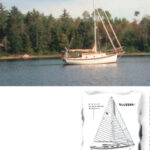
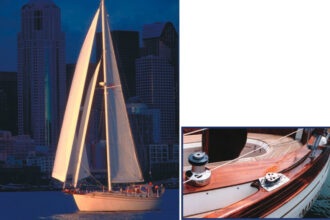
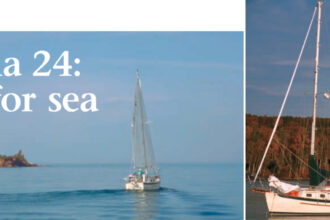
These four small yachts have all proved to be very capable bluewater cruisers with many long ocean passages to their credit. Several of them have made successful circumnavigations over the years. Despite their small size, these mini-cutters feature reasonable accommodations, suitable for two friendly sailors who don’t mind close quarters.
With the exception of the Dana 24, the major problem with these yachts is that they were designed with accommodations for four. That works reasonably well for family cruising on a short summer vacation, but the best use of these very able small craft is to carry a singlehander or a couple on extended coastal and ocean voyages. To that end, the interior layout would be greatly improved with the elimination of two berths and the addition of more stowage and tankage. I’m sure the designers would agree with me, but builders generally feel that added berths are a selling point and insist on them.
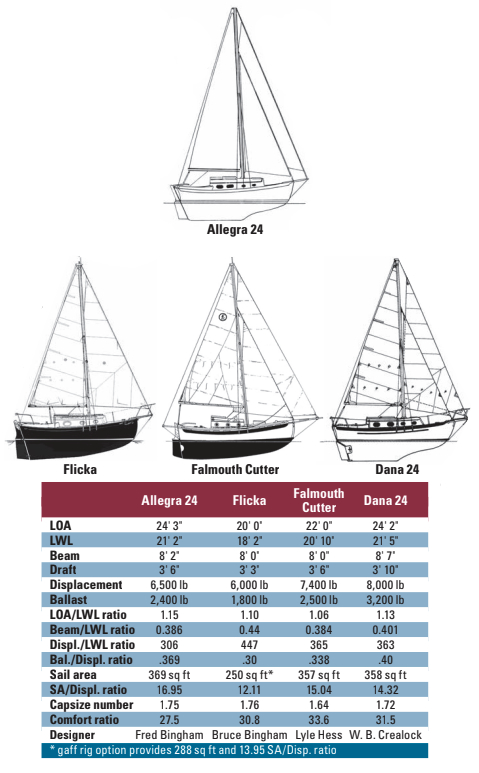
As I pointed out, these yachts are extremely able for their size and, given an experienced and knowledgeable crew, quite capable of sailing anywhere in the world within reason. The secret of their seaworthiness is that ultimate speed and weatherliness have been sacrificed for the ability to take almost anything the sea can throw at them. A look at the comparison table will bear this out.
Note that the Allegra is the only one with a sail area/displacement ratio over 16 and that their average displacement/LWL ratio is a very heavy 370. All four sport a full keel combined with modest draft and beam. This combination discourages speed under sail and weatherliness. In any case, their short waterlines limit them to theoretical 6-knot speeds in the best of conditions; 4 to 4.5 knots would be a more likely average, given their characteristics.
The Flicka appears to be the slowest of the group, due to carrying her generous displacement on the shortest waterline and being driven by 100 square feet less sail area than the others. With only a 30 percent ballast ratio, she could be a bit on the tender side, quite a handicap when the breeze pipes up. My suggestion to any sailor interested in a Flicka would be to look for a gaff-rigged version, for its greater sail area, and then set up a main topsail to add a few more square feet high up where it can catch the errant breezes.
The other three appear to be evenly matched. The Allegra would do best in lighter air due to a finer hull and ample sail area. The Dana should show her worth in heavier going, due to her husky displacement, slightly greater beam, and generous ballast. The dark horse could well be the Falmouth Cutter. She could prove to be the best passagemaker of all over a long voyage where the breezes varied from calms to gales.
As to seaworthiness, the combination of heavy displacement with modest beam gives each a reassuringly low capsize screening number, along with a comfort ratio that many 30-foot and larger yachts would envy when the wind is howling and the seas run high. These compact cruisers will carry their crews to distant shores in safety and comfort, if not in the lap of luxury.
Thank you to Sailrite Enterprises, Inc., for providing free access to back issues of Good Old Boat through intellectual property rights. Sailrite.com