Famous 1950’s racer thrives on patience and perseverance
Issue 52: Jan/Feb 2007
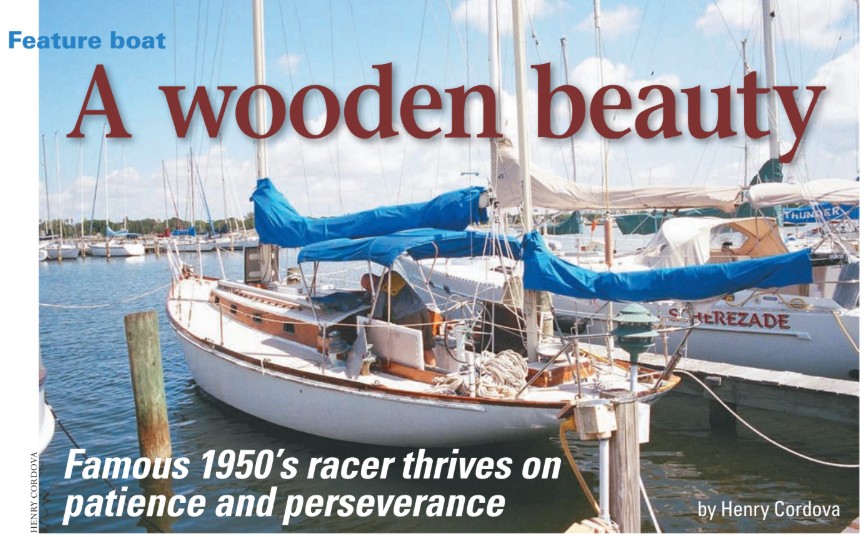
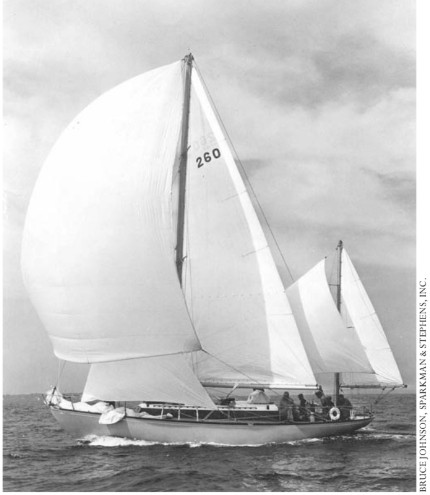
BILL TAIT SAW SINISTERRE for the first time in 1972. It was love at first sight. She was in Bristol condition. Bill asked her skipper on the spot if she was for sale. The answer was “No.” Her new owner had just bought her from her original owner the previous day. The yacht — originally named Mai Tai — was designed by Sparkman & Stephens and constructed in 1957 in Miami by Warren Bailey. Olin Stephens and one of his apprentices, Charley Morgan, oversaw the construction. She was, in a word, beautiful. In time, Bill Tait would get to know her intimately.
The lovely yawl that had captured Bill’s heart was a sister ship of the classic 40-foot Sparkman & Stephens-designed Finisterre, the wooden centerboarder that in the late 1950s and ’60s had taken the sailing world by storm. Named after Cape Finisterre on the Iberian Peninsula, S&S design 1054 had been conceived as a cruiser by Carleton Mitchell, an American writer and sportsman. Although an accomplished racer, Carleton, a two-time Southern Ocean Racing Conference (SORC) winner, also was a capable and experienced cruising sailor who had been mentally designing his dreamboat — a fully equipped, comfortable, shoal-draft design that also would possess the necessary seakeeping ability for offshore work.
Racing was not part of her origins so no effort was made to gain an advantage through any rule, although she reflects the influences of the Cruising Club of America (CCA) rating rule that governed most races in post-war America. Finisterre was built in 1954 by Seth Persson at his yard in Old Saybrook, Connecticut, with Carleton Mitchell closely supervising the project. By the standards of her day, Finisterre was considered short-keeled and beamy, “remarkably like a watermelon,” Carleton commented.
Elegantly balanced
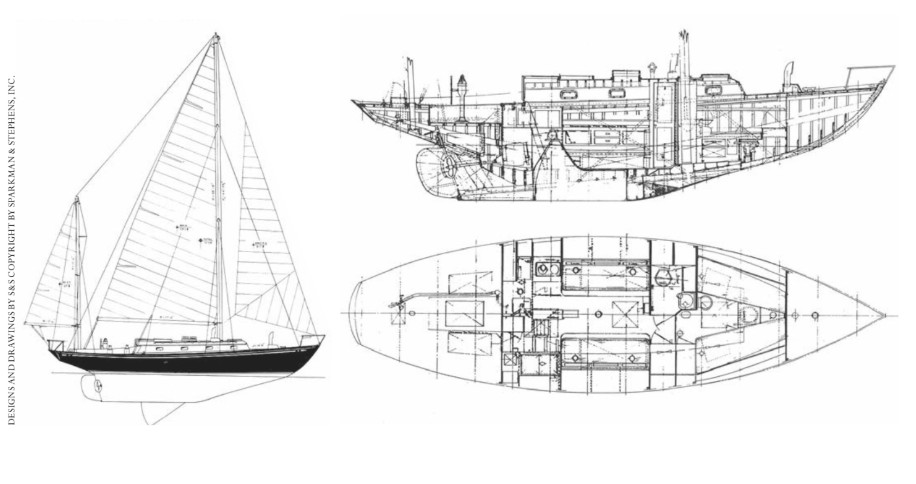
By today’s standards, her hull lines are simply breathtaking, with low freeboard, a graceful, sweeping sheer, and elegantly balanced overhangs. Finisterre caught everyone at the SORC by surprise, perhaps even her owner, and went on to a brilliant racing career, including winning a transatlantic race and three consecutive victories in the Newport-Bermuda Race, the only boat to have won that event more than once.
Sinisterre, a play on her sister ship’s name, was not an exact duplicate of Finisterre. There were some differences in construction methods, but the hull lines and interior layout were the same. Nor is Sinisterre the only S&S number 1054 still around. The Sparkman & Stephens Association Members’ Yearbook for 2005/2006 lists four others, including the class prototype. Finisterre is proudly sailed these days under her original name by a new owner in the Adriatic. Another, Querencia, has been lovingly restored to mint condition by Tom and Myra Hudson in Washington state. At last report, Winifred, on which Bill Tait once crewed on a voyage to the Bahamas, is a working boat carrying charter customers in the U.S. Virgin Islands. There are reports that yet another 1054 is currently being built to the original specifications in South America.
Introduction to sailing
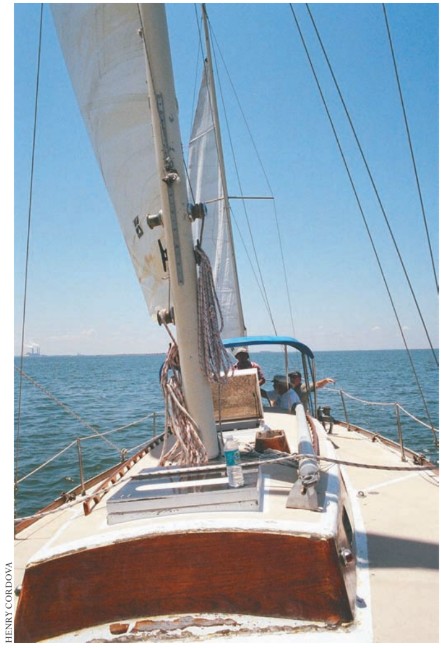
While Finisterre was rampaging in the Atlantic, Bill Tait was growing up in a Quaker village of about 300 people in southern New Jersey. There was a wide stream behind his house and he caught the sailing fever early. He built his first boat, a 10-foot dinghy, at age 12 and began his sailing career in Lightnings and Thistles. As a young man, he answered an ad to help move a South American-built 42-foot ocean racing sloop from Painesville, Ohio, to Buffalo, New York, through the Erie Canal, and then through the New York state canal system to the Hudson River. He helped sail the boat to Stamford, Connecticut, where he lived aboard all summer. Bill has no idea why that South American-built sloop was in Ohio, but he’s been involved in sailing ever since. In the early 1970s he competed in Midget Ocean Racing Conference (MORC) races in the Tampa Bay area and sailed in Long Island Sound and along the New England coast as far away as Nova Scotia.
After earning college degrees in chemistry and geography, he was employed in various capacities and industries, including hydrology and construction, before making a major career switch, apprenticing with naval architect Frank Hamlin in 1983 as a marine surveyor. Still practicing, he works on all types of vessels: sport fishermen, motor yachts, commercial vessels, and, of course, sailboats.
Shortly after his move to Florida, Bill became an active member of the Davis Islands Yacht Club in Tampa. He worked with yacht designer Ron Holland to build two boats for the national Quarter Ton championships. One of them, Eighteen (pronounced aye-teen because Ron is an Aussie), was the first of Ron Holland’s designs to be a winner. Both of the boats had been built to the International Offshore Rule (IOR), although they were not identical. The other, Genesis, ran aground and did not finish, but Bill found her five years later, neglected and falling apart. He rebuilt her from the sheer up. With Bill at the helm, she won 17 consecutive races, including the 1978 Kahlua Cup.
Slowly deteriorated
During all this time, Bill kept his eye on Sinisterre as she slowly deteriorated. Eventually she stopped sailing altogether as her owner didn’t possess the specialized skills necessary to maintain a classic wooden boat. Bill frequently renewed his offers to buy her, but the owner continued to refuse. He finally recognized that he didn’t know enough about wooden boats to keep her in repair and in 1983 the two worked out a deal in which Sinisterre’s owner got Genesis and Bill got Sinisterre.
The task of repairing the neglected yacht was daunting. Sinisterre is constructed of 1 1⁄4-inch mahogany strip planking over 2-inch mahogany laminated frames spaced 3 feet apart. The hull was in fairly good shape, except for two planks in the hull forward, one rotted frame under the cockpit seat below the waterline, and a small area of rot on the hull adjacent to it. The damaged areas were small, but restoring Sinisterre authentically required extensive work to properly interleave the new planks with the existing planking.
The decks and deck beams also required major surgery. They were rotted, as was the entire port cabin side. The cockpit coamings were missing and half the coachroof and all the hatches needed to be replaced. Also requiring replacement were the mast, sails, and rigging. If that weren’t enough, the engine was completely seized. The refit required nine months of hard work, most of it done with the boat still in the water, before Sinisterre was able to sail again. Another year went by before Bill got around to rebuilding the engine. In 1987, after 3,500 hours of work and living aboard for four years, Bill and Sinisterre placed second in the Florida Antique Boat Show.
Still without engine
Originally, Bill had no intention of racing her, but in 1985 he entered her in the first annual Bill Bogart Regatta, held in honor of a deceased former club commodore. At that time she was still without an engine. Sinisterre took first place overall. Since then, she has been a familiar competitor on racecourses on the Gulf Coast and beyond. Over the years she won the Kahlua Cup twice, the Amigos race in Mexico five times, and the St. Petersburg-Mexico race twice, the last time by a full 13 hours over the next boat in her class. Only three 70-foot racing sleds got there first.
In 1998 she was victorious in the St. Petersburg-Havana race, precisely 40 years after Carleton Mitchell won the same event in Finisterre. This grand old lady continues to strike the same fear into her rivals’ hearts as her older sister did 50 years earlier.
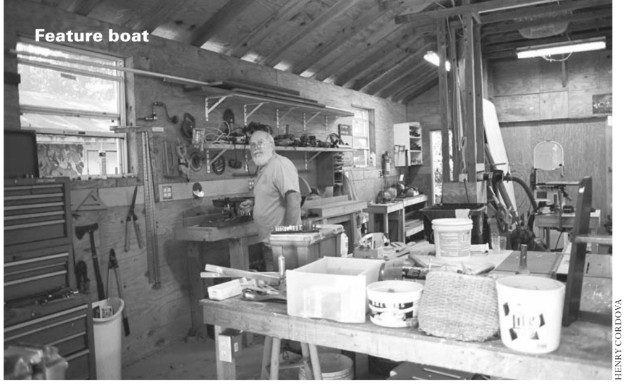
A wooden boat is never finished. In 1992 the original engine, a 37-hp Mercedes diesel, was replaced by a marinized 22-hp Kubota, and in 2001 it was time for Sinisterre’s second major overhaul. This time, Bill was better prepared. He unstepped the yacht’s masts and motored her up to the dock behind his house on the Hillsborough River, where he’d built a 20-foot by 40-foot woodworking shop. Now it was the starboard cabin side’s turn to be replaced, as well as the companionway trim, cockpit coamings, and toerails. Exterior grabrails were replaced and additional interior grabrails were installed on the cabin overhead. The refit was completed in 2002.
Today, Sinisterre is seaworthy, although maintenance work continues: a new engine and batteries were recently installed, the steering gear replaced, and the topsides and trim painted and varnished.
Special award
In 2003 Bill joined the Sparkman & Stephens Association and attended its 10th anniversary meeting in Portsmouth, England. Olin Stephens awarded Bill the biannual World Challenge Mathiessen Cup for the S&S design winning a major ocean race by the greatest margin over the second-place boat.
Though the evolution of yacht design has moved far from the centerboard yawls of the 1950s and ’60s, they still are excellent boats capable of fast passages. Number 1054 marked a watershed in yacht design and still fills a niche today, not just as a museum piece but standing up favorably to 50 years of mass production, modern materials, and computer-aided design. One need only look at the number of Block Island 40s, Bermuda 40s, and centerboard yawls still sailing to see that this type of yacht made a very successful transition into fiberglass.
After a half-century of dash and grace, Finisterre and her sisters still go to sea, thanks to sailors like Bill Tait, whose love and commitment keep their legacy alive.
Thank you to Sailrite Enterprises, Inc., for providing free access to back issues of Good Old Boat through intellectual property rights. Sailrite.com