Four basic elements of yacht design
Issue 52: Jan/Feb 2007
WE ALL HAVE TO FACE THE FACT that there is no such thing as the perfect sailing yacht, with the possible exception of the one you just bought, of course! Leaving out the professionally sailed IOR beasties, the ridiculously fragile America’s Cup racers, the popular one-design classes, and the thousands of small open sailboats, we still have to consider the factors that go into the makeup of weekenders and trailersailers, coastal cruisers, bluewater cruisers, and performance cruisers. Every one of these is a compromise of various factors. The first compromise, the most important one for many of us, is cost . . . both first cost and maintenance.
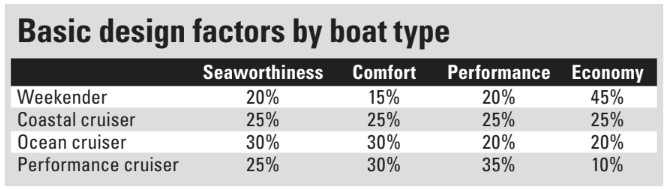
The four basic factors in the design of a yacht are seaworthiness, comfort, performance, and economy. Additional components include quality and versatility, which we’ll discuss also. In any case, it is rarely possible to gain in any one of these factors without making a sacrifice in another. Certainly, you can find a vessel that will offer more comfort, more performance, and more seaworthiness than your present boat, but you would lose heavily in economy, as you would probably have to buy a much larger yacht to obtain it all. The table below is quite general but shows a rough breakdown of the part that the various elements might play in any one type of cruising yacht. Note that the greater the percentage of economy, the lower the cost of purchase and maintenance.
Obviously, not all the yachts in any one of the above categories can be broken down exactly as shown in the table. No two yachts are identical unless they were both popped from the same mold and similarly fitted out, equipped, and maintained. For certain, one bluewater cruiser will have a shade more performance and perhaps a bit less economy or seaworthiness than indicated in the table. Another may have less comfortable accommodations but be more seaworthy. The table is a guide, however, that you can use to assess the merits of any particular vessel, perhaps your own or a yacht you are considering buying on the day you develop three-foot-itis.
Quality equals cost
One other component, always, is quality, but it is one that is impossible to assess in any table. Regardless of the type of yacht, the higher the quality of construction and finish, the higher will be the initial cost. That is true whether the yacht is new or, as the used car salesmen say, “pre-owned.” However, a boat or a car built to high standards of quality may prove more economical in the long run, due to increased durability, lower maintenance costs, and higher resale value. Truly cheap yachts are rarely a sound investment unless, like Captain Slocum, you have the ability to put your own sweat and skills into making a silk purse out of that sow’s ear.
A sixth component, also difficult to assess, is versatility. A trailersailer is very versatile in its ability to cover long distances at highway speeds. If you have limited time, but yearn to cruise different waters, that may be the way to go. Friends of mine, owners of a 25-foot, keel/centerboard yawl, have managed to sample some of the fi nest cruising grounds in North America, including Lake Champlain, the Bras d’Or Lakes, Lake of the Woods, Chesapeake Bay, and the Pacific Northwest, to name but a few. However, the majority of trailer yachts do give up quite a bit in the way of seaworthiness and/or comfort due to limitations on size and displacement (trailer weight). Some compromise is almost inevitable for the extreme versatility that these little yachts can provide.
Shoal draft also assures versatility, whether obtained by the means of a keel/centerboard, twin fins, or a wing keel, but that versatility may not require any great sacrifice of the other major factors. I know of a 44-foot Dutch-built keel/centerboard motorsailer that was cruised in the Baltic after launching, then rambled through the many canals of Holland and France and down to the Med. From there, she was sailed across the pond to cruise the entire Atlantic coast from Florida to Maine. For further adventure she was taken up the Hudson River and canals to Lake Ontario and sailed the Great Lakes to Chicago.
Then she made a leisurely voyage down the Mississippi to enjoy the warm waters of the Caribbean. Finally, after nine years of cruising, her skipper headed her homeward via the Panama Canal and sailed up the coast to her home port in San Francisco. That wandering yacht was well named: Zig Zag. She certainly had versatility, plus comfort, seaworthiness, and even reasonable economy due to her steel construction. The big compromise was performance under sail as she was a husky, full-keel motorsailer.
Other shoal-draft craft may compromise seaworthiness and comfort, as in the case of many sharpie yachts, due to light displacement and lack of headroom. Still, such a yacht makes a fine coastal cruiser for a limited budget, as it can be very economical, fast, and great fun to cruise. It also has the advantage of being able to drop the hook in all those quiet coves and gunkholes forbidden to yachts of deeper draft. A few boats simply obtain their shoal draft by fitting a long shallow keel, instead of a keel-centerboard or wing keel, but that may sacrifice weatherliness, performance and, often, safety as well. It is rarely a sound compromise.
Seaworthiness
Whether the vessel is sailing in the Great Lakes, our coastal waters, or making a passage around Cape Horn, seaworthiness is essential to cruising yachts. Of course, the Cape Horner needs seaworthiness in spades as there is no room for compromise in those turbulent and stormy waters. The more “inshore yachts,” vessels that will never be more than a couple of days’ sail from a safe harbor or snug cove, can afford to trade off a modicum of seaworthiness for comfort and, especially, for performance. Indeed, in many situations, the faster, more weatherly yacht may have a big edge in safety thanks to her ability to get to shelter quickly or even outrun the weather when caught at sea with a severe storm in the offing.
A gale well offshore can be miserably uncomfortable, to be sure, but is usually nothing that will endanger the well-found yacht and experienced crew. In truth, the biggest danger for the coastal cruiser is to be caught close to land on a lee shore in a gale. In that case, the only safe boat will be one that can beat to windward well enough to claw its way out of a rock-lined bay and make its way to the safety of open water. Many novice sailors think that a boat along the lines of the famous Tahiti ketch is the most seaworthy type, but that is not the case. Anchors can drag, engines can fail, and the long shoal-keel hull and under-canvassed ketch rig of that type of vessel will rarely provide the speed or weatherliness that can be so essential to safety in the precarious situations and extreme conditions that can develop along our coasts.
Obviously, good performance is essential to seaworthiness, but that does not necessarily imply a beamy, light displacement, fin-keel sloop. Recently I had an interesting email message from a couple in the third year of a world cruise aboard Moca, a 34-foot steel, full-keel cutter with a husky displacement/length ratio of about 330. They entered a regatta in Borneo and, in a fleet of 16 cruising yachts, were the second smallest vessel in C class, the smallest class. Nevertheless, despite the lack of a cruising spinnaker, they were first to finish in C class in the two around-the-buoys races and fifth across the line. The four boats that managed to cross ahead of them ranged from 43 to 50 feet, so Moca also finished first overall on corrected time.
Good performer
Solid proof that their little craft was seaworthy, as well as a good performer, is her course from the Pacific Northwest to Borneo, via the Galapagos Islands, Easter Islands, Pitcairn Islands, Tahiti, New Zealand, and Yap (Micronesia), to mention but a few of the many places they visited. Her owners certainly did not hesitate to take Moca where the winds blew and the seas rolled high. That kind of confidence in your boat is what you must have if you plan to venture far off-shore. Economy was a high point also, since they made a superb job of building her themselves. Perhaps their one compromise was in comfort, due to the limited accommodations and stowage aboard a 34-footer for such a lengthy voyage.
I believe that seaworthiness comes from moderation in many aspects of the design: moderate beam, displacement, draft, and overhangs. Deep draft has been said to create problems in extreme conditions, as the vessel may be rolled by a steep beam sea. In theory, the deep keel prevents her from sliding down the face of the wave and the result can be a capsize. While that may be true, I was involved as a witness in a lawsuit where the capsized yacht was a Tahiti type, one that should have slid down the face of the sea rather than be rolled over, but capsized she was, with loss of life.
We will never know if there were other contributing factors that added to that disaster, as the boat itself was lost. Still, my own opinion is that the contemporary light, beamy yacht with its wide, powerful stern and deep keel is most likely to be rolled in such seas. The great form stability of that hull shape fights to keep the yacht upright on the surface of the water at all times. That is fine, until the surface of the water is the face of a great wave at a steep angle. Then the vessel may be tripped by her deep keel and rolled over. Once capsized, her wide beam may make her slow to right herself. So moderation, including beam and draft, is the mark of the bluewater cruiser.
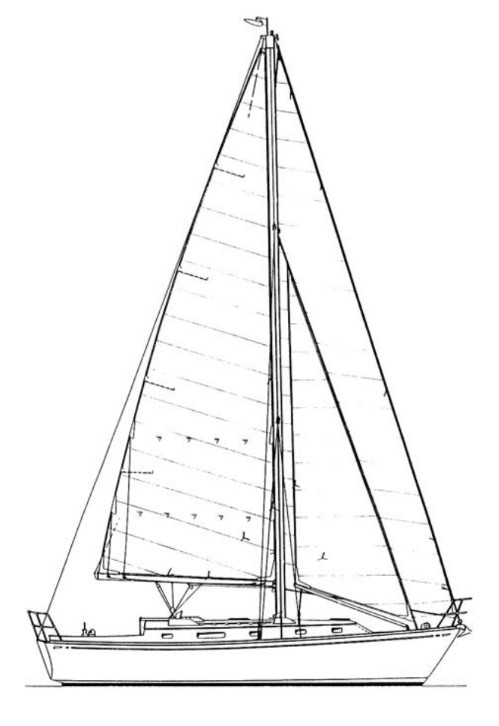
However, moderation in sail area is not necessarily good. Rather, generous sail area, combined with a reliable reefing system and a workable rig, is desirable for performance in all weather, both in coastal and ocean waters. When it comes to a workable rig, my own preference lies toward the sloop or yawl for coastal cruising, the cutter, yawl or ketch for blue water, and the schooner simply because that rig is the prettiest of all and can be versatile if properly designed.
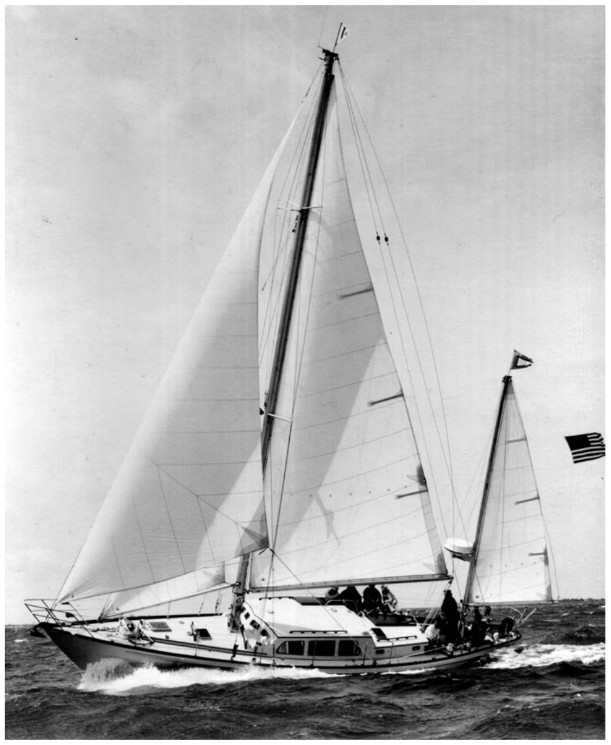
The two-masted rigs do have some advantages in heavy weather. I have owned a ketch and two yawls and found that we could drop the mainsail in a squall, and the vessel would still balance nicely and beat to windward under working jib and mizzen. Also, one owner of a 33-foot schooner told me that he and his wife were caught in a gale in the Gulf Stream while sailing offshore from Florida to New York. They took in the jib, dropped the mainsail and had no problem jogging to windward at 3 to 4 knots with the foresail alone. This is a case where versatility in the rig can add to seaworthiness.
Comfort
By comfort, I am concerned more with the motion of the yacht than with all the gewgaws of modern plumbing, electrics, electronics, and galley fixtures. The latter can add greatly to creature comfort, of course, but they can also detract greatly from economy and are not essential for living aboard. Still, I have to chuckle when I think of one couple, two wonderful clients of mine. They had one of the best yards in Britain build Julie, a 52-foot yawl, with all the mod cons, all except for the stove, that is. The owner’s wife was a very experienced sailor with several decades of cruising both in America and abroad, but she was terrified of fire at sea. I’ll never know how she did it, but they cruised extensively in British and European waters, crossed the Atlantic and sailed from Maine to the Caribbean for years, with only a two-burner Sterno stove to cook up a feast for a ravenous crew. That is a compromise in convenience that few would accept on a yacht of that caliber.
Julie, by the way, was definitely moderate in displacement, beam, and overhangs. That generally results in no-compromise motion comfort. Obviously, there are circumstances where no yacht is comfortable, such as when you’re rolling in a leftover sea on a windless, sunny, hot day, or pounding into heavy seas in gale conditions. Even then, the greater the displacement and the narrower the beam, the slower will be the motion and the less the yacht will scend (heave upward) in heavy seas. It can be carried too far, of course, and then you have a very narrow, very heavy yacht, akin to the old British six-beam cutters, that will be swept by the seas like a half-tide rock in any kind of a seaway.
It is the very beamy, very light-displacement yacht with great form stability that will bounce around the most when the seas become high. Such a hull fights to remain upright on the water’s surface and, when that surface is suddenly tilted to 35 or 40 degrees, the powerful hull will try to conform to that angle, slowed only by the keel and the wind pressure on the sails. Then, as the sea passes beneath it, the hull will snap back quickly to another angle and that is felt as acceleration, or g-force, by the crew. Up to 0.09 g is tolerable while 0.09 to 0.18 g is the threshold of malaise for some people. Above 0.18 g is intolerable motion and, for many, upchuck time.
The shape of the pointy end also has much to do with comfort. Very fi ne bows work well on a racing yacht where the weights can be concentrated amidships and the ends kept as light as possible. The bow can then lift with the seas instead of driving through them and slowing the yacht. However, such a fi ne entry does not work well on a cruising yacht that has the forepeak loaded with spare anchors, chain and bosun’s stores, plus a heavy windlass on deck and a crew member catching forty winks in one of the V-berths. The cruiser needs sufficient fullness forward for buoyancy, so the bow will lift with the seas. Otherwise, she will be slowed by them and the spray will be flying high on any windward course, making life miserable for anyone on deck.
Performance
The essentials of performance are a powerful, easily driven hull and a tall, efficient rig. The contemporary performance cruiser usually obtains its power or stability by means of wide beam and deep ballast, while the easily driven hull is derived from light displacement, a fi ne entry, and the longest-possible waterline. The tall, efficient rig is almost always a sloop or cutter and is controlled by a wide array of costly equipment: powerful multi-speed winches, backstay adjusters, bendy rigs, rod rigging, carbon-fiber spars, and all the other expensive refinements that modern technology can devise. Thus the compromise for her high performance is a very low economy factor.
In any case, few of our good old boats would be classed as performance cruisers. Some can be defined as cruiser/racers, perhaps, but many of the older cruiser/racers are not terribly extreme and can make fine coastal cruisers and even ocean passagemakers. The rigs of these yachts are invariably sloop with the exception of a few yawls left over from the CCA racing days of the 1950s and ’60s. The sloop rig is fine for the average coastal cruiser, but I would suggest adding an inner headstay and running backstays to convert such a yacht into a double-headsail sloop if extensive bluewater voyages are contemplated. Little, if any, performance will be lost and the stronger rig, with the ability to set a staysail, will definitely add to safety and peace of mind in heavy weather.
The cutter and ketch are the off-shore rigs preferred by most sailors; both have made successful circumnavigations. The cutter can provide performance equal to a sloop and, with its smaller mainsail, can be more manageable in heavy weather. The cutter provides the best combination of performance and seaworthiness and is the no-compromise rig for vessels to 50 feet or so.
However, the double-headsail ketch or yawl has the ability to set the widest variety of reduced sail combinations when the wind pipes up. The individual sails are smaller than those of a cutter and so I still feel it is the rig of choice in the larger boat sizes, say much over 45 to 47 feet. It can be effective in smaller craft as well but the compromise will be reduced performance. Still, on a long ocean passage, does a day or two, or even a few days, really make all that much difference? It’s purely a personal decision.
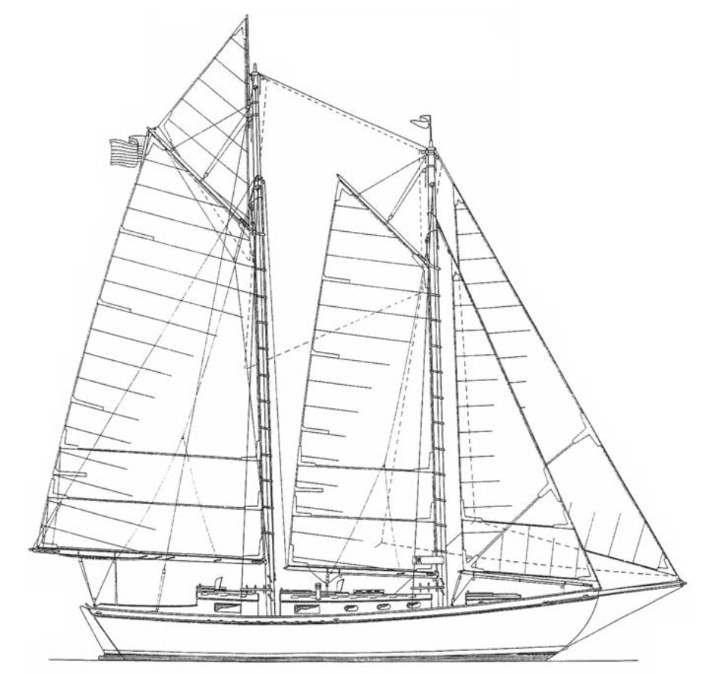
The schooner rig is another cup of tea altogether. It cannot compete with the single-masted rigs or the yawl in weatherliness but was rated faster than the ketch by the Royal Ocean Racing Club. Indeed, the Ingenue, a 33-foot Bermudan schooner, won more than her share of silver in distance races and could keep up with 40-footers when the wind came aft a bit. More recently I had a report from Southpaw, a 40-foot gaff-rigged schooner in the Pacific, saying they had outsailed three modern cruising yachts by a day and a half on the Fanning-Apia passage and, on a later 3,600-mile crossing in light air, made landfall 12 days ahead of a 56-foot ketch that left the same day. They also reported no problems handling the yacht in 45 knots of wind under reduced canvas. Obviously, the couple feels that their schooner rig is no compromise at all.
Indeed, the compromises in yacht design may not even exist in the minds of many skippers. If your present boat gives you all the comfort you need, is more than adequately seaworthy for the waters you sail and the passages you make, performs to your complete satisfaction, and is well within your ability to pay for and maintain, then there are no compromises at all. Just be sure to keep the compromises in mind when you get the itch to head for different waters or start looking for that bigger, faster, more seaworthy, and more comfortable yacht.
Thank you to Sailrite Enterprises, Inc., for providing free access to back issues of Good Old Boat through intellectual property rights. Sailrite.com