Nobility among metals has its benefits
Issue 95 : Mar/Apr 2014
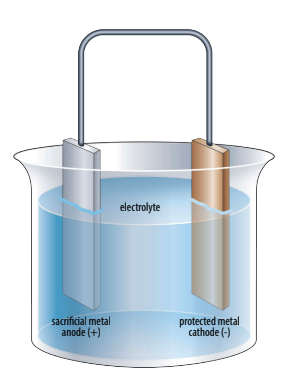
When two dissimilar metals are immersed in an electrolyte, they form a battery. If they are connected electrically, an electric current will flow between them. (An electrolyte is any substance that is electrically conductive due to the presence of free ions. Electrolytic solutions are normally created when a salt dissolves in a solvent such as water.) In the process of creating an electric current, the “less noble” of the immersed metals supplies electrons to the electrolyte. The resulting positive metal ions bond with salt ions in the electrolyte and the metal corrodes. This galvanic corrosion is an immensely important issue for sailors since our boats spend their time floating in an electrolyte.
The galvanic series
The galvanic series places metals, alloys, and semi-metals in order of their comparative nobility — noble metals resist corrosion and oxidation in an electrolyte better than less noble metals.
The galvanic series table shown here is for common metals used aboard boats in a saltwater environment. Noble metals are at the bottom of the table and the least noble at the top. The nobility order can change slightly in different environments, such as when a boat is in brackish or fresh water.
Some metals are labeled active and some passive. A passive metal is one that is protected by an oxide film. An active metal does not have this protective film and is more susceptible to corrosion as its surface is constantly exposed.
Galvanic series
Common marine metals from least noble (top) to most noble (bottom).
- Magnesium
- Zinc
- Aluminum
- Mild steel
- Stainless steel (active)
- Bronze
- Brass
- Copper
- Lead
- Stainless steel (passive)
- Monel
Sacrificial anodes
On most boats, several dissimilar metals are joined together in the water, as when a bronze propeller is fitted to a stainless-steel shaft. Galvanic corrosion on these valuable and important underwater fittings can be prevented by attaching to them a metal that’s higher in the galvanic series. The less noble metal, called a sacrificial anode, protects the more noble metals by corroding first.
A sacrificial anode must be in electrical contact with the metals it is to protect, so when a sacrificial anode is fitted, the mounting surfaces of the two metals must be clean and bright. The efficiency of a sacrificial anode depends on its surface area. For obvious reasons, an anode should never be painted.
A sacrificial anode must never be allowed to corrode away completely because, when it is gone, the next least noble metal will begin to corrode. Therefore, monitoring and replacing sacrificial anodes regularly are important steps in routine maintenance. The time between replacements varies from boat to boat but, as a rule of thumb, the sacrificial anode should be replaced when it is about 50 percent destroyed.
Anode materials
The metal used in anodes depends on the water in which the boat is used. Zinc and aluminum alloys work well in salt water. In brackish water — water with less salinity than seawater — zinc’s efficiency decreases while aluminum alloys still work well. Magnesium sacrificial anodes should not be used in salt water but offer the best protection in fresh water.
This presents a dilemma for trailer-sailors who may be using their boats in both fresh and salt water. For them, aluminum-alloy anodes are the best choice.
Shapes and duties
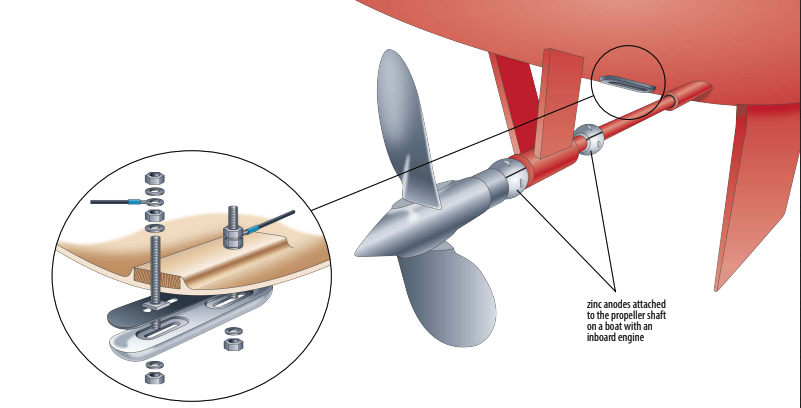
Sacrificial anodes are cast in hundreds of shapes and sizes. Some companies will also make anodes to custom specifications. For boats with inboard engines, the most common shapes are collar castings for the propeller shaft and streamlined teardrops or smooth wafers for metal rudders and other underwater metals. Propeller-shaft castings are made to match shaft diameters and come in two parts that bolt around the shaft. Two common types are streamlined collar anodes and limited-clearance collar anodes. A small spring-loaded button is often incorporated to ensure good electrical contact.
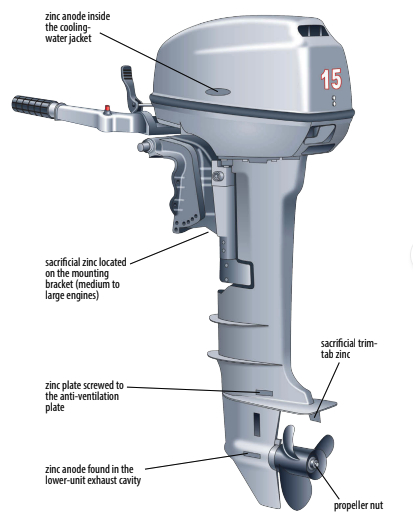
A huge variety of anodes exists for outboard motors, with different castings made for different manufacturers and engine models. The variety of metals in an outboard motor make it especially susceptible to galvanic corrosion and many outboards use more than one sacrificial anode, not only on the lower unit but also in the engine block. These should be monitored and changed when necessary. An outboard’s manual will show where these anodes should be located.
An inboard engine might have sacrificial anodes in the block or heat exchanger. Look in the engine manual to find where they are located.
Wherever water is in contact with dissimilar metals there is the chance of galvanic corrosion. This also includes metal water tanks, hot-water tanks, and refrigerators and air-conditioners that use outside water to cool their condensers.
Don Launer, a Good Old Boat contributing editor, built his two-masted schooner, Delphinus, from a bare hull. He has held a USCG captain’s license for 40 years and has written five books. His 101 articles through November 2011 are available for downloading as a collection from the Good Old Boat download website, www.audioseastories.com. Look under Archive eXtractions.
Thank you to Sailrite Enterprises, Inc., for providing free access to back issues of Good Old Boat through intellectual property rights. Sailrite.com