Memories of a very special old boat, First of a two-part series
Issue 15 : Nov/Dec 2000
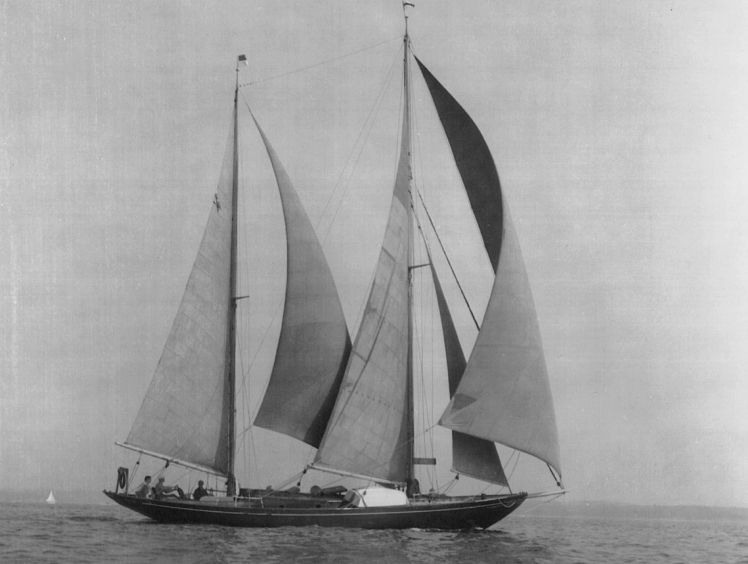
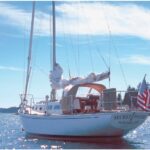
Seven Bells was named by her original owners for that time in a mariner’s day when the sun is over the yardarm. Her owners, I was told, were not particularly concerned with the altitude of the sun as much as with the occasion of the moment. Most likely, Seven Bells referred to Happy Hour, after having made a safe harbor and anchorage with supper cooking below.
She was launched at Shelbourne, Nova Scotia, in July 1926. Her owners were brothers Carleton and Thomas Cooke, a pair of New York City attorneys who knew what they wanted in a fast, seaworthy, ocean-cruising vessel. They chose William Roué, the designer of Bluenose and other rugged Nova Scotia racing/fishing schooners. Bluenose became a maritime heroine, and her image appears on the Canadian dime. Bill Roué and the Shelbourne shipbuilders gave the Cookes exactly what they wanted. Seven Bells would be not only a kid sister of Bluenose, she would become a legend in her own time.
She was 57 feet on deck, and her bowsprit added another 8 feet to her overall length. She had a waterline length of 39 feet with a beam of 12 feet 2 inches. Her draft was 7 feet and her displacement 16 tons gross. Although Seven Bells was a yacht, her Canadian fisherman heritage was very clear. Her forward and main cabins were furnished fish holds, each equipped with a large hatch, and the authorities at the time were concerned that she could be quickly converted to the fishing trade.
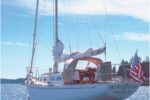
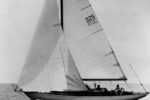
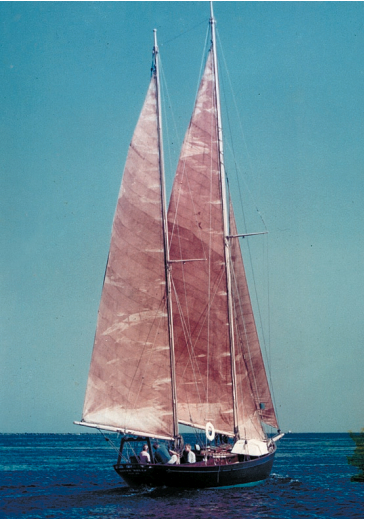
She was Marconi-rigged as a ketch (instead of the gaff-and-topsail schooner arrangement preferred by the fisherman) so that a small crew could easily manage her under mizzen and headsails in heavy weather, and when maneuvering in close quarters. Mizzen, main, and boom staysail were on travelers and sheeted aft to the cockpit. They usually needed no attention when tacking. Her forward rig was classic fisherman — a boomed staysail, and a main jib fitted with a Wykeham Martin roller-reefing gear. The jib topsail was clipped to a standing headstay rigged from the masthead to the end of the bowsprit. The leech of this pretty little jib extended about halfway down the headstay, and the sheets were rigged aft to the cockpit. The jib topsail could be counted upon to catch the light air aloft. The main, mizzen, and three headsails comprised her working rig and could be managed easily with a crew of three. For light air, she could set a mizzen staysail and a balloon jib on the headstay. A rather heavy spinnaker was carried but seldom used. One adult could just manage to hoist the mizzen if it was dry, but it required two strong adults to hoist the mainsail. Another person was needed if the sails were wet.
Painted spruce
Masts and booms were fashioned from a single piece of spruce and painted sand buff. The main masthead was 60 feet above the deck and the mizzenmast 52 feet. Both booms were more than 20 feet in length, with the mizzen boom extending 6 feet beyond the taffrail. Both masts had a noticeable rake of about 2 degrees. The standing rigging, including the bobstay under the bowsprit, was stainless-steel wire rope, and all of the running rigging was manila. In later years, she would be quite the conversation piece in harbor among her nylon-and Dacron-rigged companions.
The tanned sails were made of Egyptian cotton by Ratsey & Lapthorne, of the Isle of Wight. The deep maroon sails had been preserved with the “kotch” process and faded to a khaki shade after a few seasons. Years later, even the most faded canvas would show the dark color deep in the fibers if they were cut or torn. The preservative allowed the sails to be furled wet, without risk of mildew or rot.
Her black hull was beautiful, with a long, even sheer, low to the water at the aft quarter with a spoon bow and long counter stern. She was green below the waterline and, in the Nova Scotia fashion, lacked a boottop.
Seven Bells carried the beam and bulk of her underwater hull about even with the mainmast, slightly forward of the beam at the sheer, with a long fine run aft. In this respect, she differed from Bluenose and the other schooners of her day, which carried their underwater beam somewhat farther aft. The keel was deepest at the aftermost part and included four-and-a-half tons of cast iron fixed ballast. Cast iron was chosen because it would glance off a rocky bottom, whereas lead has a tendency to bind to the obstruction. The Cookes planned to spend most of their cruising time off the coasts of Maine and the Canadian Maritimes, where rocky pinnacles are in great abundance. Several tons of lead pigs were located in the bilge for internal ballast and trim adjustment.
Pine planked
The hull was framed in white oak and tamarack on a 22-foot elm keel and planked with longleaf yellow pine. All fastenings, including the keel bolts, were of ungalvanized Swedish iron, nearly pure ferrite (free of carbon, but with some natural alloy of nickel), chosen for its natural resistance to corrosion.
Below deck, Seven Bells was deep and narrow with full headroom fore and aft, although she might seem claustrophobic today. The cabin arrangement was a simple modification of the fishing schooner, which had a fo’c’s’le forward for the crew, two large fish holds amidships, and a cabin and galley aft.
In 1925, there were no requirements for compartmentation or damage control. There were no watertight bulkheads, sills, or compartments. Had she suffered any major hull damage, she would have gone down like a rock.
Aft of the chain locker and forward of the mainmast, was the fo’c’s’le. There were two ample berths there with lockers beneath. These were the most comfortable berths on board, and the captain usually claimed the fo’c’s’le because of the privacy and quiet, and because from there he could hear the sound of a dragging anchor carried up the cable. It was also handy to the main head, just aft, on the portside. Inside, and forward of the fo’c’s’le door to starboard of the passage, was a large sail locker. A hatch provided ready access from the fo’c’s’le to the main deck and could provide good ventilation.
Aft of the fo’c’s’le was the forward saloon, with berths port and starboard, outboard over wardrobe and storage drawers. Below and inboard of these were settees, which could be made up as berths for short passengers. A hatch with large glass lights was overhead at the forward end of the saloon.
Drop-leaf table
The main cabin was laid out like the saloon, with somewhat wider and longer berths outboard, over lockers and with settees below on each side. There was room for a large drop-leaf table fixed to the cabin sole a few inches to starboard of the centerline. The forward and aft ends of the main cabin were faced with bookcases and lockers for navigation tools and emergency gear. In the starboard aft corner, a soapstone stove stood ready to dry out the cabin and drive away the chills of foggy days.
The companion steps could be lifted for access to the engine, which was mounted to port of the mizzenmast step. The propeller shaft line extended through the port quarter, and the propeller was strut-mounted to port of the sternpost. This was a typical arrangement in those fishing schooners that carried auxiliaries and did not interfere with the stepping of the mast or require penetration of the sternpost with a shaft log. The propeller was an 18-inch, three bladed, Hyde self-feathering type that was rather innovative for its time. The original engine was a hand-cranked gasoline Scripps F-4, a popular auxiliary in 1925.
The galley featured an icebox with the ice hatch set in the starboard waterway deck. The Protane stoves, originally designed for wood and coal, were later switched to a Primus kerosene type. In spite of T. F. Cooke’s demonstrated ability with cabinetwork, he never seemed to do much for the matter of galley stowage. There was a very poor arrangement for dry stores and provisions, and I suspect it was out of reluctance to block access to the engine box with a lot of fixed stowage.
Aft of the galley and engine was a rather cluttered space under the cockpit sole that was euphemistically referred to as a “bosun’s locker.” This messy place could usually be counted upon to be the culprit when the binnacle began to exhibit sudden deviations, because someone had stowed fishing tackle, golf clubs, or other magnetic things back there.
Acetylene gas
In 1925, electric shipboard lighting on sailing yachts was rare. Seven Bells was built with a Prestolite acetylene gas cabin lighting system. Additional cabin and navigational lamps were lit by kerosene or six-volt Hotshot dry batteries. The acetylene generator was aft by the engine box. Acetylene gas was piped around the ship through small copper tubes. A few of these remained long after the system was ripped out by the Navy during the 1940s when somebody had the common sense to realize that the ship was a floating bomb full of acetylene and gasoline fumes. The engine was fitted with a backfire spark arrestor, but there was no fume exhaust blower.
Forward of the main deck was a well deck with low bulwarks faired into the cap rail, providing stowage for anchors and mooring gear. The well deck afforded plenty of clearance for the staysail boom overhead. A manually operated Hyde-Torrey windlass was mounted to the deck. The horrid thing worked by a long iron ratchet lever, back and forth about 90 degrees to afford about 3 inches of chain recovery per stroke. When possible, we avoided the use of the chain and used nylon cable. Most of the time we simply grabbed the anchor cable and manhandled the cable short, then snubbed it on the windlass gypsyhead and broke the anchor out with the engine. Once it was broken free, the anchor was hauled to the surface by hand and brought on board with a light tackle slung from a whisker pole off the mainmast.
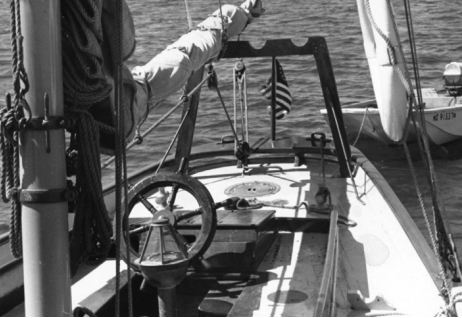
The cockpit was enclosed by deep coamings, extensions of the cabin trunk. Inboard of the coamings, the extension of the weatherdeck formed cockpit seats about 16 inches wide on each side, connected by a narrow cross-deck through which the mizzenmast was stepped, wedged and booted.
Copper tanks
Beneath the cockpit seats were two 80- gallon, cylindrical, copper fuel tanks. These were filled through deck plates in the seats, and gasoline fumes were trapped in the cockpit and the recessed deck in the middle. Why the ship did not blow up years ago, I shall never know.
With two persons either side of the wheel box, there was room in the recessed cockpit for six more people seated face-to-face. The deck of the recessed cockpit was about a foot above the water line and was self-bailing through twin scupper tubes.
There was a bronze deck plate in the recessed cockpit deck. When this cover was unscrewed, and a long pump plunger inserted, the device became a bilge pump that lifted water up into the recess and out of the scupper tubes. Unfortunately, it usually pumped out other horrible things that had found their way into the bilge from the galley and the head, or from oil leaks and spills from the auxiliary engine. It made a dreadful oily mess on the deck and the device was seldom used. It was the only bilge pump built with the ship. Someone had equipped the bosun’s locker with several portable bilge pumps with long hoses and various degrees of performance. A later replacement of the auxiliary engine included a bilge pump that was supposed to work whenever the engine was running, but it, too, had its faults.
A trip to England
Three years after taking delivery, the Cookes took Seven Bells to England. The crew consisted of T. F. Cooke, his two sons, and three recruited hands. They were Marshall Rawle; my father, Isaac Harter, Jr.; and his classmate, Ben Brewster. They sailed July 5 from Branford, Conn., where T. F. maintained a country home, and arrived at Falmouth, England 25 days later. My father served as navigator, cook, and able seaman. Nearly everyone suffered some seasickness shortly after the beginning of the trip when they sailed through the edge of a hurricane. The crew returned home by passenger steamer, and the Seven Bells came home on the deck of a freighter the next year. She would make her home port near City Island, New York for the next 13 years.
In 1942, Seven Bells was requisitioned by the Naval Reserve, and she served offshore Long Island on U-boat patrol. Not much is known about her career or whether she ever saw or heard a U-boat, but I rather suspect that some lucky Naval Reservists must have spent a lot of enjoyable hours at war. In 1944, the U-boat threat was all but gone, and the ship was returned to the Cookes in better shape than they had taken her.
The Scripps F-4 engine had been replaced with a Graymarine 140 Lugger and was equipped with a self-starter, batteries, generators, and ventilation blowers. The Navy had installed some sort of radio gear and passive sonar listening devices, but these had been taken off when she was decommissioned. Best of all, they left behind a complete new electric wiring and lighting system throughout the ship and got rid of the dangerous acetylene devices. After the war, the Cookes seldom used Seven Bells, but she saw limited service on charter to some personal friends.
Pirate ship
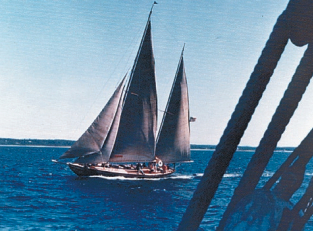
Ben Brewster, one of the crew from the 1928 transatlantic cruise, chartered her a few times, and I can recall visiting aboard with my father when they called at Nantucket in 1951. To me, she looked like a lean, pirate ship far out in the deep part of the harbor. As the shuttle launch came alongside, the black hull seemed to tower overhead. My first impression when I stepped aboard was that the ship did not move, as if stepping ashore onto a solid pier. She rode at anchor as solid as a rock. As I sat aft, listening while my father and his friends exchanged Seven Bells stories, it seemed as though the bowsprit was a mile ahead.
In 1953, when I was 19, my father chartered Seven Bells for two weeks of cruising on the Maine coast. During the first part of the cruise, we had managed to tidy up a lot of damage, make needed repairs and a few cosmetic touches that made us all feel better. While fogbound at Northeast Harbor on Mt. Desert Island, my father taught me the art of swinging and adjusting a compass. We were able to take some serious error out of the binnacle. The skipper had me row him around the ship while he took some notes from which we were able to make a better setup of the standing rigging. The trim was also adjusted by simply shifting some internal ballast that appeared to have been just dumped in one spot of the bilge at the last hauling.
All tuned up and trim, we were ready when the fog cleared, and my grandfather and my father’s friend, Marshall Rawle, joined us for some sailing. Until that day, our cruising had been leisurely, with an overcast sky and only light wind. We had done more motoring than sailing in our efforts to make our planned ports of call. But this day was different. It was bright and sunny, and a stiff breeze blew hard and steady down Somes Sound, the only natural fjord on the East Coast.
Enormous power
We had set the full working rig, with the mizzen, main, boom staysail, roller jib, and jib topsail. When I first took the wheel, I could feel the enormous power at my command.
The ship was moving faster than I had ever seen before, and I was fascinated by the way she held so steady a course with only a moderate heel to leeward. Being quite new at this sort of thing, I was naturally conservative at my task and strictly followed my father’s orders. We changed course, and I was delighted as Seven Bells tacked as smartly as a racing sloop. We did this several times until the skipper was assured that his crew was handling sheets and preventers to his satisfaction.
Seven Bells was not equipped with a modern electronic log or knotmeter. All we had was a Walker Patent Log, which was only streamed for extended, steady cruising. But Somes Sound had a number of channel buoys and landmarks on shores that were accurately located on the chart. The navigators had set up several measured courses, and my father got out the stopwatch and took the helm. On this day, I would learn some things about naval architecture and ship hull performance.
We ran one course close to windward, and my mother immediately said, “Do we really have to do this?” She never did like it when the ship heeled, especially when objects began to fall off shelves below. These loose items were secured, and we ran a few more brisk legs, with the stopwatch showing a best speed of nearly 10 knots.
In those days, I did not know about such things as “natural hull speed” or what the square root of the waterline length had to do with a ship’s performance. Many years ago, it was discovered that any displacement-hull surface vessel has a limiting speed determined by the square root of the length of the ship, in feet, at the waterline. This figure is the maximum speed (in knots) that the hull will move through smooth water without leaving any perceptible wave. Any faster than this, and the hull will begin to make a noticeable wave at the bow and stern. Water will begin to appear to pile up in front of the moving hull and turbulence will appear directly astern. The effect will be that the ship will be steadily pushed uphill, and the faster it is pushed the steeper the hill will become.
Nominal speed
Given a clean, well-designed displacement hull, and taking into consideration things like hull weight, wetted surface, trim, and performance while heeled, an additional hull factor can be calculated, which, when multiplied by the natural speed, results in the nominal hull speed, which is the highest practical speed at which the ship can be driven before the required powering forces become excessive and inefficient. The efficiency of additional speed achieved, versus power applied, becomes the most obvious when dealing with a powered vessel. Fuel costs go up astronomically with increased efforts to get those last few knots off the top. Commercial ships and their power plants are designed to operate at, or less than, their practical hull speed to keep operating costs down and profits up.
Seven Bells had a waterline length of about 39 feet. The square root of this value is 6.24. A likely hull factor of no more than 1.3 would result in a practical hull speed of 8.12 knots. Her Nova Scotia fisherman’s rig had more than enough power to spare that day in Somes Sound.
Marshall Rawle took the helm next. He had been a crewmember on the 1928 transatlantic passage and sailed all sorts of ships, large and small. At 75, he had not forgotten a thing about sailing. He tended to be somewhat less conservative than my father about how hard to push a ship and thought Seven Bells had more performance hidden away. We ran a half dozen or more hair-raising reaches, timing the runs against the measured courses.
The men were having a grand time, and my mother and girlfriend had ceased protesting. Everything that could come adrift down below was on the galley and cabin sole. I made several trips down there to investigate crashing noises and was astonished to hear how the frames of the old ship groaned and how the mainmast was clearly offset in the partners where it passed through the deck. I could hear the water rushing past the hull with a queer humming sound. The whole ship was vibrating like a living creature, but somehow the sensation was not alarming. Seven Bells was sailing again as her designer and builders had once intended.
Wrinkled canvas
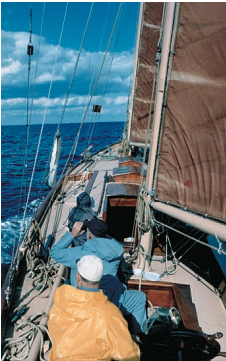
I returned on deck and sat down beside my girlfriend on the leeward side of the cockpit. We were on a hard reach on the port tack. I observed that the painted canvas covering on the main deck, usually stretched tight and smooth, was wrinkled like a washboard from the strain, as the ship thundered along at what the navigators had just reported was 11.5 knots. I looked overside and observed that the toerails were just at the water level. There was a deep depression in the water immediately aft of the bow wave, where the quarter wave began. The water was tearing past at an incredible speed, and the foam and bubbles in the wake hissed and fizzed. I turned to my girlfriend and leaned forward slightly to speak to her.
Suddenly there was a sound like a gunshot and what appeared to be shrapnel fragments rained down from aloft and bounced off the deck and stowed dinghy. Something howled just past my ear and hit the water like an artillery shell, leaving a tall water-spout in the quarter wave. The jib halyard block had disintegrated, and the big roller-reefing jib dangled overside from the bowsprit. Playtime was over for the ancient mariners, and Seven Bells could relax from her astonishing speed trials. The wrinkles disappeared from the deck. The few “shrapnel” bits that were found turned out to be the bronze rollers from the halyard block bearing. The rollers were the size of sewing thimbles, and the bronze sheave on an identical replacement was the size of a hockey puck. It would have had the effect of a cannonball if it had struck my head only inches closer.
That evening, after dinner, I went up the main halyard in a bosun’s chair and fitted a new jib halyard block. Another new experience, up so high on a rope tackle. I was only two-thirds of the way up the mast, yet the ship seemed so narrow and small, and so far below.
Part 2 of this story will appear in the January issue.
Ike’s career involved the design, construction, and testing of naval and commercial ships. He designed several small craft and marine machinery systems for friends and private customers and designed and built a 28-foot, oceangoing steam yacht for himself. He has written a number of articles on small marine steam systems.
Thank you to Sailrite Enterprises, Inc., for providing free access to back issues of Good Old Boat through intellectual property rights. Sailrite.com