. . . and two more classic clippers
Issue 95 : Mar/Apr 2014
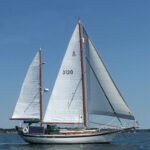
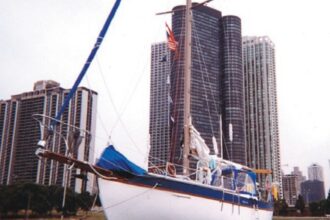
The most obvious design feature of the Bill Luders Cheoy Lee Clipper 36 is the pronounced clipper bow, which is synonymous with the name of the boat. Therefore, for this design comparison I looked for similar-sized boats with the same design feature, and chose the Cabo Rico 34 and the Gozzard 31. When done well, as on the L. Francis Herreshoff-designed Ticonderoga, the clipper bow is a thing of beauty.
In my long career of designing fiberglass production boats for a number of builders I have never worked on a boat with a clipper bow. My experience with the genre is purely observational. From that perspective, my impression is that the clipper bow can be executed in two ways. In one, the reverse curvature in the profile is achieved with the added stem piece, and the stem itself does not have the inflection. This is a common approach in wooden boats and is copied in some fiberglass models. The Gozzard 31 is an example of this style, which partially explains why its length on deck (LOD) appears shorter than on the other two boats. The other way is to build the reverse curvature in the stem and the hull together, almost as if by pinching the tip of the stemhead between thumb and forefinger and stretching the whole upper section of the bow forward. The Clipper 36 and the Cabo Rico 34 are examples of this approach.
A matter of length
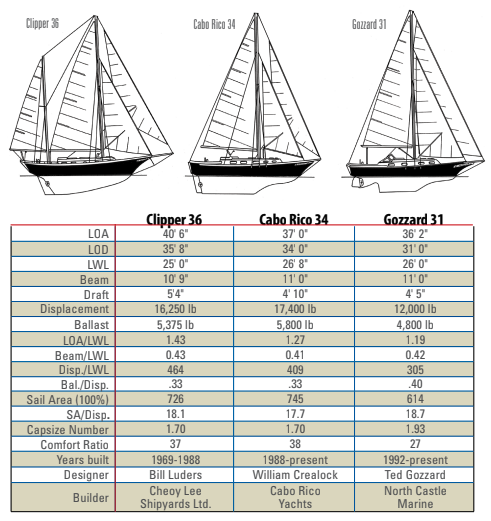
Comparing these boats was an interesting exercise on several fronts. One discovery I made was that length over all (LOA) or even LOD are poor measures of comparative size for boats with clipper bows. I began by looking at 37- and 38-foot boats, but soon realized that these boats were much too large to compare with the Clipper 36. In order to do a realistic comparison, I had to drop to a 34- and a 31-footer. Even then, these “smaller” boats are longer than the Clipper 36 on the load waterline (LWL), which is a better measure of interior volume.
The other interesting comparison in these three boats is the obvious evolution of underwater shapes from the Bill Luders Clipper 36 of the late 1960s to the Bill Crealock and Ted Gozzard cruising designs of the ’80s and ’90s. Specifically, the later designs benefit from the development of a distinct foil-type keel that becomes increasingly distinguishable from the canoe body of the hull but remains connected to the rudder, in the case of the Gozzard by means of a skeg. Obviously, this better-defined keel has a pronounced influence on upwind performance, as well as reducing the wetted surface for improved downwind performance.
Performance factors
Although sailing performance is not the primary consideration for these boats, a comparison is still of interest. I’ll begin by noting that both the Cabo Rico and the Gozzard have longer load waterlines than the Clipper, with the Cabo Rico having the longest of all. Length means greater ultimate speed, especially on a reach. The shorter waterline of the Clipper, combined with a moderately high displacement, results in a relatively high displacement/length ratio (D/L) of 464. Compare that to 409 for the Cabo Rico and a relatively low 305 for the Gozzard — due to her lower 12,000-pound displacement on a relatively long waterline length. The ketch rig will further compromise the Clipper’s upwind performance.
We often look at draft as an indication of upwind potential. The Clipper has the greatest, at more than 5 feet, while the Cabo Rico draws more than the Gozzard. However, we also need to look at keel efficiency and wetted surface. Here, the Gozzard clearly has an advantage.
Upwind stability is a function of displacement and beam, with the Cabo Rico clearly having the best combination. However, despite her shallower draft, the Gozzard, with her lighter displacement and higher sail area/displacement ratio (SA/D), combined with lower wetted surface and a more efficient underbody, will have the edge in light to moderate breezes — before she has to reef. Upwind in a blow, certainly on the verge of reefing, the Cabo Rico will perform well, considering her longer waterline, greater displacement and ballast, and lower SA/D. But in light air, the Gozzard will be the boat to beat.
Reaching and running, the same conditions apply. The longer waterline of the Cabo Rico and her greater stability work to her advantage in heavier air, while the Gozzard’s lighter displacement and lower wetted surface will favor her in light and moderate air.
Comfort and safety
The capsize numbers are all below 2, but the higher displacements of the Cabo Rico and the Clipper give them a lower number than the Gozzard. All the comfort ratios are also well within cruising boat ranges, with the lighter displacement of the Gozzard giving her the lowest of the three.
There is no question that the Clipper 36 is an exceptionally good-looking boat from the board of one of the finest designers. For that reason alone she warrants consideration by anyone interested in boats with the classic appearance of the clipper bow. However, it’s also difficult to ignore the modern underbody and lighter displacement, combined with traditional design aesthetics, of the Gozzard 31.
Rob Mazza is a Good Old Boat contributing editor. A lifelong sailor, he writes about good old boats from the vantage point of having been involved in the design of a good many of them.
Thank you to Sailrite Enterprises, Inc., for providing free access to back issues of Good Old Boat through intellectual property rights. Sailrite.com