Beyond natural artistic instinct, these simple rules can improve your photos
Issue 15 : Nov/Dec 2000
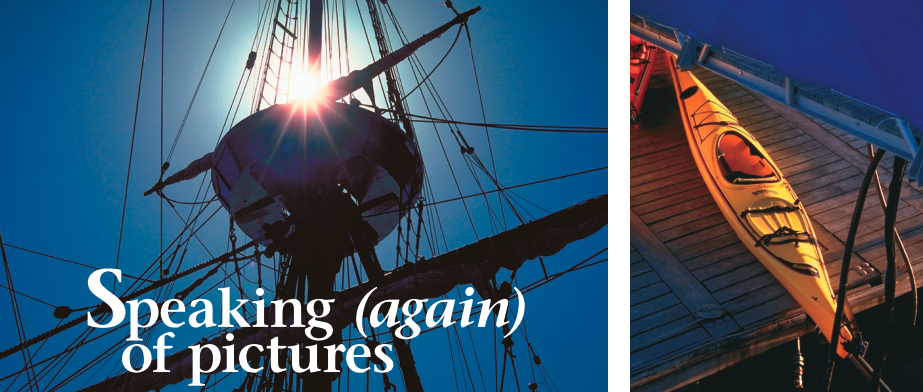
Like many of us, Mary Jane Hayes has an instinctive sense of the beautiful and dramatic. She tells us what appeals to this instinctive photographic sense in her article in the September 2000 issue of Good Old Boat.
But there are guidelines, a set of photographic rules of thumb, that guide all of us — photographers and viewers — on a conscious and subconscious level. In her article, Mary Jane speaks primarily of content — what’s in the photo to make it interesting. The other important piece of the puzzle is composition — how it’s arranged or viewed to make it compelling.
Sight lines
Composition in a photo often involves sight lines: the angle of a bridge, the lines in clouds, or the individual elements in a photo (such as Mary Jane’s photo of a boat anchored in the distance and a beached dinghy in the foreground) on the cover that cause our eyes to travel within the photo and take in the whole scene. In the case of the anchored boat and the dinghy, we even understand immediately what has happened, since our own beach explorations result in similar scenes.
Rule of thirds
Cameras are often the undoing of our photographic sense. They generally have a focusing screen or area in the center of the viewing field. We can be lulled by the center of focus into having all subjects smack dab in the center of each frame perfectly focused and boringly repetitive. Or we can focus the subject and shift the camera to frame a much more interesting shot.
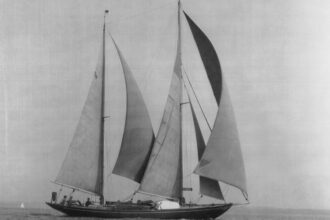
Photographers speak of the rule of thirds. Mentally divide the frame into thirds horizontally and vertically, making a grid of nine rectangles. Better places for our primary subject matter are the intersections of these lines. So a shift of the camera to place a passing boat off-center to one of these locations results in a stronger photo.
Movement
If that sailboat is under way, it’s best to locate it in your photo so that it has some visual room to sail into. Give it space ahead by placing it back from the center.
Closeups
Don’t try each time to include the entire boat. Sometimes it improves matters to focus on just part of the picture that you’re seeing with your eyes. Zoom in. Go for the details.
Angle of view
Consider shooting up at some things, down at others. Crawl on your belly (and not just for a shot of the bilge pump or fuel tank). Climb hills and bridges. Enjoy the view, and while you’re at it, take a photo for the memories.
Horizontals and verticals
And while you’re thinking about framing, subject matter, and sight lines, don’t forget that your camera is also capable of taking vertical shots. Rotate it 90 degrees to accommodate tall subject matter, such as sailboats. It just so happens that magazines are vertically oriented also. Cover shots are verticals, as are many of the photos we use inside.
Rules meant to be broken
Since rules are meant to be broken, don’t take any of the advice given here so freely (and that’s exactly what it’s worth) too seriously. Shoot what’s pleasing to you, and it’s likely to be appealing to others also.
Some of the concepts Mary Jane expresses almost poetically in her article in the previous issue can also be broken down into photographic terms.
Action and movement
It’s not just what is framed and how it’s framed in a photo. It’s also what’s going on that makes it interesting. These shots are the ones you get when your camera’s at the ready, and you get one chance to point and click. You may not have time to think about the rule of thirds. Shoot anyway. You may be very pleased with the results.
Reflection
Boats, in particular, lend themselves to gorgeous reflection shots, as do shorelines and sunsets. Capture these
scenes any time they appeal to your personal sense of beauty.
Weather
Mother nature uses fog and rain, wind and light, to paint our seascapes in muted tones and bright colors. As we enjoy this variety, we can capture it on film. Even the stuff we don’t appreciate from a personal-comfort point of view — such as storms, rain, and fog — can make dramatic photos.
Mood
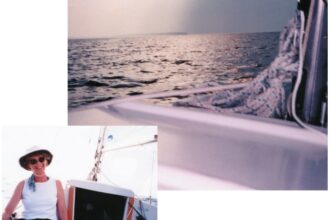
The angle of the sun can influence the mood of our photos — morning mists, rich evening gold, and backlighting — these moments create the mood shots in quiet anchorages and along the shore.
Contrasts
Dark and light, small and large, power and sail, race boat and traditional yacht . . . all these things and more make for interesting contrasts when captured together in a shot.
Color
Sometimes the bright color of an object makes the image. Sometimes it’s the muted colors of fog or mist that make the photo attractive, peaceful, or surreal.
Shapes, textures, patterns
The artistic nature in us comes out when we notice and appreciate a coiled multicolored line, a row of boat bows, footprints in the sand, the ripple of water on the beach, and more. Capturing the pictures that appeal to us makes it possible to share this momentary joy with others.
People and animals
We’ll never tire of seeing photos of children, animals, and people actively engaged in doing something. Shoot these pictures of family, friends, pets, and wildlife whenever you can. Don’t say “cheese” first; capture them doing what they’re doing unselfconsciously. These are the moments that make beautiful memories and memorable photos.
Scenics
Scenes steal the show sometimes: a dramatic lighthouse on a rocky point, a sailboat passing under a bridge, an evening’s rich colors on the shoreline, a sunrise, or a sunset. Enjoy these scenes, and while you’re at it, capture and share them.
Shooting in our environment
Cameras that calculate exposure automatically vary in the way that they do the calculation. The simplest point-and-shoot cameras may calculate an exposure based on the average amount of light coming into the lens. This causes problems with some kinds of pictures, including some of the bright sea scenes we deal with on our boats. The classic example is backlighting, in which you’re trying to shoot an object or person with a bright background (like the sky or water).
Simple averaging meters will “stop down” too much, based on the bright background, and give you a nice shot of the sky while underexposing the subject in the foreground. It’s necessary to compensate for this by using the backlighting setting of your camera (many have them) or by using a larger aperture (lower f-stop number) or a slower shutter speed.
Compensation is always guesswork, to some degree. It takes trial and error, but 1/2 to 1 1/2 stops is the usual amount required. About twice as much compensation is required for print film as for slide film. Print film has more latitude and forgiveness. Slide film sets a higher standard. You must be closer to perfect to get a good shot. Bracketing helps here.
If you can, and if this helps your camera, try stepping up close and metering the subject and then stepping back to shoot. Obviously this isn’t a big help when you’re shooting from your boat across the water at another boat.
If you have a more sophisticated camera, it may have a spot meter, a narrow-zone meter, or even a selection of metering systems for solving this problem. Refer to your manual for more information about your camera’s idiosyncrasies.
Capture your world and share it with the rest of us.
Karen is editor of Good Old Boat. Mary Jane is a frequent contributor to these pages and to many other boating magazines.
Thank you to Sailrite Enterprises, Inc., for providing free access to back issues of Good Old Boat through intellectual property rights. Sailrite.com