Care in the fall ensures a carefree spring

Issue 92 : Sept/Oct 2013
Outboard motors on small sailboats should last a long time because they’re lightly used. Most are run only to get the boat into and out of a slip. Those used on dinghies might get harder use taking the crew on excursions and shuttling between shore and the sailboat loaded with laundry, provisions, and jugs of fuel or water. Over the years, I have developed maintenance methods that have helped prolong the lives of my outboards.
In the fall, when the motor is being laid up for the winter, it must be fogged. To do this, I construct a rack using a stepladder, a 2 x 4, some clamps, and a garbage can. I clamp the 2 x 4 to the ladder and hang the motor on it with the prop shaft hanging down in the garbage can. I fill the garbage can with water deep enough to cover the intake for the cooling water. I set the fuel tank up on top and run the hose down to the motor. I can then run the motor.
The rubber bulb in the fuel line, used to prime the motor’s fuel pump, has an arrow on it. The bulb needs to be plumbed in the fuel line so the arrow points toward the motor. One thing I’ve learned is that — before starting the motor — the rubber bulb should be held with the arrow pointing up when being pumped. This helps move the air out of the line and through the motor.
After starting the motor, I look for cooling water squirting out of the hole on the back of the motor. With the motor running at a steady speed, the flow should be a steady stream. This tells me the water pump is working properly.
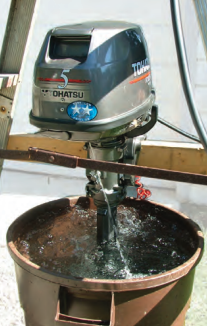
In the fall, I run the motor until it gets warm. After making sure the prop can’t hit the side of the garbage can, I put the motor in gear to turn the prop shaft. I never run the motor in gear above idle or for very long. Once it has warmed up, I spray engine fogger into the air cleaner until the engine stalls and stops. When it has cooled, I remove the spark plug and spray engine fogger into the spark-plug hole for 10 seconds, then pull the starter cord about six times. This thoroughly coats the cylinder with the fogger. Next, I replace the old spark plug with a brand-new, properly gapped, spark plug. The motor is then ready to store on a rack for the winter. A new spark plug every year is a good practice. It’s not very expensive and ensures a sweet-running machine in the spring.
One additional note for the newer four-stoke motors is to remember, when setting it down, to place the control arm on the bottom so the crankcase oil won’t run into the cylinder. Filling the cylinder with oil is a bad thing.
When spring arrives, I put the motor back on the step- ladder rig and start it up before heading to the lake with it. This way, I can make sure the motor runs like a top before it goes on the boat. If there is a problem, I can attack it at home or, if necessary, take it to the shop. Usually it runs just fine. A springtime check at home avoids the embarrassment of getting to the water, launching the boat, and not being able to start the motor.
Perry Olds first sailed in a homemade 8-foot pram when he was 20. Over the last 40 years, he has sailed in the Pacific, the Atlantic, the Mediterranean, the Caribbean, the Chesapeake, and the Great Lakes. When he’s not sailing or working on boats, he’s reading or dreaming about sailing.
Thank you to Sailrite Enterprises, Inc., for providing free access to back issues of Good Old Boat through intellectual property rights. Sailrite.com