Use the proper wire for safety and reliability
Issue 97 : Jul/Aug 2014
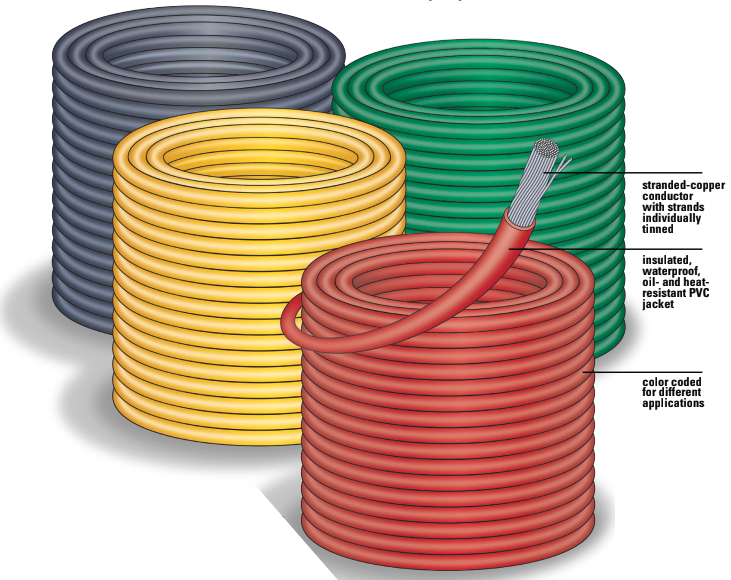
Household electrical wire, automotive wire, and marine-grade electrical wire are all very different. When subjected to the vibration and rapid accelerations in all directions commonly encountered on boats and surface vehicles, solid copper wire can fail. Marine and automotive wire is, therefore, made with multiple strands of fine wire to make it flexible and reduce the chance of failure from work hardening or metal fatigue.
In addition, each of the strands in marine wire is tin-coated to protect the copper wire against corrosion should water intrude into the wire’s jacket. This is especially important in a saltwater environment. To further shield the conductor, the PVC insulating jacket is heavy, waterproof, and oil-resistant. It is also able to withstand high heat, an important property when the wire must pass through the engine room. These wire specifications hold for both low-voltage DC wire as well as AC wire.
When doing a wiring job on board, resist the temptation to buy the less expensive house wire or automobile wire. These products just don’t hold up in a marine environment.
Wire gauge
The size of the conductor in marine wire, which determines its current-carrying capacity, is specified using the American Wire Gauge (AWG) system.
In this system, the larger the number, the smaller the diameter of the conductor. Thus, 16-AWG wire is small, with a diameter of about 6⁄100 inch, while the diameter of 0-AWG wire is large — nearly 1⁄2 inch — and has the capacity to carry very high currents. For wires larger than 0-AWG, the designations are 00-AWG, 000-AWG, and so forth.
Wires labeled SAE (Society of Automotive Engineering) are designed for use in surface vehicles, not for the special conditions in which marine wiring must serve. What’s more, the copper conductors in SAE and AWG wires of the same designated gauge are different sizes. SAE wires are up to 12 percent smaller than AWG wires of the same gauge number.
The American Boat and Yacht Council (ABYC) wiring recommendations, and charts found in Chapman’s Piloting and other publications for boat owners and users, apply only when using AWG wires, not SAE wires.
Wire sizing for circuits
The wire specified for any circuit must be of a gauge that is sufficient to carry the combined amperages of all the appliances (loads) on that circuit without excessive power loss and without overheating.
Although copper is an excellent conductor, it still offers some resistance to the flow of electricity and this resistance is inversely proportional to the cross-section area of the wire — it increases as the diameter of the conductor becomes smaller. The higher the AWG number, the smaller the wire, and the greater its resistance per unit length.
Resistance also increases in proportion to the length of the wire between the voltage source and the load (appliance), and this resistance causes a voltage drop between the source and the appliance. If this voltage drop is excessive, the appliance will not perform efficiently. To avoid excessive voltage drop, the longer the wire, the greater the diameter of the wire’s conductor must be.
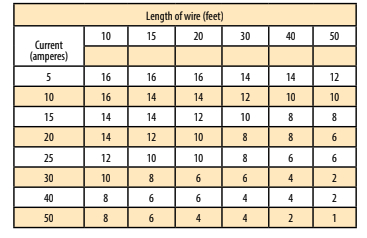
The accompanying table shows the recommend relationships between wire length, amperage, and wire gauge to keep the voltage drop in a 12-volt system less than 3 percent when using AWG wire.
Color coding
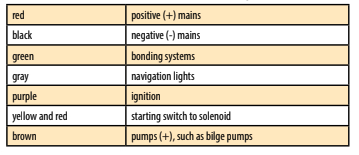
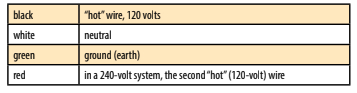
The ABYC specifies standard jacket colors for wires that have different functions. This helps enormously in troubleshooting electrical problems as well as in preventing wiring errors.
Wiring diagrams
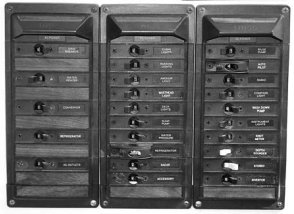
All boats should have wiring diagrams for their low-voltage DC and their AC electrical systems. These should be updated whenever a change or addition is made. The diagrams should show all batteries, switches, fuses, circuit breakers, lights, and appliances, and indicate the colors of the wires that connect them.
Don Launer, a Good Old Boat contributing editor, built his two-masted schooner, Delphinus, from a bare hull. He has held a USCG captain’s license for more than 40 years and has written five books. His 101 articles through November 2011 are available for downloading as a collection from the Good Old Boat download website, www.audioseastories.com. Look under Archive eXtractions.
Thank you to Sailrite Enterprises, Inc., for providing free access to back issues of Good Old Boat through intellectual property rights. Sailrite.com