Making the right connections
Issue 101 : Mar/Apr 2015
For electrical wiring aboard boats to meet recognized standards for safety and reliability, wires should be connected to equipment and other wires by means of terminals attached to their ends. A wire should never be wrapped around a screw on an electrical terminal-board, and wire nuts used for household wiring should never ever be used for connecting wires together on a boat.
Wire terminals aboard boats must be able to survive harsh conditions — salt air, salt water, oil, heat, cold, and vibration — and not all electrical terminals are created equal. When doing a wiring job on your boat, use marine-grade terminals rather than those from the local hardware store.
Crimp-on marine terminal
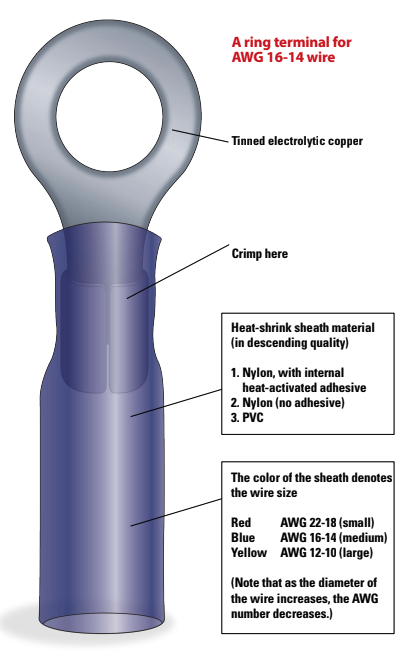
A crimp-on marine terminal is made of electrolytic copper that is tinned to reduce corrosion. Electrolytic copper is highly malleable. This allows the crimping tool to easily compress the terminal’s shank around the wire without fracturing the copper. Terminals come in a huge variety of shapes and sizes, the most common of which are the ring, spade, butt, quick-disconnect, and snap-plug.
The round shank of the terminal where the wire is inserted must match the wire size being used, and the shrink-tubing covering the metal shank of the terminal is color-coded to indicate the wire size for which the terminal is intended (see the illustration at right). The shrink-tubing covers the shank and part of the insulation of the inserted wire, reducing or eliminating the intrusion of substances that might adversely affect the electrical connection. Although PVC is usually used for the shrink-tubing on terminals purchased at a hardware store, PVC tends to become brittle with time and crack, reducing the terminal’s ability to stay dry. For marine terminals, the best covers are nylon sheaths that have a heat-activated adhesive on the inside. These seal the terminal sheath more effectively and also reinforce the bond between the wire and the terminal.
Wire gauge
The diameter of the conductor in a wire determines the wire’s current-carrying capacity. For marine wiring, this diameter is specified using the American Wire Gauge (AWG) system (See “Marine Electrical Wire 101,” July 2014). In this system, the larger the number the smaller the conductor’s diameter, and conversely, the smaller the number the greater the conductor’s diameter. Thus a 16-AWG wire is small, with a conductor diameter of about .06 inch, and a 0-AWG wire has a large conductor diameter, nearly .5 inch, along with a high current-carrying capacity.
Crimping a terminal
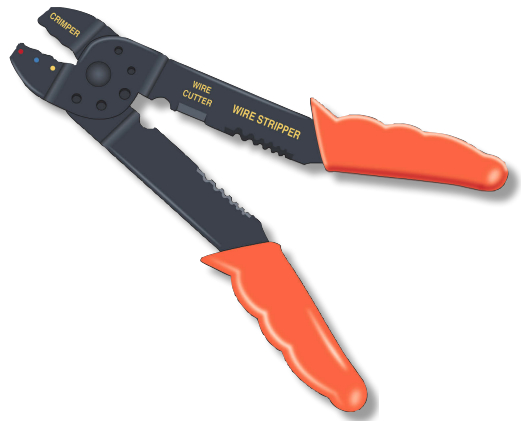
Crimping tools vary tremendously in price. A ratcheting crimper will cost rather more than an inexpensive tool from the local hardware store but will ensure consistent and reliable crimps. The best professional-grade crimpers can cost $1,000 or more.
Before crimping a terminal, strip the insulation off the end of the wire. Most hand-held crimping tools also have wire strippers, so select the wire stripper that matches your AWG wire size. Insert the wire into the terminal’s shank. Then, using the appropriate die in the crimper, position the crimping tool over the shank of the terminal and squeeze the handles. Check each crimp for mechanical and electrical soundness by trying to pull the terminal off the end of the wire. When you have determined the connection is mechanically strong, it’s time to shrink the sheath.
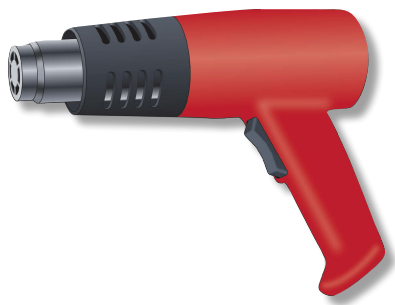
This is most easily done using a heat gun, similar to a hair dryer but hotter and made just for this purpose. As the heat shrinks the tubing, it activates the adhesive on the inside.
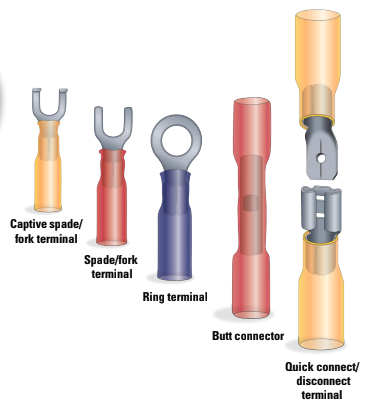
Common crimp-on terminals
The ring terminal provides the most secure connection, since even if the screw holding it becomes loose, the terminal will remain in place.
A spade terminal (also called a fork terminal) is inferior to a ring terminal, as it may slip out if the screw becomes loose.
A captive-spade terminal is a spade or fork terminal that has turned-up tips on the two forks that make it less likely to pull off should the connection screw become loose.
A butt connector is used to join the ends of two or more wires together. Step-down butt connectors are available for connecting wires of different AWG sizes.
Quick-disconnect terminals allow a quick way of connecting or disconnecting equipment. These terminals should be limited to currents of less than 20 amps.
Three- and four-wire connectors are used for joining multiple wires together.
Don Launer, a Good Old Boat contributing editor, built his two-masted schooner, Delphinus, from a bare hull. He has held a USCG captain’s license for more than 40 years and has written five books. His 101 articles through November 2011 are available for downloading as a collection from the Good Old Boat download website, www.audioseastories.com. Look under Archive eXtractions.
Thank you to Sailrite Enterprises, Inc., for providing free access to back issues of Good Old Boat through intellectual property rights. Sailrite.com