Year-round sailing leads to year-round upkeep

Issue 76 : Jan/Feb 2011
When we decided to expand our sailing horizons from northern freshwater “summer boating” to full-time cruising, we didn’t fully realize the impact that would have on vessel maintenance. Up north, we created a to-do list in the fall of every year as part of our haul-out and winterizing routine. When spring came around, we prepared ourselves and our boat for the long-awaited sailing season by going through the to-do and launch lists. This ritual was dictated by the seasons . . . primarily due to winter’s effect on fresh water.
Spring outfitting covered most of our annual maintenance issues: bottom paint, Cutless inspection, zincs, varnish, waxing, winch lubrication, steering (fit and lubrication), engine controls, rigging, engine coolant, pressure-water systems (flush and inspect), remounting sails and canvas, lines, and safety gear. It was also the time when we completed projects we’d planned over the winter while looking forward to the sailing season ahead. As a result — other than perhaps an engine-oil change or dealing with a broken piece of gear — we were set for the summer.
Full-time cruising is a different world. Our boat now remains in salt water for extended periods of time and the exposure has led to increased maintenance. We also use our boat daily, year-round, and we don’t always haul it annually. Once we made this transition, we found we were doing our maintenance on the run rather than by the seasonal clock.
A new bottom
Salt water introduced us to a variety of new critters intent on turning our hull into a reef and slowing our passage. Our first surprise was that our beloved VC 17 bottom paint had to go: it wasn’t formulated for warm southern salt water. We thought we could paint over it, but learned from Interlux that, to ensure a good bond for any new paint, the VC 17 would have to be removed entirely. We tried washing it off with acetone, then lacquer thinner. We quickly realized there were not enough rags in Mobile to accomplish the task. We ended up sanding it off.
Since we’d gone that far, we applied a barrier coat of Interlux 2000 before painting with ablative bottom paint. Over the years, we’ve used hard finishes (Trinidad), water action ablative (Micron CSC), and chemical ablative (Micron 66+), in that order. We discontinued Micron 66+ due to adhesion problems. We are currently using Micron Extra, trying for a two-year finish.
Effects of salt water
Our second surprise was that the running lights virtually never all worked when we needed them. Salt water caused bulb bases and press fittings within the fixtures to corrode, and we usually discovered these failures just before a night crossing. We finally replaced the fixtures with Hella sealed LED units, which was a win-win: the lights are reliable and use less current.
Next on the learning curve was the need to monitor our zinc anodes. A friend’s boat was eating prop-shaft anodes at the rate of two every three months. We were going through a pair a year on our 43-footer (we’d never had to replace them in fresh water). We had both boats tested for stray current. Our vessel was neutral but his wasn’t (yet, after several rounds of testing, they never isolated the reason).
Seacocks required more attention. Even when actuated monthly, one or two tend to become locked and require cleaning and lubrication during our bi-annual haulouts. Another safety issue arose with our lifelines, which have become discolored and corroded at the ends of the white polymer jackets (because the coating deprives the stainless-steel wire of the air contact it needs). I’ve seen this coating become sticky within a year on other boats. Our next set of lifelines will not be covered.
Engine maintenance
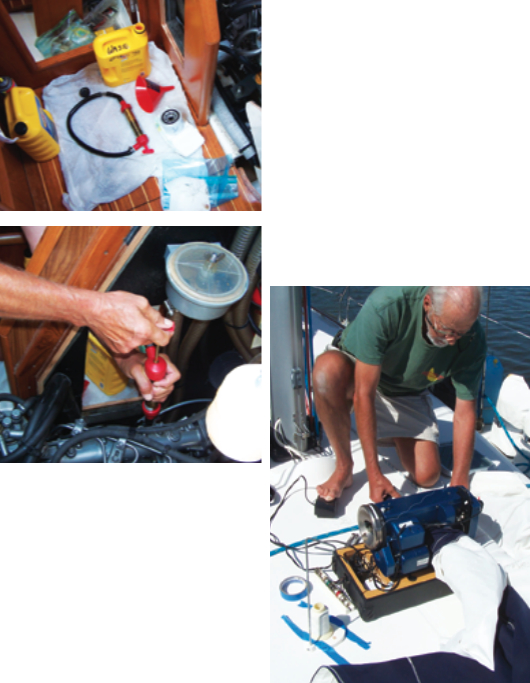
Where oil changes were once part of our autumn routine, our engine’s service schedule is now dictated by the hour meter following the guidelines in the manual for the Yanmar diesel. Every 150 hours, the oil gets changed; every 300 hours, we change the oil and filter. We check engine mounts, belts, and shaft connections when doing the oil change.
Since using the boat full time meant more engine hours, we learned to carry enough oil and filters for two oil changes. There are times I think of our sailboat as a slow trawler with a very tall antenna.
The primary fuel filter that came with the boat was marginal under heavy use, and once caused a loss of power in rough seas. I removed it and installed a Racor filter. We carry multiple cartridges for this unit and for the secondary filter on the engine. We check the Racor’s sediment bowl with each oil change. When we bought our vessel, we installed a PYI Max-Prop and kept the fixed three-bladed propeller as a spare.
We had the Max-Prop rebuilt last year when tip play exceeded 1/4 inch. We have not yet reinstalled it, since the boat must be hauled to do so. With the Max-Prop, we paid a premium in higher fuel consumption compared to the original fixed three-bladed propeller. We sailed faster with this prop, but sailing faster seemed more important when we were on the Great Lakes in that we were traveling with a sister ship and wanted to maximize our weekend cruising range. That said, we still appreciate the additional boat speed as we frequently buddy-boat with longer vessels.
Batteries and electronics
Originally, we had flooded-cell batteries and we checked the fluid level with each oil change. Our first set of batteries lasted less than a season due to an improper installation. Our second set lasted four years (we go through a 50 percent discharge cycle daily). With our current AGMs, I check the post connections for corrosion four times a year. We monitor battery charge and discharge performance with a Link 2000 (I wouldn’t be without it, though I cross check by monitoring voltage). We carry a spare alternator as we consider electrical power to be mission-critical. Additionally, we have solar panels and a wind generator.
Our biggest ongoing headache has been our electronic navigation instruments. Some would say our boat is over- equipped, and they’d be right. We have two chart plotters, an autopilot, a depth sounder, wind-speed instruments, two tridata repeaters, a gyro compass, and a rate-of-turn compass. (I keep a list of models, serial numbers, and software versions on our website for easy reference.) Most of the components work all the time. However, the wind indicator almost never works right and the chart plotters crash frequently. It’s not an obvious wear or corrosion issue — it appears to be a factor of product design and reliability. If we were to do it all over again, we’d go minimalist with a good GPS-linked laptop charting program, a wind vane, and a handheld wind-speed indicator.
Sails, canvas, and rigging
Each year of cruising is roughly equal to four seasons on the lakes. Consequently, preventive maintenance is now part of our daily routine. Every time we hoist our sails, we do a quick inspection for loose stitches or frayed tapes. We carry a Sailrite sewing machine on the boat so we can take a “stitch in time” and thereby prevent most major repairs. We treat the dodger and Bimini the same way. We move zippers and lubricate them monthly with Zippy Cool to prevent corrosion and salt from locking the sliders in place. We also wash the canvas annually and mist it with 303 Fabric Guard to maintain water repellency.
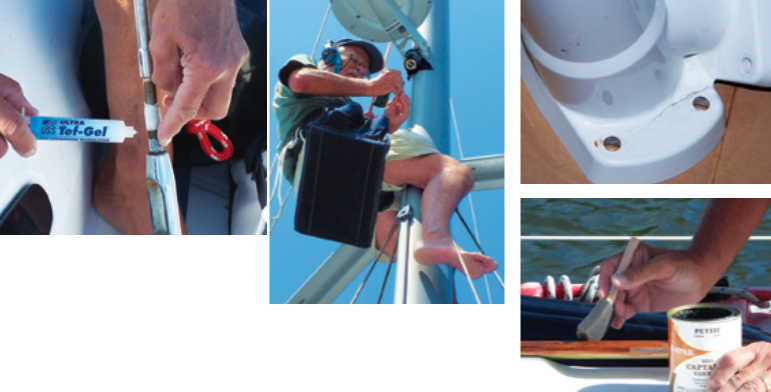
I check the standing rigging during my morning walkabout. Believe me, it’s scary finding a piece of broken cotter pin on the deck. I find myself holding my breath until I find the source and fix the problem. Each time I go aloft, I visually check wire, fittings, and the spreader mounts. I inspect the rigging thoroughly semi-annually, going aloft with a magnifying glass to look for corrosion stains, separated strands, and cracked fittings. I do the same for the mast, boom, vang fittings, and blocks.
We check our running rigging with each use, end-for-ending the lines when exposed portions show chafing or stiffening. We also check our mooring lines with each use and replace them when they become stiff or worn.
Plumbing
The heads in our boat are an ongoing project. We use a pump lubricant to keep them operating smoothly. I rebuild them as needed, replacing foot valves, choker valves, and pumps. My wife jokes that she decided to marry me when I said I did toilets. To her dismay, she later found I really didn’t “do toilets” at home. On the boat, however, I’m regularly tearing them apart, proving her decision to be a wise one after all.
The economics of purchasing parts often leads to replacing the entire units, since it is cheaper and easier. The biggest cause of failure on our Jabsco manual heads is cracking around the base of the pump barrel and at the pump’s mounting flanges.
We’ve replaced our pressure-water pump once, at 12,000 gallons. We don’t do any special water tank cleaning, since we turn over the water in the tanks every two weeks (more than 16,000 gallons so far). We do filter the water into and out of the tanks, mainly to prevent sand from getting into the system.
Brightwork
I believe every proper sailing vessel should have teak — a small piece you can hold in your hand and store in a drawer — something that should be taken out only to impress guests. Unfortunately, our vessel has acres of teak.
Maintenance of our brightwork is an ongoing experiment. So far, we’ve seen the longest life with two coats of West System epoxy (using their 207 hardener) overlaid with three coats of Captain’s varnish. I prefer the deep grain colors and depth of finish this system provides. We renew the surfaces with a scuff sanding and another coat of varnish when they start to dull or scratch.
Maintenance record
We record all maintenance in our vessel maintenance log, noting the work done, the date, and who did it. We also note when this maintenance should be repeated. If work needs to be put off for parts, we keep an active to-do list in a separate section of the log. I record needed parts on my phone (a Palm) so I remember to buy them when I’m in a marine or hardware store.
Our diligence has paid off in the reliability of our vessel. We’ve logged more than 28,000 miles on our “quickly getting to be a good old boat.” Is our system infallible? I guess not. The other day, we realized we’d not changed the lubricant in our dinghy engine’s lower unit in three years — something that was on our autumn haul-out checklist in years past. Whoops! Where did the time go?
Barry Hammerberg has owned and worked on boats for more than 50 years. He was trained as an engineer and gained a solid understanding of boats and equipment through careers in production fiberglass molding, vacuum-bagged and cold-molded custom boats, and machinery design and construction. For the past four years Barry, mate Ruth, and their parrot have been living on their 43-foot Jeanneau, Another Adventure, following the warm seasons along the East Coast from the Bahamas to Nova Scotia.
Thank you to Sailrite Enterprises, Inc., for providing free access to back issues of Good Old Boat through intellectual property rights. Sailrite.com