A Raised-Saloon Cruiser for Two
Issue 131: March/April 2020
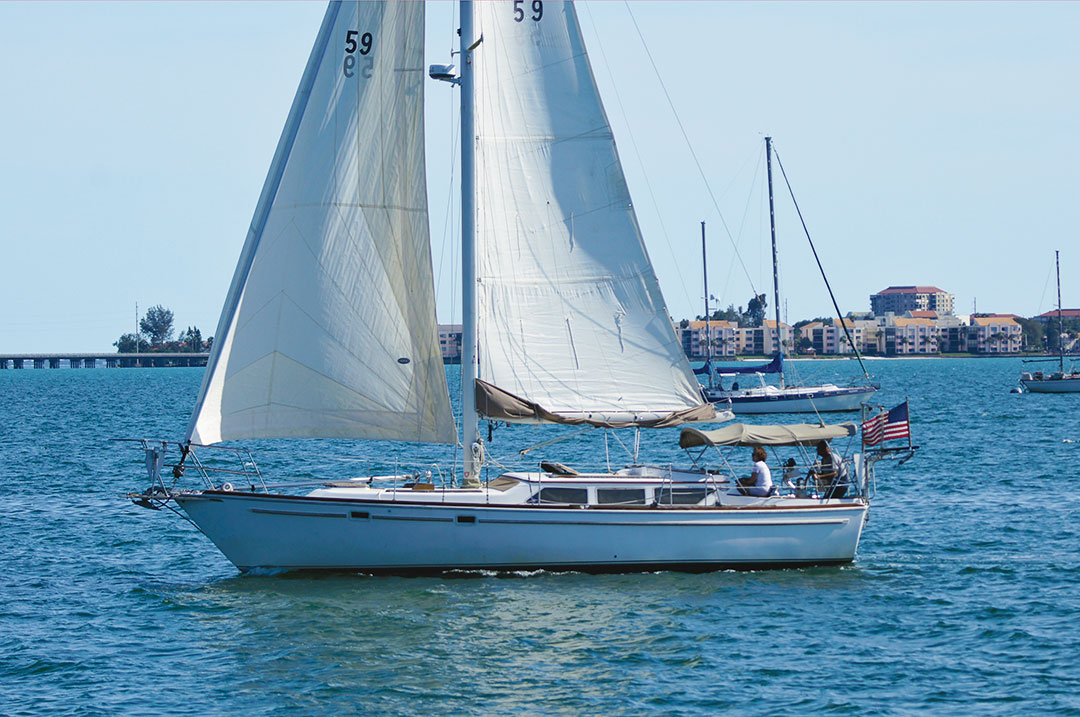
For 14 years, Rosie and Carl Anderson sailed their Bombay Clipper 31 throughout the coastal waters of western Florida. But after an extended trip from Florida to Maine and back, their cruising dreams grew. To fulfill them, they realized they needed a larger boat, one designed with a cruising couple in mind. They chose a Gulfstar 39 Sailmaster, naming her The Glass Slipper, with an eye toward the boat’s unusual, innovative interior layout and easy sailhandling.
History
After leaving Columbia Yachts, Vince Lazzara spent the next several years of his non-compete agreement building fiberglass houseboats under the company name of Sea Rover. Once the agreement expired, he sold Sea Rover and established Gulfstar Yachts in the Tampa Bay area. His initial offerings were low-priced, lower-quality boats. This changed after contracting Ted Hood to design a number of models. Quality improved dramatically, and the product line expanded to include motorsailers. In the mid-1980s, Vince’s sons, Richard and Brad, joined the company. Though they tended to gravitate toward powerboats, Richard taught himself yacht design and drew the lines of the 39 Sailmaster. Over a production run from 1981 to 1984, the company produced 60 hulls; The Glass Slipper is hull 59. Around 1987, Gulfstar ceased production of sailboats and merged with Viking Yachts, a powerboat manufacturer.
Design and Construction
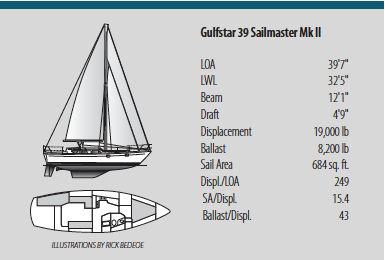
The most noticeable feature of the Gulfstar 39 Sailmaster’s distinguished profile is its raised saloon. The boat’s bow is sharp, the transom almost plumb, and its sheer very flat. Overall, the lines are clean and sleek. The interior is sometimes referred to as a single-stateroom design or a galley-forward design. Both descriptions are accurate and somewhat unusual for a beamy 39-footer.
Gulfstar built the 39 Sailmaster in two versions. The Mark I has a deep cockpit locker on the port side and a spirits locker on the starboard side, just aft of the head compartment. The Mark II replaced the port-side deep locker with a shallow locker and a quarter berth below and swapped the spirits locker for a hanging locker.
Construction of the Gulfstar 39 Sailmaster is strong and of high quality. The deck and hull are fiberglass and polyester laminates. The deck and topsides are cored with end-grain balsa, adding stiffness while reducing weight. Below the waterline, the hull is solid fiberglass. (Many boats built in the 1980s experienced blisters, and Gulfstars were not immune. It’s wise to carefully check this when buying one.)
On deck, the non-skid is molded-in, and all exterior wood—including eyebrows, handrails, toerails, companionway doors, and cockpit coaming tops—are solid teak. The hull-to-deck joint is an overlapping design commonly known as a shoebox joint.
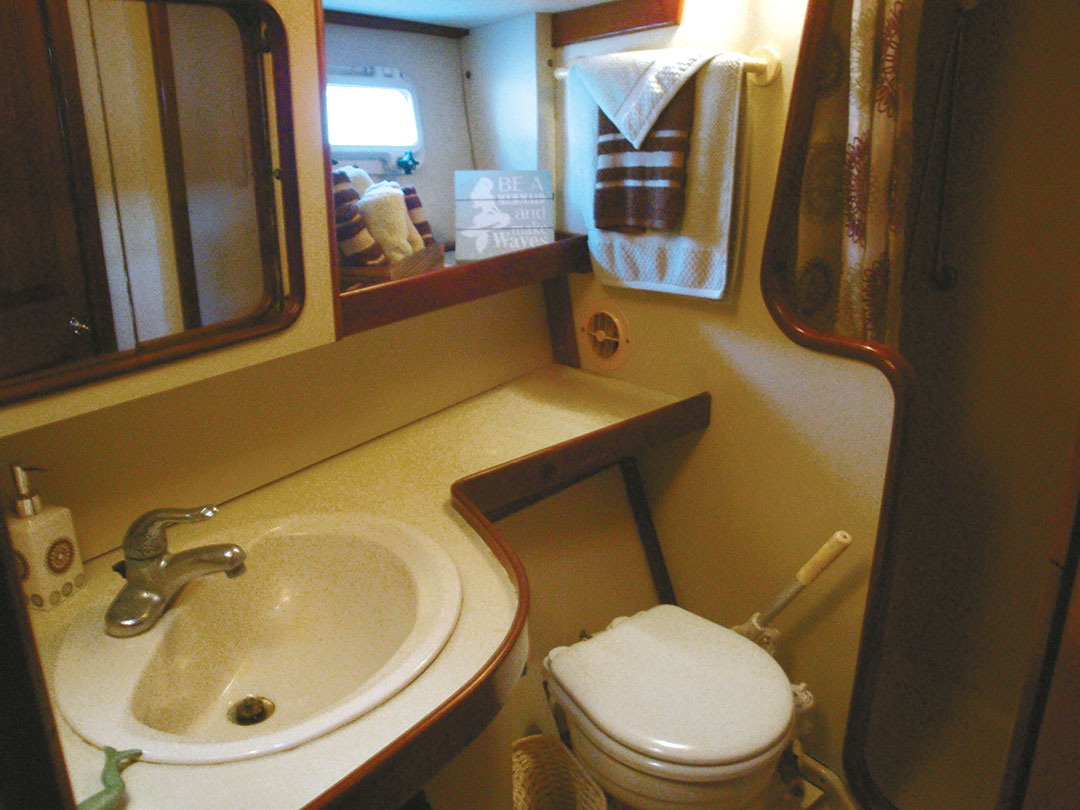
The interior is stick-built and utilizes a longitudinal stringer system. The bulk of the interior is marine-grade plywood veneered with teak and finished with gloss varnish. Areas not finished in teak are paneled with an off-white laminate. The overhead is off-white vinyl, the sole is teak and holly, and the doors are raised panels of solid teak.
Joinery rivals that of the most expensive yachts. Gulfstar even held a patent for a special process for cambering the corners on interior woodwork.
Hardware is above average quality. All ports and hatches are aluminum, seacocks are bronze, and the ballast is lead and encapsulated.
On Deck
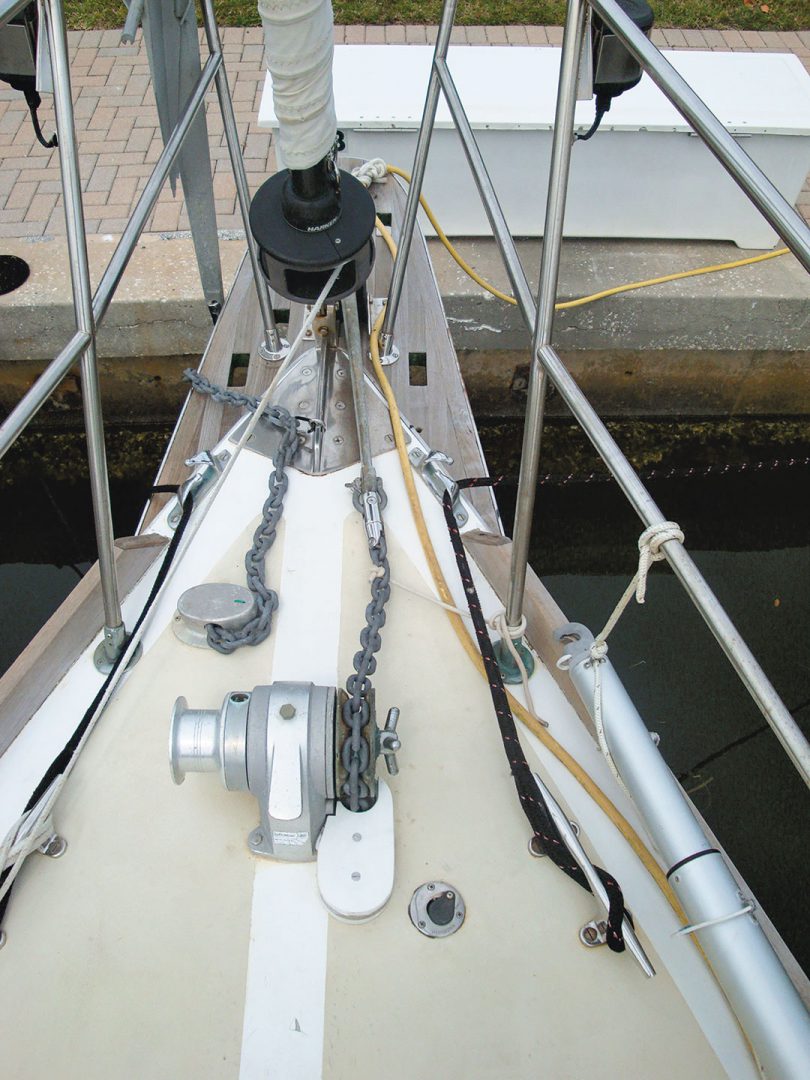
Beginning at the stem is a teak anchor platform followed by a pair of 12-inch open-throat cleats, chocks, and a windlass. The open foredeck allows a pragmatic, uncluttered working platform for sail changes, anchoring, and mooring. There’s even enough room here to stow a dinghy.
Just aft of the cabin trunk’s rise is a 24 x 24-inch centerline hatch. Following aft are port and starboard 63-inch teak handrails. Next is a pair of stainless steel cowl vents mounted on top of teak Dorade boxes. In the topsides below this area are four opening portlights, two per side. Just before the doghouse over the raised saloon is the keel-stepped mast.
On top of the raised saloon’s doghouse is a pair of 12 x 17-inch hatches, twin 76-inch teak handrails, the mainsheet traveler, and a sea hood over the companionway. The doghouse is fitted with six large, fixed portlights, three per side, plus a pair of large forward-facing fixed portlights.
For security, stainless steel bow and stern pulpits are connected by dual lifelines. The sidedecks are 18 inches wide and rimmed with a 3-inch-high teak toerail. Port and starboard 10-inch, open-throat cleats are mounted amidships. To protect the topsides, 8 inches below the deck is a teak rubrail capped with a stainless steel strip.
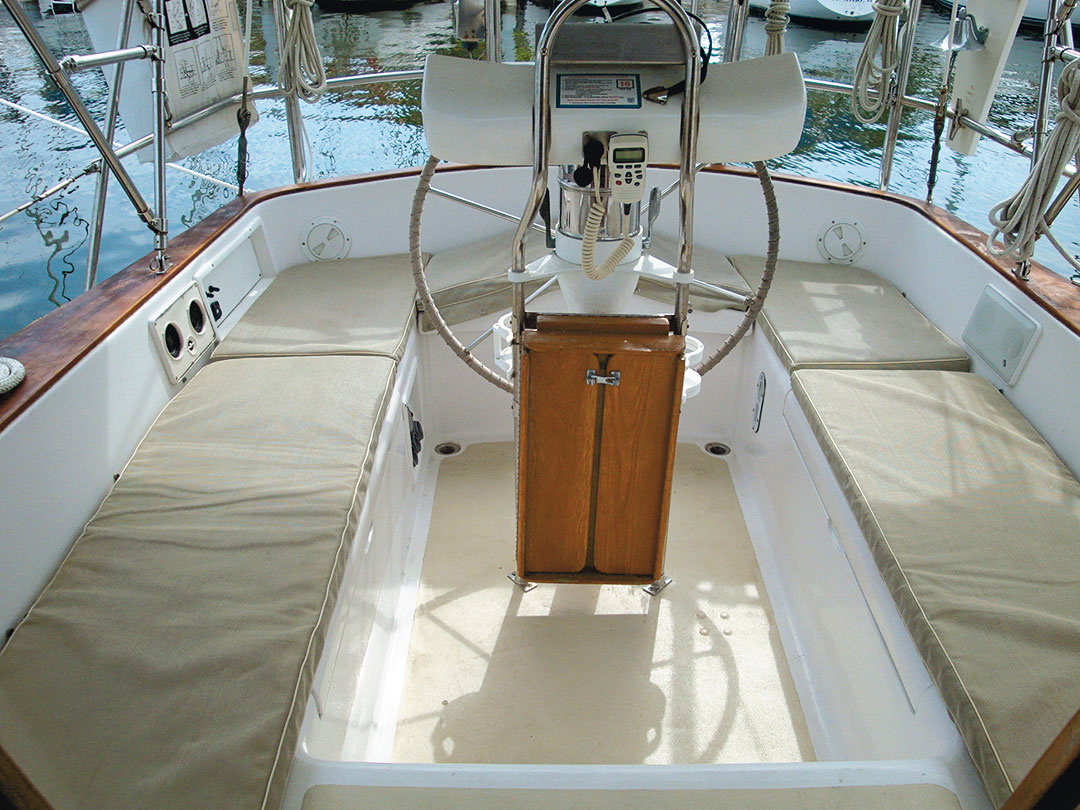
The roomy cockpit is 7 feet long with slightly sloping coamings and a 3-foot-wide footwell. A 16-inch-deep by 16-inch-high bridge deck deflects most water coming over the deck, and four 2-inch drains, one in each corner of the footwell, disperse any water that does make it into the cockpit. Stowage consists of a dedicated propane locker beneath the helmsman’s seat and a pair of cockpit seat lockers. With a quarter berth beneath (on the Mark II), the port locker is shallow. The deep starboard locker affords access to the boat’s batteries and engine. In addition to the helm pedestal, there’s a centerline swim ladder and a pair of 10-inch cleats.
Below Deck
While the Gulfstar 39 Sailmaster’s interior at first seems typical, once below its novel arrangement becomes quite apparent. The boat’s forward sections—V-berth, head, and galley—are lower than the main saloon. The forward galley is unusual, and the raised saloon, coupled with large side- and forward-facing windows, makes for a light and spacious-feeling interior.
According to Carl, the boat features several factory options, to which he recently added $25,000 in interior and system upgrades, including new refrigeration, air conditioning, battery charger, starter, batteries, and refinishing all the interior woodwork.
Just aft of the divided chain locker in the forepeak is a roomy V-berth, 7 feet long and 61⁄2 feet at its widest. Outboard and above are fiddled shelves. Aft and to port, a his-and-hers hanging locker is topped with a bureau, and to starboard is a complementing four-drawer chest with bureau top. The 30-gallon plastic holding tank, plus three stowage drawers, are beneath the berth. Port and starboard opening portlights, the large overhead hatch, and a Dorade vent provide natural light and ventilation. From this stateroom, one door leads to the head compartment and another opens to the remainder of the interior.
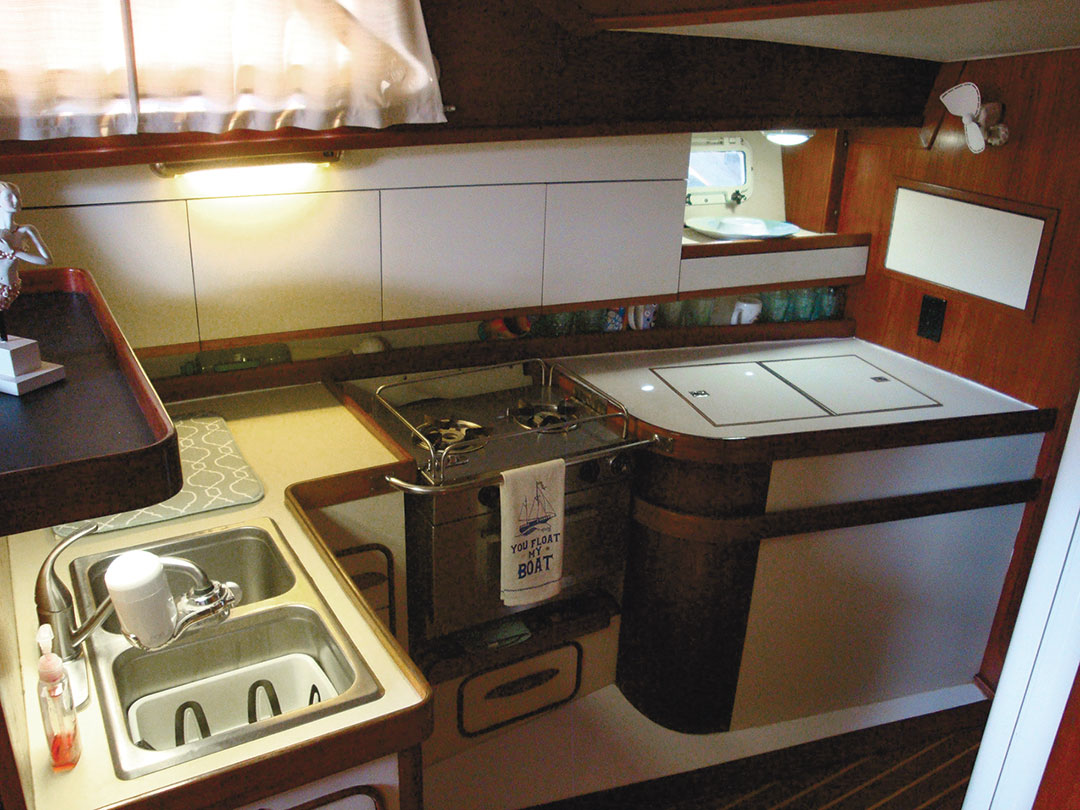
Just aft and to starboard is the head compartment whose most notable feature is a one-piece fiberglass shower stall with integrated seat.
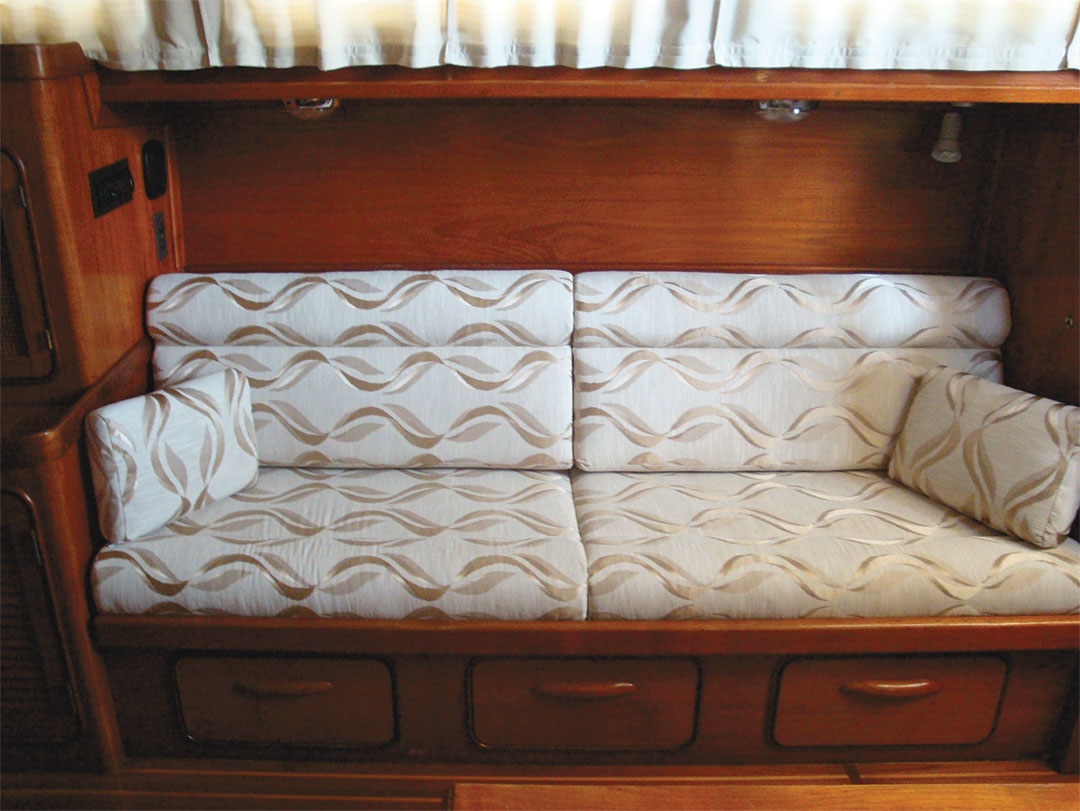
Aft to port, basically across from the head, is the roomy galley, which includes a deep, double, stainless steel sink, a top-loading icebox, and a pass-over counter that lets the chef hand food and drink directly to those in the saloon.
On The Glass Slipper, the outboard cabinets are a custom factory option. Stowage is abundant in numerous shelves, drawers, and cubbies, and a clever in-the-sole compartment sits in the step-up to the saloon. At waist height there’s a novel grab rail/towel rack. A single opening portlight serves this area.
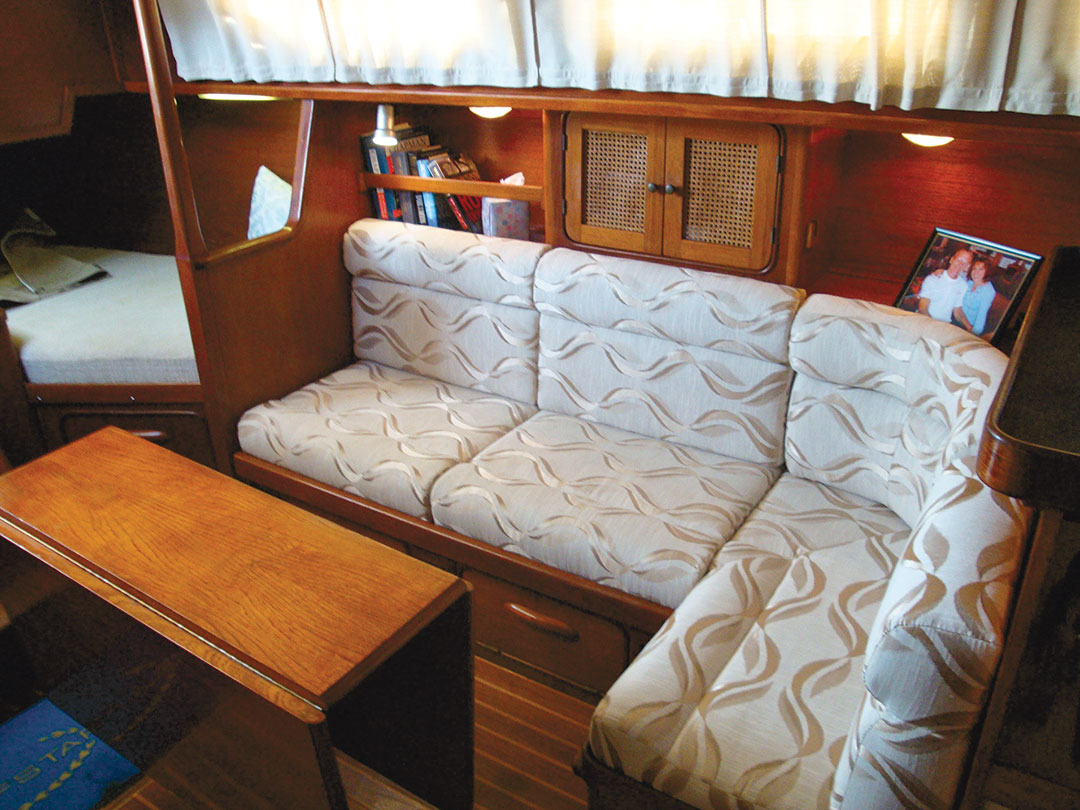
The main portion of the saloon is comprised of an L-shaped settee/berth to port and a straight settee/berth to starboard. Both settees measure 61⁄2 feet and can be converted to cozy doubles. Both have stowage beneath and behind as well as bookshelves above. In addition to the shelves above the port settee there’s also a cane-fronted cabinet.
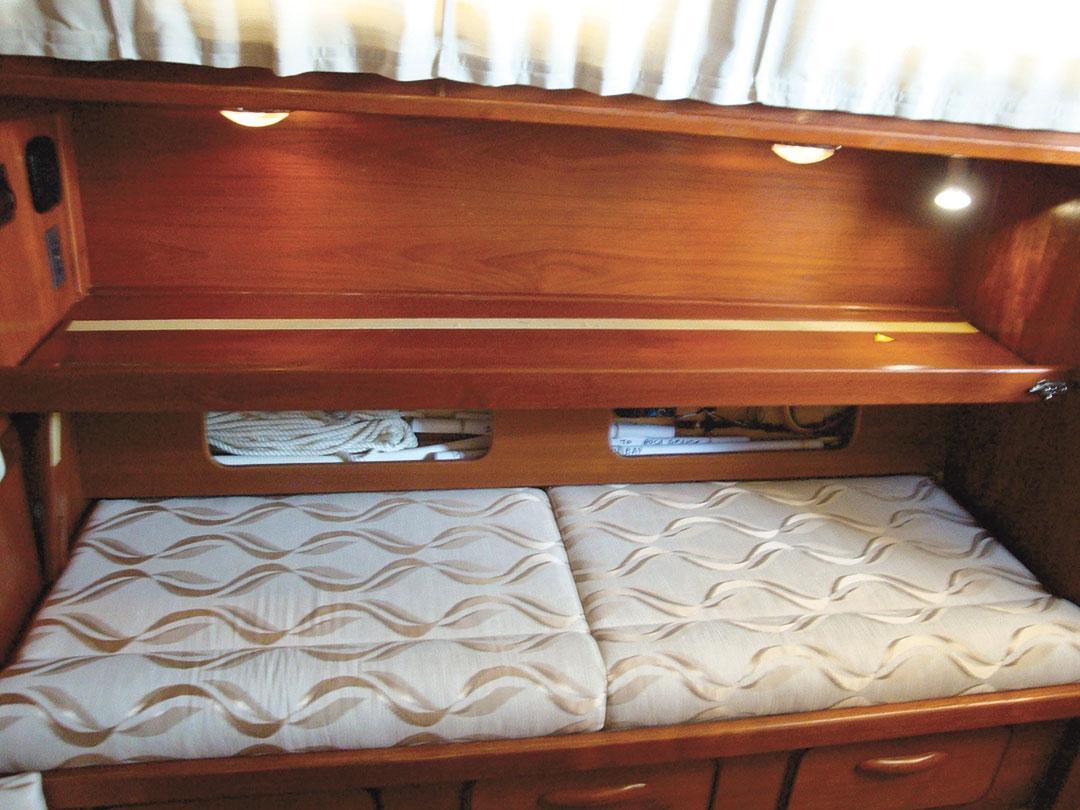
The eight large, fixed portlights and two overhead hatches create a bright and airy cabin. However, leaking in these portlights is one of the most common complaints among this design’s owners. It’s recommended to rebed them before leaks damage the interior teak.
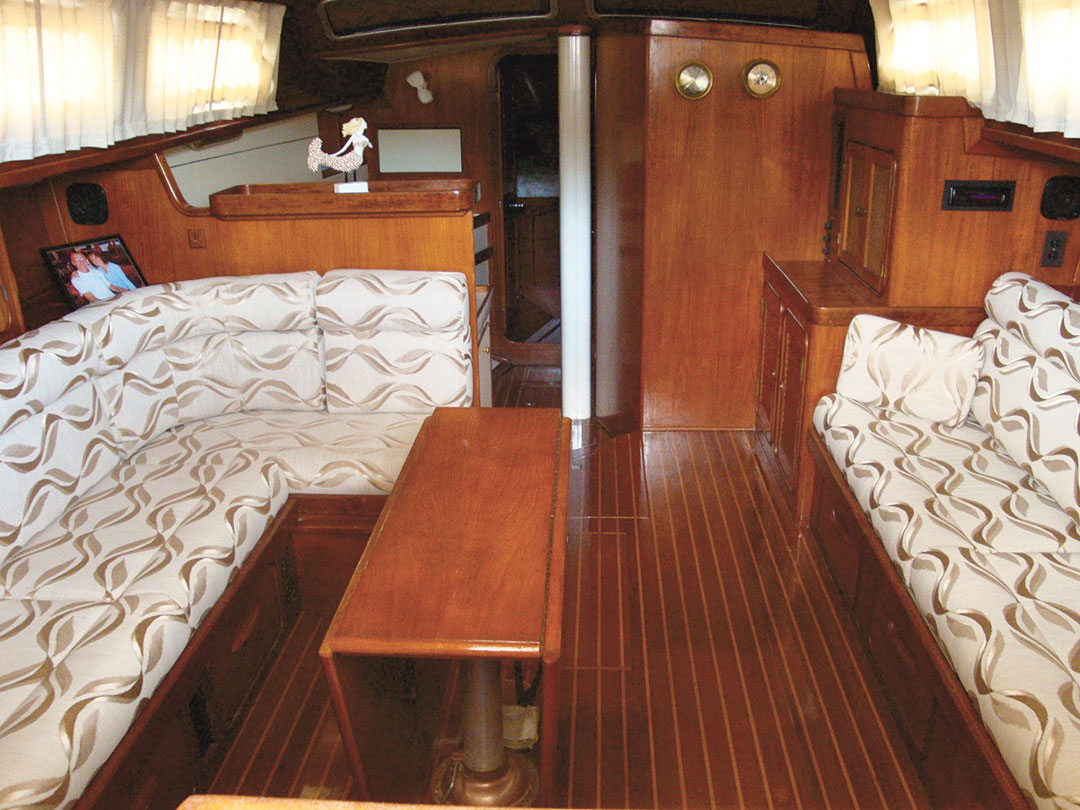
Numerous LED lights, both task and accent, provide illumination throughout the boat.
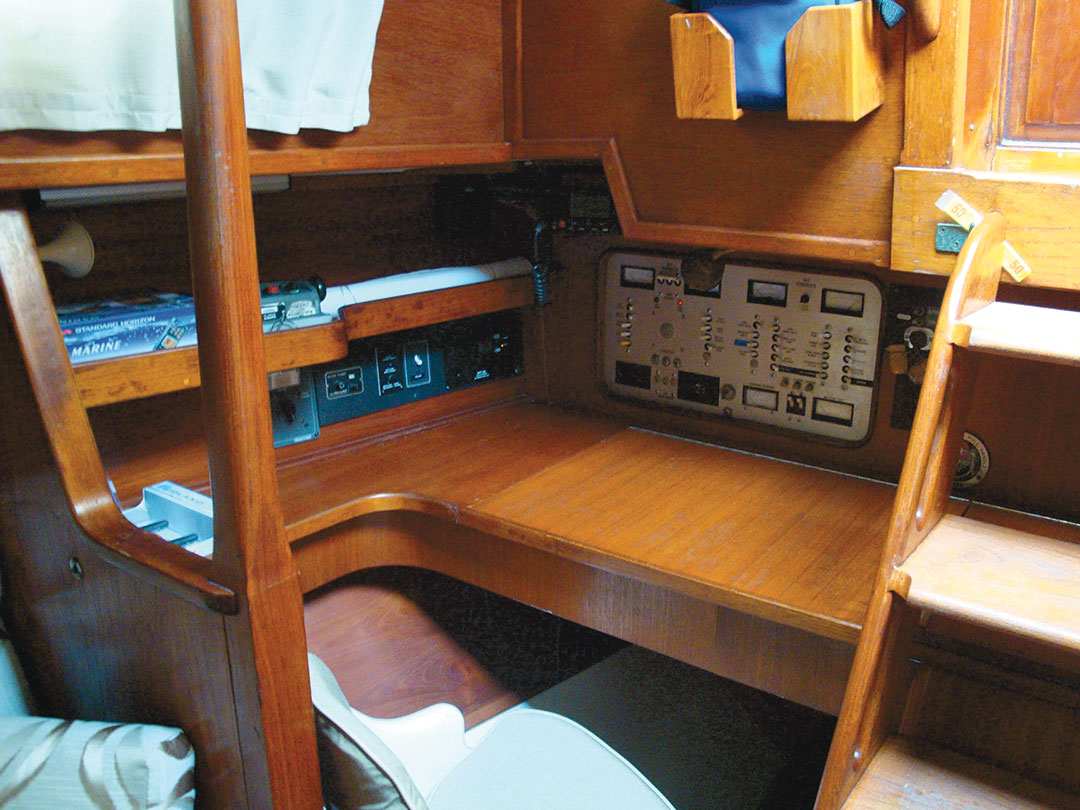
On the port side of the Mark II, across from the nav station to starboard, is a quarter berth. Beneath is stowage as well as the water heater. Access to the engine can be gained here by removing an inside panel.
Six individual panels in the sole provide access to various bilge features, including the 80-gallon aluminum fuel tank and the 150-gallon plastic water tank, located above the ballast.
Rig
The Gulfstar 39 Sailmaster’s rig is simple and straightforward. The keel-stepped mast, with outboard chainplates and boom, are aluminum extrusions painted white with polyurethane. The single pair of spreaders is tapered, and all standing rigging is stainless steel wire. Supporting the mast are a pair of cap shrouds, dual pair of lowers, and a split backstay. There’s also a topping lift.
All running rigging is double-braid polyester line. The halyards are sheaved internally and terminate at a pair of Barient #21 winches and horn cleats mounted on the mast. The mainsail is sheeted mid-boom and leads through a traveler situated forward of the companionway, terminating at a Barient #21 winch and cleat. On the underside of the boom, just aft of the gooseneck, is a single Barient #8P and a pair of line stoppers for two reefing lines.
The headsail sheets are led aft through cars and 12-foot tracks mounted on top of the toerails. These sheets terminate at Barient #28 winches on the cockpit coamings. Mounted onto the starboard track is a stainless steel folding boarding ladder.
Underway
The boat has a long fin keel, which affords the kind of tracking and stability commonly attributed to a full keel but without as much drag-inducing wetted surface area. Its rudder skeg provides excellent directional stability and keeps the rudder from stalling at extreme angles.
The outboard chainplates affect the boat’s upwind abilities by limiting sheeting angles, but this boat is designed for cruising first and foremost, not necessarily performance to weather. It can carry its full complement of sails up to about 20 knots or so before calling for a reef. The boat’s best point of sail is a reach, and the helm balances well.
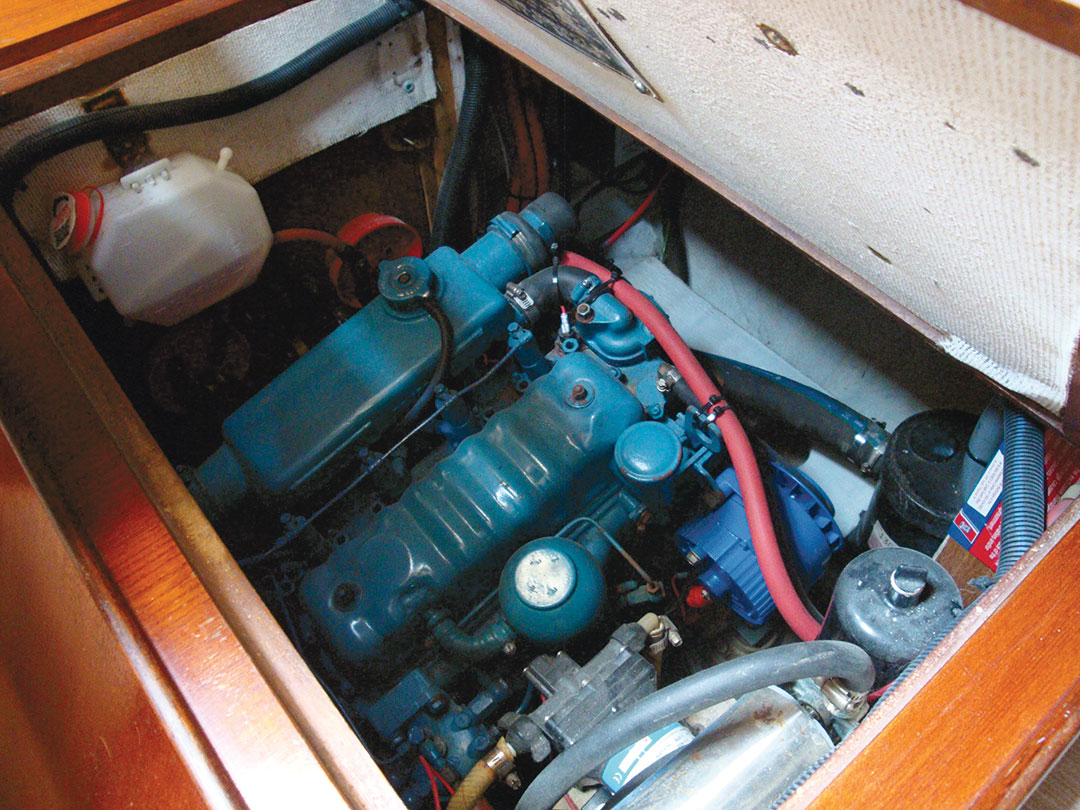
The boat’s auxiliary is a 50-horsepower Perkins 4-108 diesel with a Velvet Drive transmission connected to its propeller via a V-drive. This drive train is more than adequate to punch through a tough sea.
The Glass Slipper suffered from leaking at the rudder shaft seal. The fiberglass housing around the shaft is too short, and depending upon angle of heel, this design mistake allows water to enter the boat. Carl heightened the housing and eliminated the leak.
Conclusion
The Gulfstream 39 Sailmaster is a unique and comfortable sailboat that can be sailed or comfortably cruised by two people. She’s well built, well laid-out, wonderfully appointed, and sails well. Her styling is not dated, and with 60 hulls built, there’s a good chance that a couple are on the market at any given time. Expect to pay $50,000-$80,000 for a good one.
Gregg Nestor is a contributing editor with Good Old Boat. He has authored four books on sailing: Twenty Affordable Sailboats to Take You Anywhere, Twenty Comfortable Sailboats to Take You Cruising, The Trailer Sailer Owner’s Manual, and All Hands on Deck. He became a snowbird a few years back, after relocating his boat from the Great Lakes to Florida.
Thank you to Sailrite Enterprises, Inc., for providing free access to back issues of Good Old Boat through intellectual property rights. Sailrite.com