A boat specially suited to Florida’s shallow waters
Issue 36 : May/Jun 2004
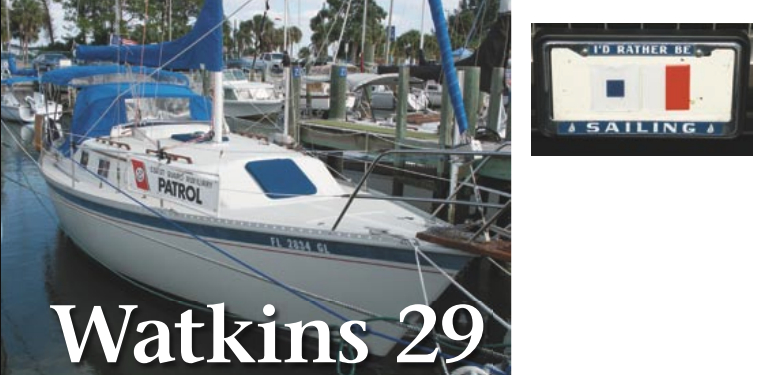
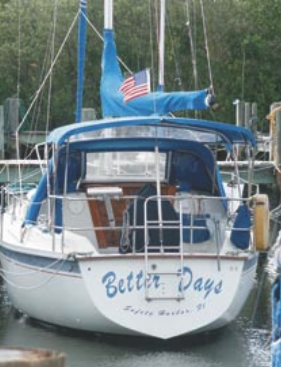
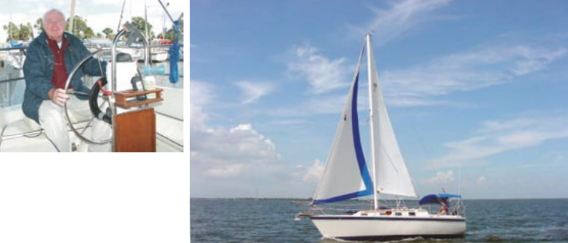
Frank Fitzhenry, of Clearwater, Florida, owns a sailboat on the west coast of Florida that is an official U.S. Coast Guard Operational Vessel. When Better Days, his Watkins 29, is at anchor, Frank flies the flag denoting the sloop is a Coast Guard asset. When under way, he raises the Coast Guard Auxiliary flag.
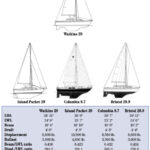
As a Coast Guard Auxiliary boating safety instructor, Frank uses his 1985 sloop when training students in aids to navigation, towing, knot-work, and similar topics. “We don’t do search-and-rescue with Better Days,” he says, noting his 29-foot, 4-ton sloop with 10-foot 4-inch beam, 4-foot draft, and almost-full keel resembles a “fat manatee,” the large, slow-moving “sea cow” found in Florida waters.
Frank bought his Watkins 29, hull No. 40, because of its capacious interior, 6-foot 3-inch headroom, and ample stowage. “And Better Days is the biggest boat whose mast would fit under the bridges across Old Tampa Bay.
“My boat’s not fancy,” he says, “but it more than serves my needs. What’s important to me is to be able to sail, to get out on the water. I don‘t race, and I don’t expect Better Days to sail like a Hunter or Catalina. I’d prefer this boat any day if I’m out in 6-foot seas. A sailboat is better than a powerboat in serious weather because you can button up a sailboat. And a powerboat without power is dangerous.”
Leaking ports
His only complaint: some portlight seals leak, and fixing them is more expensive than installing new portlights.
The Fitzhenrys live a mile from well-protected Safety Harbor Marina where they keep Better Days. “My boat’s convenient and easy to sail, so I use it two or three times a week. My friends with boats on trailers or dry-docked don’t use theirs as often.
“I can grab a sandwich and be on open water (Old Tampa Bay) in 10 minutes. Even a 40-minute sail on the bay is worth it,” he adds. Frank and his wife, Pattie, often daysail or take sunset cruises, “enjoying each other’s company away from phones and hassles.”
Though they seldom, if ever, sail on the Gulf of Mexico (a two-hour sail away), they frequently sail four hours to St. Petersburg with other members of the Safety Harbor Boat Club. “All the boats stay at the municipal marina or anchor out, then we walk to the movie theater, shops, and restaurants.”
Occasionally they and friends. will take a long weekend and make a similar cruise to Sarasota/Bradenton. “When we get home we’re not whipped, like you are after three or four days at sea,” Frank says.
Frank began sailing at 17 in an International 14 — which he recalls as “not a beer-and-date boat. You’re either working or in the water.” He later owned a Hunter, a Catalina, and a series of powerboats.
Shallow sailing
When Frank retired from a career building TV broadcasting stations, he and Pattie moved to Safety Harbor. He sought a boat suitable for the shallow local waters, where boaters are married to the tide tables in winter. (North winds blow the water out of Old Tampa Bay, which can cause problems at low tide.) On the bay, winds are usually moderate, he says. “But when fronts come through, conditions deteriorate and sort out the men from the boys.”
After buying Better Days in Stuart, Florida, Frank sailed her across Florida through Lake Okeechobee to Fort Myers, up the Gulf Intracoastal Waterway, then outside to Safety Harbor.
“What a trip on the Gulf Intracoastal Waterway,” he recalls. “Once we had two 30-plus-foot powerboats coming at us from the bow and two from the stern. All passed us within two minutes. We rocked like crazy and almost went up on the shore from the wakes. But outside [in the Gulf] we had steady 10-knot winds from the east, and we easily cruised on up to Safety Harbor.”
At the time Frank was thinking of getting a captain’s license, so he joined nearby Dunedin’s Coast Guard Auxiliary Flotilla. “I liked the members. . . older gentlemen like myself,” he says. Meetings and socializing led Frank to take classes, teach boating safety, and serve as communications services and communications maintenance officer. He also founded the Safety Harbor Boat Club.
No need now
“I don’t need a captain’s license now,” he says. “I’m not a title person, and I’m not going to ferry people or bring boats across the Gulf. Several friends with licenses call me to crew on three- or four-day trips. Sometimes I’ll go, sometimes not.”
When he bought Better Days, Frank considered the boat to be in good condition, including her original main, new 150-percent genoa, original upholstery, refinished teak interior bulkheads, watermaker, GPS interfaced with digital select radio, and rebuilt Yanmar diesel engine.
Nevertheless he rewired and upgraded the electrical system, changing all interior lights, adding an outlet in the cockpit, and installing new individual circuit breakers, each with an indicator light. “Now the electrical system is idiot-proof. If the indicator lights are off, the power’s off,” he says.
He also added a 300-watt inverter on each battery, so he can use 110-volt power under way and generate 600 watts for his Christmas lights. Solar panels top off the batteries.
“There are always little things to do aboard,” Frank says. He’s added creature comforts: a stereo system with CD player, new faucets, a shower with a teak base, a cutting board over the sink, a well-insulated refrigerator, a solar fan in each Plexiglas hatch cover, and a battery-operated fluorescent light mounted on the main cabin ceiling that can be taken into the cockpit or on deck.
Cabin arrangement
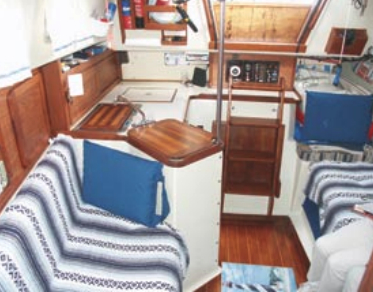
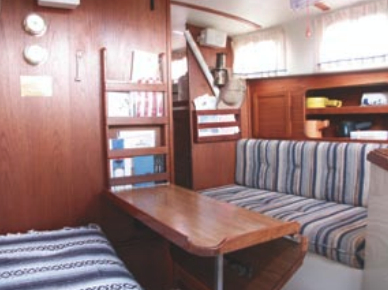
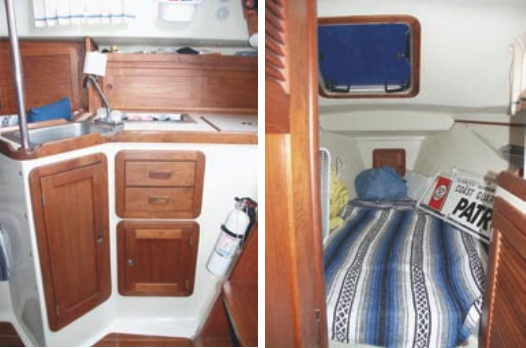
The main cabin has the instrument panel under the companionway, a quarter berth to port, a galley with a two-burner stove, a sink and a refrigerator to starboard, a central folding teak table, and port and starboard settee/bunks with shelves outboard. The enclosed head is forward to port, opposite a hanging locker to starboard. Fans in the forward hatch and two windows ventilate the V-berth in the bow.
A Bimini covers the cockpit, and Frank has applied indoor-outdoor carpeting over the plastic hatches to prevent their deterioration from UV rays.
On deck all lines, marked for foolproof handling, lead to the cockpit.
When maneuvering, “Pattie’s on the bow and looks back for my hand signals,” Frank says. “We hardly ever speak . . . only if things go wrong. And then we never raise our voices.
“Some men are Dr. Jekyll and Mr. Hyde when they sail with their wives,” he says. “What’s there to yell about? Louder doesn’t make it better.”
His advice to novice boaters is: “Take a boating safety class. It’s really amazing what people do — no background, no life jackets, no knowledge, no equipment. Then they find themselves in 6-foot seas in trouble.”
“This boat is perfect if all you want is to be on the water with the wind in your face,” he says. “Keep it simple, no muss, no fuss.”
Better Days is aptly named. “When I’m grouchy, Pattie tells me, ‘Go sailing, you need an attitude adjustment,’ and she’s right. I’m always up after I’ve been sailing. Even my kids know to ask for something after I’ve had a great sail.”
Thank you to Sailrite Enterprises, Inc., for providing free access to back issues of Good Old Boat through intellectual property rights. Sailrite.com