A very determined sailor labors to renovate a 66-year-old Alden woodie
Issue 36 : May/Jun 2004
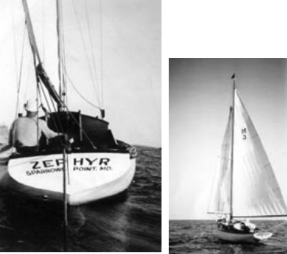
When I went for a sail last August on Zephyr, my 1938 Malabar Jr., designed by John Alden, it was so much more than a typical day on the water. It was the culmination of a dream set in motion three years earlier and a reminder to be careful what you dream for.
Sailing a classic wooden yacht along New England’s coastline is a romantic notion: sun glistening off varnished mahogany hatches, the dance of spray on canvas decks, accolades received from admirers in quaint ports . . . it’s easy to fall in love with a dream. But there is a dark side. Old boats require much attention, quickly fall into a state of disrepair, and can hide a plethora of problems. Despite these negatives, and fueled by a healthy dose of naive optimism, I decided I wanted to take on the restoration of a classic wooden sailboat.
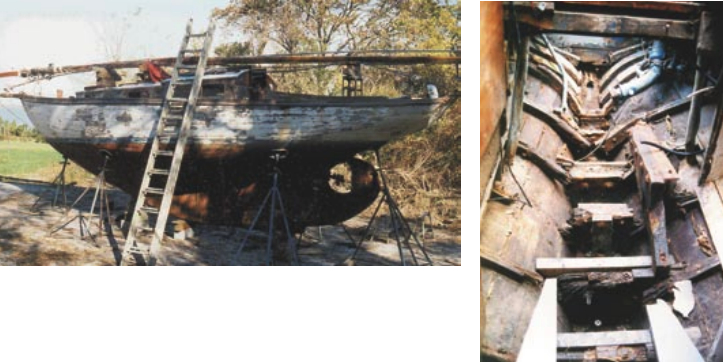
I found Zephyr listed for sale on the Internet for $5,000. She had been out of the water for two years in Mamaroneck, New York. After my cursory inspections revealed that she was indeed a “project boat,” I signed a contract to pay $2,000 within six months. I then had her moved to my house. While writing the check to the boat hauler, I thought, “Well she’s mine now . . . for good or for bad.” One week later the nephew of her owner called me with the news that the owner had died, and it was his wish that the boat be mine for free. I was moved that Don, who had owned Zephyr for 56 years, considered me such a worthy successor. I made a promise to myself that no matter what was wrong with the boat, I would get her sailing again.
Looking for rot
My first task was removing the interior of the boat to inspect for rot. What I found wasn’t pretty. Most of the oak frame heels were rotten or split in the bilge. The floor timbers were in tough shape as well, but the planking looked good. The Gray Marine engine didn’t turn over, the canvas deck had been painted so many times it was cracking and peeling, the mast had a broken spreader, and the list went on. It was hard to know where to start. There was so much to do, and I didn’t really have a plan. That first winter all I did was refinish some of the trim. I was clearly intimidated by the project and avoiding the major structural issues.
From the original construction contract that came with the boat, I learned Zephyr was built in the winter of 1938-39 in South Bristol, Maine. She was framed with white oak and planked with Philippine mahogany in the caravel style of construction. Through research on Internet forums like http://www.woodenboat.com, I found Zephyr’s rot problems were common. I bought the recommended books and learned about my options.
To fully restore the boat as she was originally built would require replacing all defective material with identical new pieces (no epoxy or other modern miracles). This type of museum-quality restoration was beyond my skills and finances. But a renovation would allow me to use modern methods and materials to give strength back to the hull. I opted for a repair/renovation job.
Over the course of about eight months I cut, fit, and sistered 18 frame ends and nine floor timbers into the bilge. I used white oak with heavy bronze fasteners. It was a real joy to see and smell fresh sawdust in the boat. The new timbers shone brightly in contrast to the older, darker wood. Some sections of the planking needed replacing, and I installed a few new butt blocks. Things were looking good now. My carpentry was rough in places, but it was strong.
Canvas decks
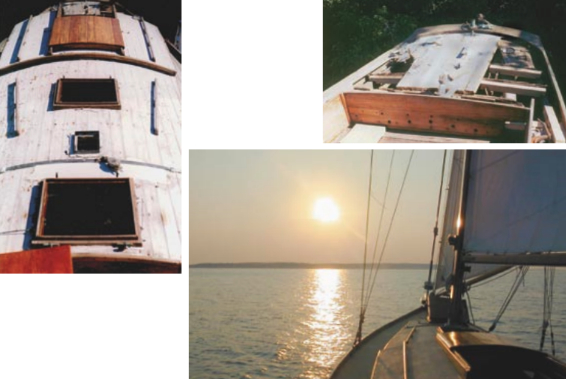
As fall of the first year approached, I turned my attention to the deck. Zephyr had, as original, canvas decks over pine tongue-and-groove planking. As I pulled up the old canvas, I was surprised to see it was still very strong. No rot. The planking underneath was also in very good shape. The canvas appeared to be bedded in white lead paste. I decided to duplicate this procedure with the new canvas. After removing the old canvas and tacks, I laid thick roofing paper on the deck, coated it with the lead paste, and then stretched and stapled the canvas over the paste. To size the canvas, I rubbed it with a hot chamois, which drew it tight as a drum. Then I painted it with an oil-based paint.
With the deck now completed, the aesthetically pleasing Alden lines became more visible. The graceful compound curves that make up the stern, the sweeping stem and sheer, and the arched cabin roof are design elements not commonly found on modern production boats. I loved the idea of preserving an important aspect of marine design history. The drive of consumer demand and evolution of modern materials have placed an ideological wall between old and new boats. I couldn’t help but wonder, will today’s new boats be appreciated in 60 years as much as I appreciate Zephyr now?
Over the winter of the second year, I set up an electric heater inside the boat and worked on refinishing and reassembling the interior. Piled high in my garage were about 20 odd-shaped mahogany boards that somehow, when reassembled, would become settees, drawers, and doors. As I looked at the pile, I hoped my labeling and visual documentation were comprehensive enough to lead me back to a finished interior. Over the course of about six weeks, I stripped all the interior wood, sanded it with 80- and 120-grit papers, and put on two coats of primer and three coats of finish paint. It looked great. It was magical to see these odd shapes of wood find their places in the curved hull, forming seatbacks, bunks, and drawers. I realized my skills in repairing this boat paled in comparison to the skills needed to design and construct her.
Dreaded engine
With only one major obstacle left, I turned my attention to the belly of the beast: the dreaded engine. The Gray Marine sure didn’t look very good. The debate whether to rebuild or buy new was decided when I found a used Yanmar 3GMD on the Internet for $1,000 . . . less than it would cost to rebuild. I had the motor shipped from Florida, and it sat in my garage until I figured out how to install it. The whole trick is to get the motor’s driveshaft coupling exactly lined up with the existing shaft coupling. I built a three-dimensional template of the motor and suspended it from a wire running directly in the center of the shaft log. From this I made cardboard templates of the engine beds. Out of large oak timbers, I cut and installed the engine beds. I bolted and epoxied them in place and hired a guy with a backhoe to drop the new motor in. The four rubber engine mounts allowed me to fine-tune its position. I had a new driveshaft made up and reinstalled the stuffing box. A new exhaust system of flexible hoses and a plastic waterlift muffler went in as well. After connecting the fuel line, electrical wires, and cooling water, I cranked the engine over, and it started right up. Beautiful!
Time for launching
I worked full-time for about two weeks finishing up a million little tasks in preparation for launch day. Two-and-a-half years of restoration work were now coming to a head. While watching the white hull and mahogany trim of Zephyr roll past me and out the driveway, my mind reeled with thoughts of the past two years and the next 24 hours. I jumped aboard Zephyr just as she was lowered into the water and stood in the bilge to watch the water pour in. It streamed down the keelson and wept from the few seams I could see. I lifted the engine hatch and saw a gushing stream, like a garden hose, coming in next to the stuffing box. I wasn’t prepared for the sight of my pride and joy leaking like a sieve. I reminded myself the boat had been out of the water for at least five years, so the timbers were bone dry.
I spent the entire day by myself belowdecks in the pouring rain making sure Zephyr didn’t sink. I felt very depressed at the amount of water coming in. Every time the pump kicked on (at two-minute intervals), I cringed. This was not at all what I had expected or wanted. I began to feel that this whole project was a big mistake, but because I had put so much money and time into the boat, I couldn’t back out (something like a bad marriage). I finally figured out that the deadwood area of the keel, made up of large oak timbers, was where most of the leaking was taking place. Over the next three days the gush turned into a stream, then to a trickle. All seemed OK.
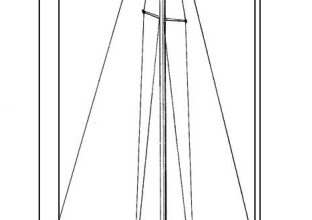
After about two weeks I decided to have the mast stepped. The 45-foot Sitka spruce spar went in without a hitch. I let Zephyr sit for about a week and then tensioned the shrouds and stays and went for a sail in very light winds. My first sail. What a thrill. She handled well and moved right along in the light air. After a half hour I went below and pulled up the sole around the mast step. To my horror, a stream of water was flowing in . . . more than had ever leaked before. I dropped the sails and motored back to the dock, not certain what my next move should be. It was scary thinking all that was keeping my boat afloat were batteries and a bilge pump.
Two days later, I was awakened just after midnight by my neighbor pounding on my door shouting, “Your boat is sinking at the dock.” Here it was: my worst nightmare. I drove to the marina not knowing what I would find. By the time I got to the dock, Zephyr was floating well, with about 10 men onboard with buckets. On returning from a midnight sail, they noticed Zephyr very low in the water and graciously bailed her out. Without their help, Zephyr would have been on the bottom. I traced the problem to a blown fuse on the bilge pump. The water level came within inches of the air intake of the motor. Feeling scared and lucky, I had Zephyr hauled out.
Still leaking
Over the course of six weeks I recaulked the seams and launched again. Still leaking. I put small copper patches on the stem. Still leaking. I used large copper patches. Still leaking. I put patches on patches. No leaking in the bow, but there was a new leak on the port garboard. I was at my wit’s end.
I finally re-launched August 11, believing all leaking was now coming from plank shrinkage and that it would swell up again after time. I motored six miles to my permanent marina, fully expecting something else to go wrong. But it didn’t. Over the course of the next couple of weeks, all leakage slowed to a manageable level.
I started taking Zephyr out for sails. Always expecting the worst, I was pleasantly surprised. On Day One we had 3 knots of wind. All was OK. Day Two was up to 5 knots. Still no leaks. Day Three had 5 to 10 knots of wind. Still no leaks. Day Four had 10 to 12 knots in lots of chop. There was minor leakage. Then I took a weekend trip to a maritime festival in 15 to 20 knots, and all was fine.
Yes, dreams do come true. You just have to be prepared to pay the price. I have saved a classic yacht from the scrap heap and am helping preserve a piece of maritime history. Zephyr needs more work, but with me in her ownership cycle she’ll get it. For me, the water sparkles a little brighter, the sun shines a little more brilliantly, and the wind is a little sweeter when I sail my Zephyr. I look forward to more.
Thank you to Sailrite Enterprises, Inc., for providing free access to back issues of Good Old Boat through intellectual property rights. Sailrite.com