A comparison of the Watkins 29 with three contemporaries
Issue 36 : May/Jun 2004
For comparison I tried to choose boats from a reasonably similar era with a reasonably similar purpose: that is to say, comfortable coastal cruisers with no pretensions about being racer/cruisers. These are family yachts of moderate displacement without deep, high-aspect-ratio fins or ultra-tall and racy rigs.
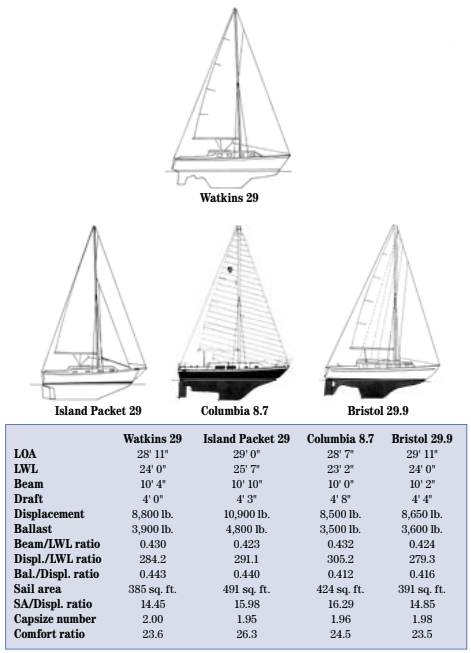
It was rather difficult to find three yachts close to the Watkins 29 in beam, draft, displacement, and so on. I could have used the Eastward Ho 31, but we covered that boat in a recent issue (November 2003). So I was quite surprised when the numbers for the Island Packet 29, the Columbia 8.7, and the Bristol 29.9 came out so close to the Watkins 29 in so many respects.
The Island Packet is, perhaps, the most uncommon of the four boats here, with its heavier displacement and very full keel. I selected it because, like the Watkins, it was designed and built in Florida and, as is to be expected, both boats feature shoal draft to suit the local waters and buyers. The shoal draft of the Bristol 29.9 is rather surprising as it is a New England boat, and sailors in the northern waters generally prefer a bit more draft for weatherliness. The Columbia 8.7, designed by an Australian, has the deepest draft as one might expect of a West Coast product. For this reason, I would tend to think the Columbia would have the edge in windward performance, particularly when backed up by the design skills of Alan Payne.
Despite the husky Island Packet being the odd man out of this grouping in a way, the comparison figures opened my eyes. The beam/ waterline ratios are in the very small range of 0.423 to 0.432. The ballast/displacement ratios are between 0.412 and 0.443, and the gap between the low and high capsize screening factors is a meager 0.05, an unusually narrow range. Even the comfort numbers are close, with only the heavier Island Packet having a slight edge due to its greater displacement.
The displacement/length ratios vary only between 279 and 291, with the exception of the Columbia, which, interestingly, despite being the lightest of the group, has the heaviest displacement/length ratio due to its rather short waterline. There is somewhat more variation in the sail area figures though, with the Watkins appearing undercanvassed by contemporary standards and the Bristol on the light side, while the other two appear to be more reasonably clad for whatever the weather gods might offer.
My performance guesstimate would give the Columbia 8.7 the all-round edge. The Watkins and Bristol 29.9 appear fairly closely matched. Much would depend on the skipper’s ability to get the most of the yacht, especially in light air. Indeed, the skipper would be wise to have along a very large genoa for times when the breeze is soft. The Island Packet is more difficult to pin down with its full keel, long waterline, and ample avoirdupois. It should reach along just fine in a good breeze, but its weatherliness and light-air performance are harder to predict. Again, the helmsman could make all the difference between good and mediocre performance.
Any of the four boats would be a fine coastal cruiser for a couple or a family and would prove quite capable of voyaging to the Caribbean or making the Inside Passage to Alaska in comfort and safety. I would not class them as bluewater yachts, but I know for a fact that many similar yachts — many obviously less seaworthy craft — have nevertheless made long and successful ocean voyages. The secret is good seamanship and ample preparation in ensuring that the equipment, the crew, and the yacht are all 100 percent up to snuff.
Thank you to Sailrite Enterprises, Inc., for providing free access to back issues of Good Old Boat through intellectual property rights. Sailrite.com