Thinking outside the lockers and drawers
Issue 78: July/Aug 2011
Any of us who have lived or considered living aboard a boat understand the problem of finding enough space to stow all of our possessions. Boat designers and builders like to brag that their 35-foot model will sleep 10 and seat 15 for dinner, but they don’t provide space on the boat to store bedding for 10 or the dishes and provisions needed to feed 15.
Whenever my wife and I were looking at a boat that we might buy, we would spend the first hour sitting in the main saloon asking ourselves where we would put everything we need to be comfortable and enjoy our time cruising. If we couldn’t quickly answer that question, we would move on to the next boat.
In most boats there’s a great deal of wasted space alongside the hull, behind steps and cabinets, and in many other areas. We’ve learned that, if we get creative, we don’t have to spend the dollars for a very large boat just to haul all of our stuff.
Our current boat, Beach House, illustrates the problem, since she is 34 feet long and we were transitioning from a 40-foot sailboat with more storage than most 50-footers. As we pondered, we realized the fi t would be tight, but we eventually concluded that we could make it work. The deal was done and we began the process of moving aboard.
First, the visible spaces
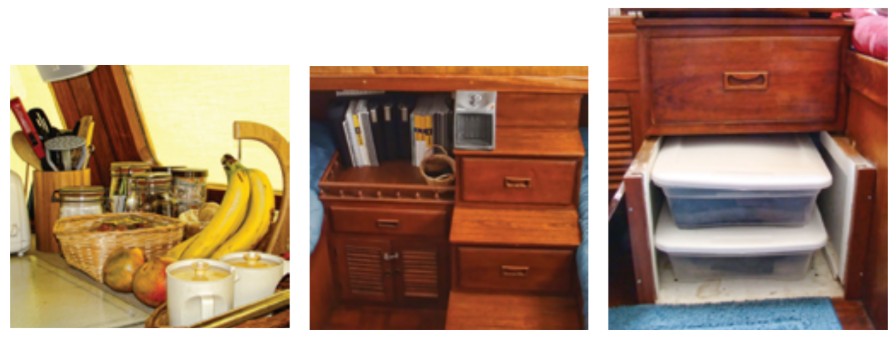
In the galley area, we have four large drawers and two cabinets. We optimized the drawers with plastic dividers and small plastic baskets. In a large open area under the pilothouse windows next to the galley, we keep glass and plastic containers with secure lids and additional galley utensils stored in wicker baskets.
We also have large open shelves at the aft end of the main saloon. On these, we store snacks, chips, cereal, and so on in wicker baskets, large zipper-type plastic bags, and airtight plastic containers. We use a non-skid drawer liner, found in rolls at most hardware stores, to keep everything from sliding around.
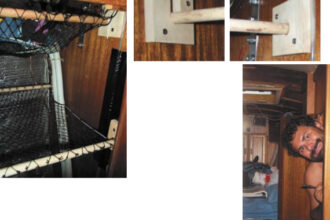
We find hanging fishnet bags are great for fruits, baked goods, and lots of other things. Hanging cup holders hold wine glasses and stemmed tumblers upside down over the shelf in the main saloon, freeing up cabinet space for vertically stacked plates and stacking cups.
In the heads, we use plastic baskets to divide and organize the contents of cabinets. That way, we get more in them than if we just piled things in and had to sort through it all every time we needed something. We put paper goods in hanging net bags, where they stay much drier than when we used to stuff them inside lockers.
We also used several off-the-shelf products found in regular hardware stores and marine chandleries, such as small stainless-steel and mesh hanging storage containers that attach to the bulkheads with large suction cups. Strategically placed small teak racks hold shampoos and sundry items; small hammocks strung up along the inside of the hull store all kinds of items; towel bars and towel racks hold several towels and washcloths that might normally be stored in a drawer or locker. We store cleaning supplies, organized in plastic containers, on the shelf that the toilet is mounted on.
The less visible
So much for the easy part. To handle long-term stowage we had to get creative with less-obvious spaces.
Water tanks take up most, but not all, of the space under the bunks in the aft cabin. Because getting in and out of that space is not easy, we store in there several power tools that are not used very often.
Perhaps because of the shape of the hull, there is almost always some unused space behind drawers. This can be used for additional storage as long as you keep in mind that you have to remove the drawer to get to it.
Larger items will usually fi t in areas under seats and settees. These spaces are also suitable for bins with lids for clothes, linens, and paper goods, for example. Items that need to be stored flat and be readily available, such as charts and placemats, can go under seat cushions and mattresses.

Accessing the inaccessible
The next step is to look for small modifications to the boat’s furniture that can pay off in a big way.
We found space in the aft cabin under the bottom companionway step. By removing the tread and riser of the bottom step, and with very little additional carpentry work, we found we could slide large plastic containers (of the kind used to store items under a bed) inside the steps. The riser and tread can now be easily removed and replaced to make use of this otherwise unused space.
The space between the first and second step was also deep and open. We enclosed the area just under the first step with a nice piece of teak with an opening cut in it. We can now store shoes and other items where normally there would be nothing. Because we cut this in an oval shape, we fitted a split plastic hose over the cut edges to finish it off.
Large open areas, such as under the forward V-berth, can be partitioned off into smaller compartments to allow much more to be stored in them.
Off-the-boat options
We use a few other tricks to keep the need for onboard storage to a minimum.
Almost every liveaboard we know has a large “portable dock box.” This can be anything from a small second car or older-model station wagon to a full-size utility van. For years, we used a Chevy Astro van until it got too tired. We used this “dock box” to store items we might not need on the boat but wanted to have access to regularly, such as our extra sails, materials we might need and use for repairs and projects, and some larger tools and toolboxes.
We also used the vehicle to store seasonal clothes we didn’t need: winter clothes in the summer and summer clothes in the winter. We found this to be much simpler than keeping them on the boat. The clothes were also better protected because we put them in bags that can be compressed by using the suction end of a vacuum cleaner. Since our dock box/vehicle is parked at the end of the dock, it’s nearby and also provides a second vehicle when we need it.
If all else fails, local self-storage facilities will rent a small room for a reasonable rate.
If you look around your boat and use your imagination, you can come up with some pretty creative ways to find the extra storage space you never thought you had.
Chuck Baier and his wife, Susan Landry, have lived aboard for years and have cruised extensively along the U.S. East Coast and Gulf Coast and in the western Caribbean. For the moment, they live aboard Beach House in Deltaville, Virginia, where they work for Waterway Guide, Chuck as the general manager and Susan as the editor.
Thank you to Sailrite Enterprises, Inc., for providing free access to back issues of Good Old Boat through intellectual property rights. Sailrite.com