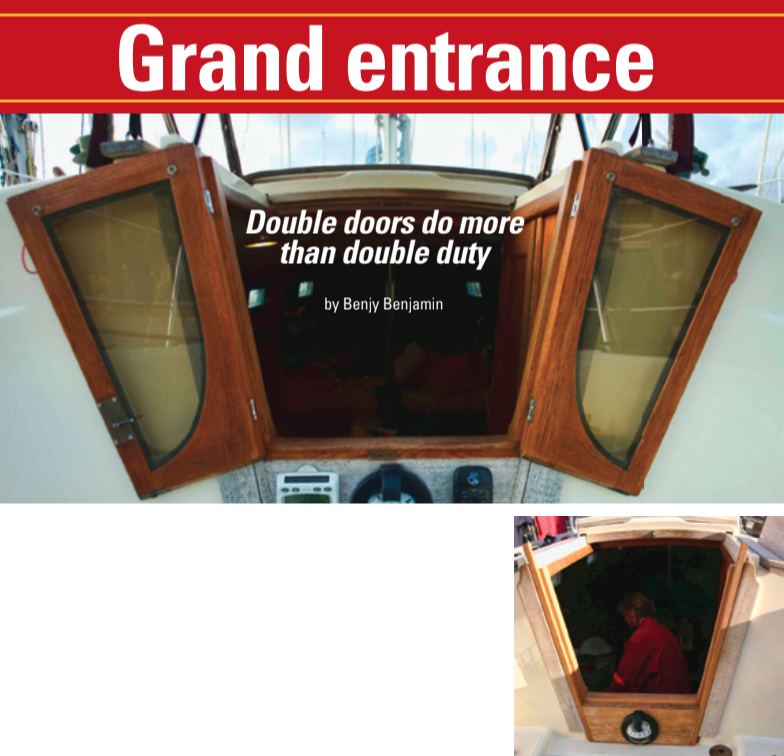
Double doors do more than double duty
Issue 78 : May/Jun 2011
Living aboard a boat changes one’s priorities. What works for the occasional trip can become downright annoying on a daily basis. Take the companionway dropboards for example. If you live aboard, removing and refitting them each time you come and go soon becomes a drag, especially when you have four of them to remove!
On a small boat where storage is at a premium, it makes sense to store things “on” the boat. I favor roller furling if for no other reason than the sails are stowed on the furler and not taking up valuable space in a locker. I applied the same logic when I fitted companionway doors, and no longer have the problem of where to stow the dropboards.
Doors for Doolittle, my Dana 24, had to be elegant yet strong. They had to open wide enough to be stowed flat against the cabinhouse. They had to house the ship’s compass, a GPS, and a depth sounder. I also wanted to be able to refit the original boards easily, if needed. And I didn’t want to drill any holes in the fiberglass. Quite a tall order!
The most logical way to achieve all these goals was to create a set of doors in a frame that could be dropped into the same groove the dropboards used. I shaped two uprights and used the first dropboard to join them at the bottom. It takes a little more effort for us to lift a leg over the extra height at the companionway, but we can live with it . . . especially as it has given us a great new place to sit when on watch at sea.
A place for instruments
When I first ordered Doolittle, I told Pacific Seacraft I did not want a compass fitted in the usual place, to starboard of the companionway. This ruins a good place to sit and prevents a door, when fitted, from swinging all the way back. Besides, it’s hard to read the compass if you’re sitting on the other side of the boat. With my door arrangement, I was able to fit the compass on the boat’s centerline and, what’s more, without cutting a huge hole in the fiberglass. The GPS now lives on one side of the compass and the wireless Tacktick speed/log unit lives on the other.
I chose a Tacktick display mainly because it has no cables. This meant I could easily fit it to the doors and connecting it wouldn’t be a problem. The GPS needs only a 12-volt supply that is plugged in when at sea. Yet another advantage of the door frame was a narrow space on the inside, beneath the door sill, just deep enough to store the instruments and cables when not in use.
Once I had completed the frame, I could move on to making the doors themselves. They would have windows in them to let light into the cabin. I wanted a window shape that suited the boat, but I wasn’t having much joy. Everything I drew looked wrong. I asked an artist friend for suggestions and he nailed it on the first try.
I made the doors of teak with simple tongue-and-groove joints and epoxy glue. This is a very simple, yet strong, way to join wood. Also, because of the tongue, the pieces stay in place and lock the assembly together, making clamping and gluing easier.
A tricky catch
My previous boat had doors that were fitted with amazing bronze handles but, as we were going to lean against these doors, I couldn’t use any sort of external mechanism on them that would make that uncomfortable. I wanted simple catches so the doors would close by themselves, and a simple mechanism for opening them.
I had to solve a couple of slight issues before I could have neat flush catches: no one manufactured any such thing . . . and how on earth would I operate them?
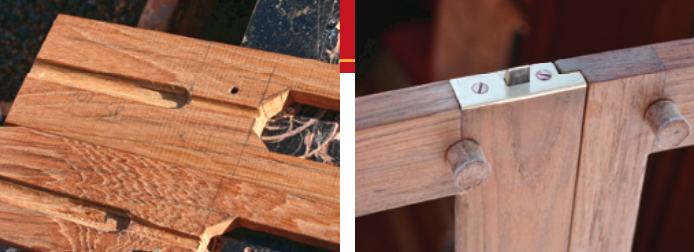
One door closes on the other so only one of them needed catches. For the top and bottom catches to be operated, they would have to be connected to the door handle with strings, which meant the door would need to be hollow. Drilling such a long hole was out of the question, so I made this part in two pieces and routed them out to create a hole for the string, for runners for the catches, and for the return springs that fit over the shanks of the catches.
The strings meet inside the door where they are connected to a door handle or lever. A square of bronze on the outside of the door has a hole in it for the padlock. A hasp is fitted below it. When folded up, the hasp covers the handle, which then cannot be operated.
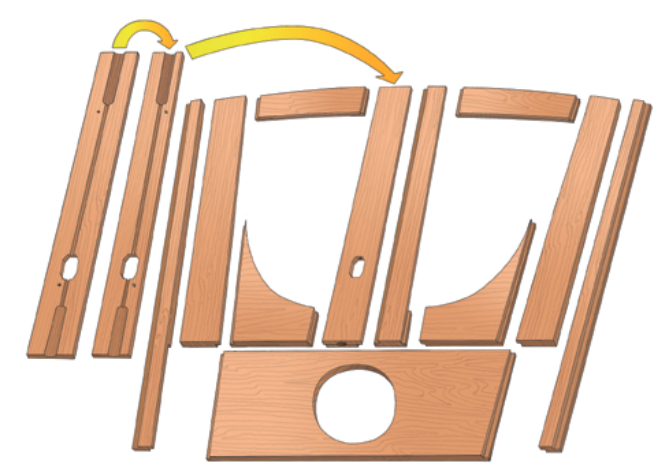
A nice trick when mating two pieces of wood like this is to screw a couple of brass wood screws into one of them, cut the heads off the screws, then position the other piece of wood in place and tap it with a mallet. Where the cut-off screws mark the wood lightly, drill small holes the same diameter as the screws’ shanks. The screws now act as keys, and the two pieces match up in only one way. Otherwise, when clamping pieces of wood for gluing, they can slip or slide. This easy trick is the perfect invisible remedy.
I made the windows from lightly smoked 5mm polycarbonate. They are held in very neatly by a special tape made by 3M that is suitable for sticking polycarbonate to other surfaces (see sidebar). The polycarbonate is incredibly strong, as is the tape, so it all makes for a light, yet very strong, set of doors.
I had to extend the original wooden lip on the sliding hatch to cover the new doors as they are about 3/4 inch farther aft than the dropboards were. The entire assembly can be removed in moments as the doors are held in place by only two wood screws.
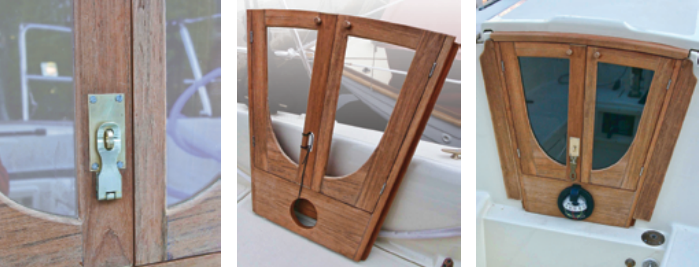
I oiled the doors on the inside to match other interior wood and left the outsides bare teak. I installed a brass ventilator in the inner panel. It allows some air to pass when the boat is closed up and it also provides a way to get the inner panel off when I need access to the stored instruments.
I glued two leather-covered teak plugs to the tops of the doors on the outside. These stop the doors from bending when being leaned against. I fitted each plug with a loop of elastic that can be clipped over the cleats on the cabintop to prevent the open doors from banging when it’s windy or rough at sea.
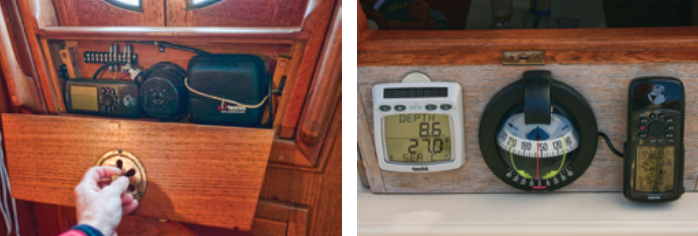
The doors are very easy to use and have made our lives easier. Light from the windows also brightens the boat’s interior, making it more cheerful, and it’s a pleasure to be able to watch our damp sparrow friends eating the food we put out for them while rain beats down on the doors. I’ve made quite a few mods to Doolittle over the years, but not one has changed our lives quite so much as the doors did. The spray hood comes close, perhaps, but that’s another story . . .
Benjy Benjamin loves sailing, making things in wood, and photography, and sells dinghy plans at. He lives aboard Doolittle, a Pacific Seacraft Dana 24, with his partner, Celia, near St. Tropez in the south of France. He works on classic yachts to fill the time when not exploring the Med.
Thank you to Sailrite Enterprises, Inc., for providing free access to back issues of Good Old Boat through intellectual property rights. Sailrite.com