Avoid paying for those expensive thumps

Issue 54 : May/Jun 2007
Our 30-year-old Ranger 28 has a balanced rudder and is tiller-steered. While I prefer a tiller and like the feedback it gives, it unsettles me if I feel the rudder touch the hull, especially when the touch results in a resounding thump. I get a clear message, “You’ll pay for that.”
When we pulled Gilded Lily for bottom paint, close inspection revealed a crack in the rudder parallel to the rudder shaft, which we repaired. Payback.
I set out to eliminate the problem by building a tiller-stop collar that limits the rudder arc to port and starboard and am very pleased with the result. Ours is made of imported hardwood so dense I doubt it would float, but other materials could be oak, ash, aluminum, or high-density polyethylene.
Start by fabricating a collar the same outside diameter as the upper flange for the rudder shaft, with the inside diameter just big enough to fit over the tiller head fitting. The stop collar needs to be tall enough to engage the pinch bolt on the tiller fitting. Drill the collar to match the flange bolt holes. You must replace the old bolts with longer ones at assembly. Everything should fit up to the bolt holes in the upper flange.
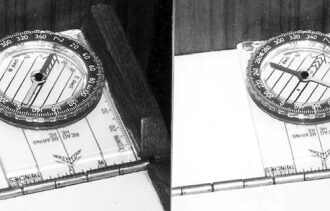
Mark the limit of the tiller’s swing to starboard and port. Be sure your marks are visible after the collar is installed, with the bolts in place. Using the reference marks and the centerline of the tiller shaft, mark the edges where you want the tiller to stop. Be sure to leave extra material for fitting when you cut the clearance for the tiller.
When you finish, your marks on the collar should resemble a letter “C” with the ends aligned to the center. When properly fit up, the rudder should not be able to touch the hull anywhere.
I rough-cut the stop on a band saw and finished the outside diameter, inside diameter, and tapered surfaces on a lathe. The holes were made on a drill press. The stop edges were marked as described, cut with a band saw, and sanded to finish. The whole job took about four hours.
Remember when you start this job that removing the tiller head will allow the rudder shaft to drop out of the shaft tube. The rudder has to be held in from below, either blocked up, if ashore, or with a sling made fast to the toerails, cleats, or stanchions, if afloat.
Thank you to Sailrite Enterprises, Inc., for providing free access to back issues of Good Old Boat through intellectual property rights. Sailrite.com