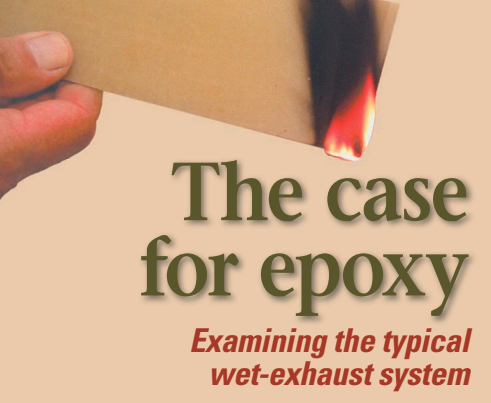
Ignited by a charcoal grill lighter, this epoxy/fiberglass laminate burns with a yellow, sooty flame and does not self-extinguish. It would not meet the test criteria 94V-0 when tested in accordance with UL 94, Test for Flammability of Plastic Materials for Parts in Devices and Appliances. A wet-exhaust system component made from the same material would, therefore, not meet ABYC standards.
Issue 54 : May/Jun 2007
After building a custom waterlift muffler with epoxy and fiberglass, one question remained: how does it compare with the commercial ones made of polyester/vinylester resin composites or molded plastic?
For almost all applications, epoxy resin is superior to polyester and vinylester resins. It makes a stronger fiberglass laminate, its secondary bonding strength is far superior, and it is much more resistant to osmotic water migration. Indeed, it has been the industry standard for repairing and coating blister-damaged hulls constructed of polyester/fiberglass laminates. It has, however, two draw-backs: high cost and flammability.
A typical supplier lists 5 gallons of polyester resin with hardener for $119.95 and the same amount of epoxy with hardener for $257.80. This price ratio helps one understand the popularity of polyester resins with most boatbuilders, although a few top-end builders have recently switched to epoxy. Why then wouldn’t epoxy also be superior for building waterlift mufflers? Indeed, when I spoke with David Parks, of Marine Muffler Corporation, a major manufacturer of fiberglass components for marine wet-exhaust systems, he cited cost as the problem with epoxy but didn’t see much wrong with my epoxy-muffler concept.
The problem with epoxy is that there is insufficient demand for it to be formulated with higher heat resistance and flame retardancy when cheaper polyester resins will suffice for most of the industrial applications for which fire retardancy is required. And, therefore, a waterlift muffler constructed from epoxy laminates would not meet the American Boat and Yacht Council (ABYC) standard requiring that such fiber-reinforced plastics “shall meet test criteria 94V-0 when tested in accordance with UL (Underwriters Laboratories) 94, Test for Flammability of Plastic Materials for Parts in Devices and Appliances.”
Test criteria
Briefly, this test uses a 1⁄2-inch by 1⁄2-inch by 5-inch specimen that is held in a clamping device at one end in the vertical position. A burner flame is applied to the free end of the specimen for two 10-second intervals separated by the time it takes for flaming combustion to cease after the first application. Two sets of five specimens are tested. For each specimen, total flaming combustion must be less than 10 seconds duration. For all five specimens in any set, total flaming combustion must be of less than 50 seconds’ duration. Flaming and glowing combustion for each specimen after the second burner flame application must be less than 30 seconds’ duration. Flaming drips from any specimen must not ignite cotton placed 12 inches below the specimen and, finally, no specimen may burn up to the clamp holding it in position above the burner.
The sample of epoxy laminate that I have ignited with a charcoal grill lighter would not pass this test (see photo on Page 37). Instead, it burns quite nicely with a yellow, sooty flame that does not self-extinguish. The flammability of epoxy, therefore, seems to condemn it for use in building a waterlift muffler. Or, could it be that the ABYC standard is too stringent? To judge this, I decided to take a look at what goes on in the typical wet-exhaust system.
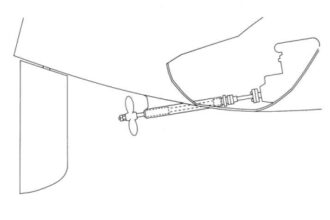
Take a minute to review the diagram on Page 35. Follow the exhaust hose 12 inches up from the waterlift muffler to the mixing elbow. This is where the hot exhaust gases and the engine cooling water come together, or are mixed.
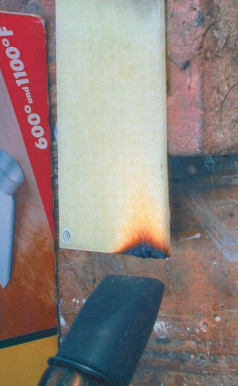
A heat gun on the 1,100° F setting charred this epoxy/fiberglass laminate, but was incapable of causing flames or glowing embers.
Uncooled exhaust
I asked Mark Coulson, the staff engineer at Marine Exhaust Systems of Alabama, Inc., “What is the temperature of diesel exhaust at the mixing elbow, if not cooled by water?”
He responded, “The temperature varies and depends on the engine. Generally anywhere between 700° F to 1,100° F. For reference, the wet system would be under 200° F.”
This is supported by Chris Cerullo of Laborde Products, a Yanmar engine dealer, who says, “According to Yanmar test parameters, if we were measuring the exhaust temperature just prior to the mixing elbow, the maximum allowable temperature is 1,130° F. This temperature is going to vary somewhat according to propeller load and ambient temperatures. In the case of an overloaded engine, it may be higher also.”
Having already learned that an epoxy-based laminate would burn when an open flame is applied to it, I now sought to learn what would happen when it is exposed to uncooled, non-flaming exhaust gases. After a period of contemplation, I decided against asking Ken Simmons to let me run his Yanmar dry to do a real-world test of my waterlift muffler. Instead, more prudently, I conducted a couple of simulations.
In one test I applied heat to an epoxy-based laminate from a distance of approximately 1⁄2 inch with a heat gun rated for 1,100° F. The laminate charred but did not burst into flame, even after prolonged application of heat. In the second test, I put another epoxy laminate sample in the oven of our kitchen stove and set it for 200° F. Then I increased the temperature in a series of 25-degree increments.
Layers separated
At each increment, I examined the laminate and tried to bend it using cooking tongs. By the time it reached 400° F, the laminate had browned to the color of “just-right biscuits.” When I tried to bend it, it buckled at several points where the fiberglass cloth layers separated. However, once cooled, the sample returned to near-original strength.
It is, therefore, reasonable to conclude that a waterlift muffler made from epoxy-based composites would become unserviceable after being subjected to uncooled exhaust gases for more than a few minutes, but it would not ignite, so long as one kept one’s charcoal grill lighter away from it. Therefore, the ABYC requirement that such a muffler meet UL Standards for “flammability of plastic materials for parts in devices and appliances,” may be a bit of overkill and, as we shall see, is contradictory. Because ABYC standards are voluntary, one may interject one’s own conclusions, bearing in mind, however, that, as stated by Matt Murphy, the editor of WoodenBoat magazine (issue #135), “these standards [ABCY standards in general] are the product of some of the best minds in the industry and years of experience.” However, in issue #134 of WoodenBoat magazine, an article, entitled “Marinizing a Subaru Engine for Marine Use,” describes, as part of the marinization process, a clever design for building, from an epoxy/fiberglass laminate, a custom waterlift muffler, which would accept exhaust from the dual-exhaust manifolds of the Subaru engine.
Comparing mufflers
Jerry Powlas offered me the waterlift muffler he had just removed from his project boat. He thought I might like to subject it to the “charcoal grill lighter test,” just to see how it compared to my epoxy-composite muffler.
A couple of days later, when I opened the FedEx box, I found a nice plastic waterlock. For a hoarder of boat parts, it was difficult to apply flame to this perfectly useable muffler. However, expecting it to meet ABYC fire-retardancy standards, I didn’t anticipate any real damage, perhaps a little melting around the edge of the inlet hose fitting. Was I in for a surprise! Within seconds of applying the flame, the muffler ignited and continued to burn until I blew it out.
Now that the muffler was alreadypretty much ruined, I decided to experiment further: I took it outside and set it on a cement block and re-ignited it. The flames quickly spread and soon melted blobs of burning plastic were dripping to the ground. Within a few minutes, the fire reduced the muffler to nothing but a puddle of melted, burning plastic).
I was surprised that this muffler (I have one in my boat) burned so readily, actually more readily than the epoxy composite. It was about 26 years old, so perhaps something has changed since then.
The descriptions of similar waterlocks offered for sale in the current West Marine catalog make no mention of fire-retardancy. However, elsewhere on the same page, descriptions of the Vernalift mufflers, made by Centak Industries, include a claim for fire-retardancy, leading one to infer that this is meant to be a desirable quality — a selling point. Is this further evidence (besides the flammability of black rubber exhaust hoses) that the ABYC standard for fire-retardancy is at least inconsistent?
Expert opinions
I asked BOAT/U.S. for any data they might have relating to boat damage or losses resulting from exhaust-system meltdowns or fires caused by the loss of cooling water. Chuck Fort, their technical services associate editor with Seaworthy and Exchange magazines, offered the following:
“Exhaust component meltdown is common on overheated engines, especially V-8 gas engines. Usually, the driver doesn’t notice the gauge or can’t hear the alarm.
“Most of our claims are for gas powerboats; typically the rubber hose that connects the manifold to the exhaust system melts. This often causes a lot of smoke which, in turn, makes people think the boat is on fire. Sometimes the hoses do catch fire and have caused boats to burn, but it’s not common. On some boats, breaching the cooling system causes water to enter through the exhaust system and, occasionally, boats sink.
“The reason for the overheating is usually that the seawater impeller has failed or, less commonly, an obstruction in the system . . . ”
He goes on to say, “ . . . there is one standard that many people are not aware of: (ABYC Standard) P1.7.1.4. An indicator shall be provided at all helm positions to indicate loss of exhaust system cooling water supply.”
Buying time
Chuck Fort continues, “Cheap hoses melt quickly . . . The better the hose, the more time it will buy you if your engine overheats.”
Mark Coulsen, of Marine Exhaust Systems of Alabama, echoes Chuck’s concerns for exhaust-system safety: “This is an important subject that too many boaters take for granted. The whole system should be inspected hand-over-hand routinely . . . all the way from the initial water intake to the exhaust outlet. Any defects should be further inspected/corrected as soon as possible. The Coast Guard’s website has a good checklist that I copied and put on our website” (see Page 37).
In view of this information, I consider a properly built, one-off waterlift muffler constructed of an epoxy/fiberglass laminate to be a fully serviceable component of a marine wet-exhaust system.
My workshop tests demonstrated that an epoxy composite could not pass the UL test for flame-retardancy. It nevertheless performs better than SAE J2006-certified black rubber exhaust hose when subjected to heat and flame. The standards adopted by ABYC for these two components therefore appear to be inconsistent, all the more so considering that the more poorly performing exhaust hose is closer to the heat.
Logically, two conclusions are possible: either both the epoxy composite and black rubber hose are unsuited for wet-exhaust system applications or both are suitable. Based upon my investigations, I consider both the epoxy waterlift muffler and black rubber exhaust hose to be satisfactory components of a well-designed, properly installed, regularly inspected, wet-exhaust system.
Hoses: the weak link?
The other parts of the wet exhaust system, from the mixing elbow to the transom, are the hoses and, if needed, elbows and bellows. The hose connected to the mixing elbow is in the front line, in the event cooling water is lost, and therefore subjected to the highest temperatures. To learn more about hoses, I turned to the Trident Marine Systems website and found a column entitled “Ask Bill” . Bill is Bill Shields, the president of Trident Marine and a recognized expert on marine hose and boating safety.
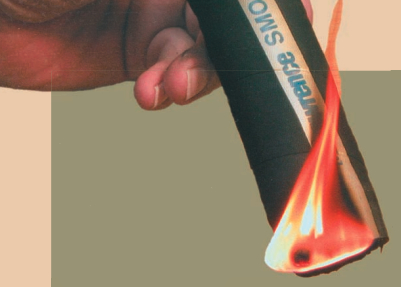
This sample of black rubber exhaust hose burned with enthusiasm when ignited by a charcoal grill lighter and would not self-extinguish. It nevertheless carries the SAE J2006 certification and therefore meets the ABYC standard for approval as a wet-exhaust system component.
In his column, Bill emphasizes the importance of a properly designed, installed, and maintained wet-exhaust system and the importance of using high-quality, certified exhaust hose and flexible connectors like bellows and elbows. By certified, he is talking about SAE J2006 Marine Exhaust Hose Standard, which has been adopted by both the ABYC and National Marine Manufacturers Association (NMMA). This standard requires hose, bellows, and elbows to “pass a number of performance tests, including an aggressive high-heat test (1,100° F for 2 minutes at 4,900 cubic feet/minute air flow). That simulates running the engine at full power for 2 minutes with no cooling water.” There is no mention of a flame test similar to the UL test for plastics flammability.
There are essentially three grades of certified wet exhaust hoses. The first, made from 100 percent EDPM high-temperature hard black rubber, is the least expensive and will withstand continuous heat up to 250° F. The second two are made from two different grades of silicone. One will withstand 350°F continuous and is colored blue. The other is colored red and will withstand 500° F continuous. Bill Shields strongly recommends one of the silicone formulations because of the higher temperature ratings and also because they will last up to six times longer than black rubber and will therefore be more cost-effective in the long run.
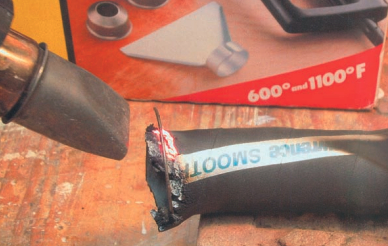
The 1,100° F setting on the heat gun chars this black rubber exhaust hose sample, just as it did to the epoxy/fiberglass laminate. However, in this case, it also produced glowing embers but did not flame. This hose carries the SAE J2006 certification and meets ABYC standards, while the slightly less flammable epoxy/fiberglass laminate does not.
Hoses will burn
I was unable to find specific information regarding the flammability of exhaust hose. However, a couple of my inquiries brought responses suggesting that they will burn. When I asked Mark Coulsen, of Marine Exhaust Systems of Alabama, Inc., what the failure of these components consists of — meltdown or distortion, noxious gases, fire — he told me that “hoses will melt, crack, or become so brittle that abrupt failure is possible at a later date … Running dry or nearly dry can result in fire, flooding, carbon monoxide poisoning/asphyxiation . . . ”
Dave Parks, of Marine Muffler Corporation, told me that (in the event of cooling-water loss) the hose goes first and is not fire retardant. He also recommends silicon hose, because of its higher temperature rating.
Having found nothing really definitive about the fire-retardancy of exhaust hose, and because the SAE J2006 Marine Exhaust Hose Standard (adopted by ABYC) measures heat resistance but not fire-retardancy, I reopened my workshop laboratory. What I found was an inconsistency in ABYC standards for two different non-metallic components of the exhaust system. I applied my charcoal lighter flame to a new piece of SAE J2006-rated wet-exhaust-system black rubber hose. It ignited as quickly as, and burned just a little better than, did the epoxy laminate I tested previously (see photo above). I then gave it the same heat-gun test as I had given the epoxy laminate. The heat gun produced glowing embers where applied to the hose, while the epoxy laminate only charred (see photo below). While these home-workshop tests were primitive, I found that the unapproved epoxy laminate was less flammable than the ABYC-approved exhaust hose; at least it didn’t burn with as much enthusiasm. I suspect that the only reason that a waterlift muffler made from an epoxy/fiberglass laminate would ignite was because flames from a burning ABYC-approved exhaust hose reached it.
Unlikely to ignite
Even in the event of a loss of cooling water, neither component would be exposed to open flame and would be unlikely to ignite. However, Bill Shields’ advice that silicon hose is preferable should be considered, especially for that hose section between the exhaust elbow and the waterlift muffler.
While the ABYC requirements are apparently contradictory in this instance, ABYC Standard P-1 Installation of Exhaust Systems for Propulsion and Auxiliary Engines (downloadable for $40 at <http://www.abycinc.org/standards>) is nevertheless an excellent guide and should be carefully read by anyone undertaking an exhaust-system installation. The advice provided by paragraph P.1.7.1.4: “An indicator shall be provided at all helm positions to indicate loss of exhaust system cooling water supply” should be taken to heart by everyone operating a vessel with a wet-exhaust system.
Twice I have experienced water-pump impeller failures. Neither boat was equipped with an exhaust-overheating alarm. Great good luck allowed me to notice the change in exhaust sound and discover the problem before damage was done. If not discovered in time, an exhaust-system meltdown can be very expensive and possibly dangerous. I’ve ordered my alarm. I recommend you do so also. It could be the best $70 to $80 spent on your boat.
Thank you to Sailrite Enterprises, Inc., for providing free access to back issues of Good Old Boat through intellectual property rights. Sailrite.com
Paul Ring is a contributing editor with Good Old Boat. He sailed, repaired, modified, restored, and built boats for the past 44 years and currently sailing his Nonsuch 260 with first mate, Barbara Brown, out of Fairhope Yacht Club on the Eastern Shore of Mobile Bay. Paul also enjoys carving wood and sculpting clay.