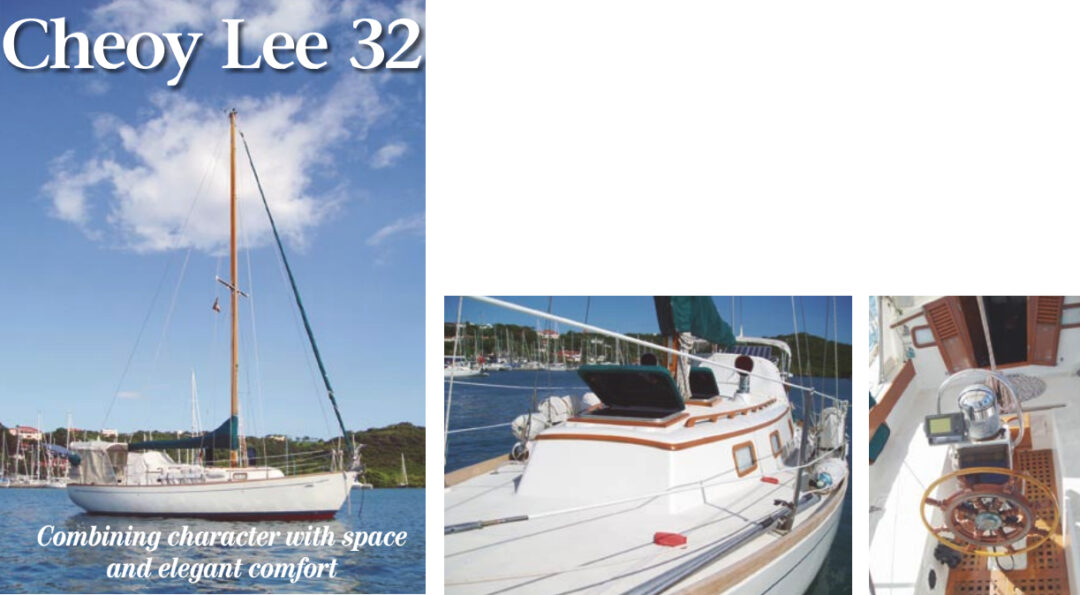
Combining character with space and elegant comfort
Issue 40 : Jan/Feb 2005
We first saw Zephyr in Sapodilla Bay in the Turks and Caicos, noting her size more than her appearance. My wife, Olga, and I had been assured that almost no one was cruising to the Caribbean in small boats, yet among nine boats waiting there to sail to the Dominican Republic, four were less than 32 feet in length.
A week later, the weather window we were awaiting finally materialized, and we all made the overnight crossing together, nine masthead lights forming a constellation on a pitch-black ocean. Daybreak revealed the astonishing mountains of Hispaniola, barely conceivable after the low islands of the Bahamas. Entering Lupéron Harbor that morning, we became forever linked as members of the “group of nine.”
We often spent time ashore in company with Zephyr’s owners, Bruce and Cheryl Horton, but, with nearly 100 cruising boats in the harbor, more than three months would pass before we went aboard Zephyr. When we did, we discovered something special.
In 1993, Bruce and Cheryl were living a “normal” life — a comfortable house with a mortgage, two cars in the driveway, and two jobs. But the house happened to be in Vero Beach, Florida, a community where an inordinate number of sailors pause, soon to leave for (or recently returned from) far-flung destinations.
“I was working as an electrician,” Bruce recalls. “I got paired up with this guy, and he was always talking about sailing around in the Caribbean. He had just returned from there, and he had lots of stories.”
Entrancing tales
A friendship developed that soon expanded to include Cheryl. Bruce and Cheryl were entranced by the tales told by new friend George. More to the subject at hand, they were strongly attracted to the life George described.
Neither Bruce nor Cheryl were new to boating. Bruce had recently owned a 50-foot houseboat in Tennessee. Cheryl describes her boating experience as “mostly ornamenting powerboats in a bikini,” but she had done a lot of that and loved being on the water. The two of them began to talk about buying a sailboat. George encouraged them by inviting them aboard his boat — which was on the hard in a boatyard for most of the time they knew him. That didn’t matter.
“George’s boat was very traditional — lots of wood. I loved that,” Cheryl confesses. “It’s probably why we ended up with a boat with so much wood.” Bruce recalls that the boat had no through-hull openings and that it was tiller-steered. These were manifestations of George’s “strong and simple philosophy” about cruising sailboats. It wasn’t a bad introduction.
Soon enough, the Hortons were scouring classified ads, looking for a sailboat to buy. “But we didn’t know a sloop from a ketch, full keel from fin, or stiff from tender.” At first their search was hobbled by uncertainty. Then, as their knowledge of what they were actually looking for grew, they saw the number of potentially suitable boats decline. Their search droned, sputtered, then ground to a complete halt. Even the idea of going cruising lost steam.
Drove by marina
Bruce and Cheryl turned their attention to real estate. “We had been out looking at a parcel of land and just happened to drive by the municipal marina,” Bruce says, eyebrows raised in apparent lingering wonder at the unexpected ways life turns. Nodding at a shared memory, Cheryl continues the story: “We just decided to stop and take a walk on the docks.”
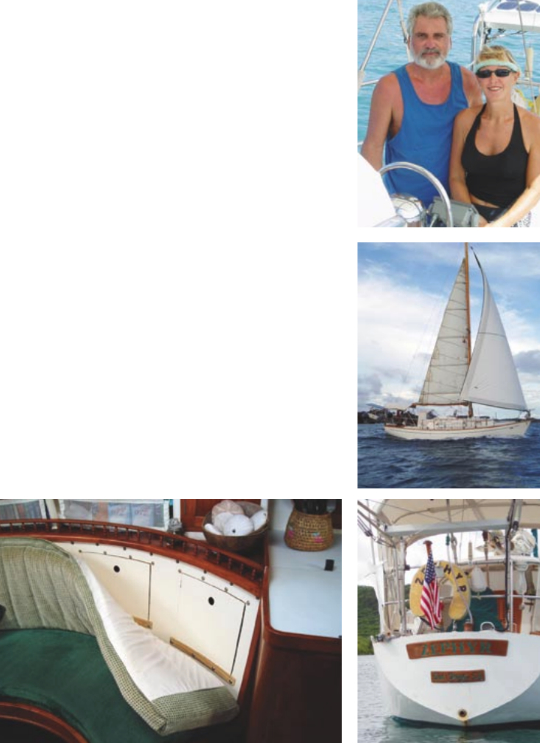
It was a life-altering stroll. In one of the transient slips they discovered a small sloop with a wooden mast, teak decks, and loads of traditional character. Hanging from the lifeline was a diminutive “For Sale” sign. They paused, walked on, then came back. Fortunately for this story, the sloop’s owners were aboard and accommodating. One look below and Cheryl was in love. And why not? This particular boat, of which only a small number were built, has a unique and singularly attractive interior.
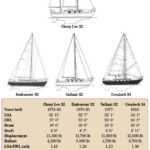
Designed by Ray Richards and constructed in fiberglass in the Cheoy Lee yard in Hong Kong, the Cheoy Lee 32 is only one inch shy of being as long as the name suggests. It draws 4 1⁄2 feet and weighs just over 11,000 pounds. With a 27-foot waterline and a 10-foot-6-inch beam, the Cheoy Lee 32 has a generous amount of interior space. It is here that this boat most distinguishes itself.
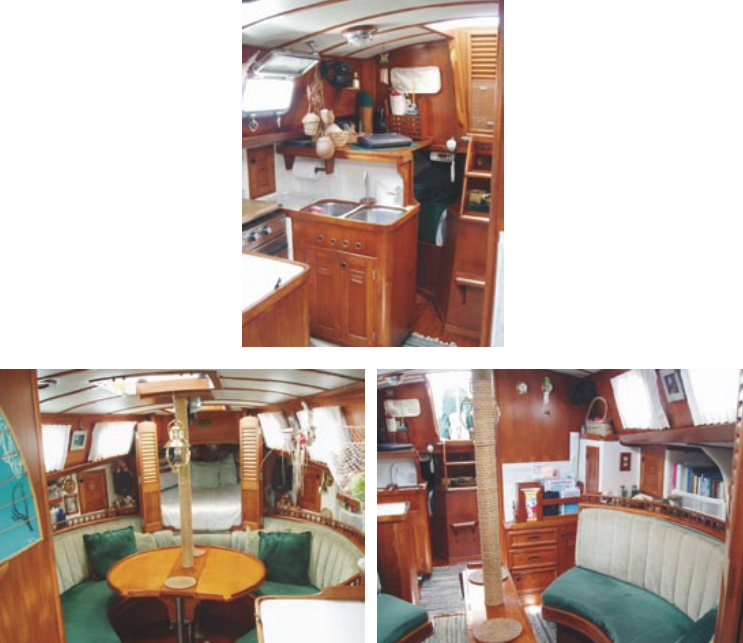
The most prominent cabin feature is the centerline circular settee spreading across almost the full width of the saloon and providing comfortable seating for eight or more. A drop-leaf table converts this space to a dining area. This table can be lowered for guest sleeping. Forward of the settee is a large V-berth that can be screened from the main saloon with folding louvered shutters.
Enclosed head
Aft of the settee on the port side is a hanging locker and a convenient and attractive drawer cabinet. Aft of these saloon features is the enclosed head. On the starboard side is a U-shaped galley with a gimbaled propane stove. Aft of the galley is a stand-up navigation desk, with a quarter berth below. A second quarter berth is aft of the head. Two overhead hatches and eight portlights keep the cabin fresh and make it bright.
A step on the engine access hatch and a small ladder above leads into a spacious cockpit with pedestal steering and wood coamings. In addition to the spruce mast and teak decks, the Cheoy Lee 32 was delivered with teak eyebrows, handrails, toerails, portlight frames, and deck-hatch bases. The carved nameboard on the transom was also teak.
Zephyr was the name carved on the board. The Hortons quickly became her new owners. “The necessary negotiations were really little more than a formality,” Bruce says with a shrug. “Zephyr became Cheryl’s boat the minute she stepped below.”
Commissioned in San Diego in 1977, Zephyr had carried her first owners south along the Pacific coast of Central America, through the Panama Canal, and across the Caribbean Sea to the U.S. East Coast. Her second owners took Zephyr back to the Caribbean, as far south as Grenada, before returning to Florida. Bruce and Cheryl became the third owners.
They kept the name: “We had made the mistake of renaming another boat and had nothing but bad luck with it. We weren’t taking any chances.” This nod to superstition augured well for grasping the nuances of becoming sailors.
Building a kitty
The Hortons sold their home and moved aboard Zephyr. They spent the next three years living aboard in a Fort Pierce marina, building a cruising kitty, and learning to sail. There they also removed the teak deck, divining early the potentially destructive nature of this feature of their new boat. This deck project included moving Zephyr’s anchors to the bow and removing an anchor well that intruded into the V-berth. Aft they installed stainless davits for carrying a dinghy.
Another early modification was the installation of 12-volt refrigeration. Surmising that he would need to add insulation, Bruce cut an opening into the space behind the back of the circular settee to gain access to the box. This led to seven more backpanel openings, creating eight much-appreciated new storage compartments. One of these compartments houses a small watermaker.
“In the marina we met lots of other sailors preparing their boats for cruising. But few actually went,” Cheryl relates. There is pride in both her voice and posture when she continues, “We went.”
Indeed they did. In 1997 they stowed docklines aboard and set off across the Gulf Stream for the Bahamas. Their first cruise would last seven months, taking them nearly the full length of the Bahamas chain and expanding their sailing knowledge exponentially. It ended at Rum Cay, where they had a friend rebuilding a hurricane-damaged home. An offer to help had spurred them to sail south and east of Georgetown, Exuma — the usual terminus for a first Bahamas cruise.
Found employment
At the end of their first cruise they did not return to the United States. Rather, they both found employment with the Atlantic Undersea Test and Evaluation Center (AUTEC) on Andros Island. At AUTEC, the Hortons had both the time and the facilities to make labor-intensive improvements. Among them was stripping and barrier-coating Zephyr’s bottom. With access to the center’s machine shop, Bruce turned and shaped a taller foot-pump spout, “the best galley improvement for me,” Cheryl says. Indeed, one does wonder if spout manufacturers ever actually tried to wash a pot under the standard offerings.
After two years, they had also accumulated a list of maintenance and improvement projects that they could not easily accomplish in Andros due to the limited availability of parts, so they headed back to Florida. By the time they arrived, a new project had been added to the top of their list—replacing Zephyr’s chainplates. “On the trip back we broke one due to corrosion we couldn’t see. The chainplates were all hidden behind cabinetry,” Bruce says. “So in addition to replacing all the chainplates, we made modifications below that left them visible to regular inspection.” Zephyr remained in Florida for six months while Bruce and Cheryl re-rigged her, replaced the tired Volvo MD-11C with a new 3GM Yanmar, and renewed the exterior canvas.
Canvas work merits more than a toss-off mention. It is an ongoing art form aboard Zephyr, with wholesale and subtle changes occurring on a regular basis. Bruce does the design. Cheryl does the sewing. Cheryl has also done all the interior upholstery on the Sailrite sewing machine that is an essential part of Zephyr’s cruising equipment.
What changes?
After two additional years working and cruising in the Bahamas, the Hortons finally pointed Zephyr’s bow toward the Caribbean. Eighteen months later they were in Grenada, where Olga and I reconnected with them. There I asked them both what, after 10 years of being aboard, they would change.
“Ray Richards’ original design has been nearly perfect for us,” Cheryl says. “We have not altered it at all. All of our improvements have been in equipment and appointments.”
“I think I would like a cutter rig,” Bruce ventures, then falls silent. A one-item wish list says all there is to say about how well matched this boat is to her owners. But time takes its toll on us all. “We plan to cruise for two more years,” says Cheryl, “probably completing the Caribbean circuit. When we are finished with cruising, whenever that is, Zephyr will be for sale.” When that happens, someone will have the opportunity to acquire a very nice boat.
“Our powerboats were always just toys . . . possessions,” Cheryl tells me as I am leaving. “Sailboats are different. I really believe that sailboats have a soul. Zephyr’s soul is protective. This is a boat that takes care of all who sail aboard her.”
I had cause to reflect on this parting remark two weeks later as Hurricane Ivan was devastating Grenada. Just days before, Zephyr had safely carried Bruce and Cheryl out of harm’s way to Venezuela’s Isla de Margarita.
Thank you to Sailrite Enterprises, Inc., for providing free access to back issues of Good Old Boat through intellectual property rights. Sailrite.com