Stories abound, but what’s the truth? Should you leave the engine in gear or not when sailing?
Issue 12 : May/Jun 2000
Do you sail with the engine in gear, or out of gear? The experts say the issues are lubrication, heat, and clutch plate condition.
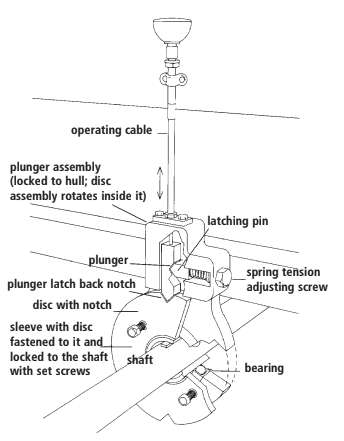
All boats should have the means to prevent the propeller shaft from rotating when the boat is under sail. This can be as simple as putting the transmission in reverse while sailing forward, or as complicated as providing a separate shaft lock or brake to prevent rotation. Some transmissions use oil pressure from their own oil pumps to control shifting. There is no pressure when the engine is off, so these types require a separate shaft lock. These transmissions are sometimes called hydraulic transmissions but, in reality, they are only transmissions with hydraulically controlled shifting. Other transmissions control shifting by purely mechanical means. Some of these are splash lubricated, and have no oil pump. These transmissions are sometimes called mechanical transmissions. Both these names, hydraulic and mechanical, refer only to the method of shifting. The method of transferring power in both cases is mechanical. True hydraulic drives are not part of this discussion.
Although the forward motion of the boat makes the propeller shaft rotate, some gearboxes may not be well lubricated because the oil pump isn’t being driven, and the gears that accomplish the splash lubrication are not turning. Overheating and damage to the marine gear may result.
Some offshore sailors add a pulley and a belt to their coupling, and use the free-turning shaft to produce electricity for battery charging. This power is not free, though, as it comes with increased shaft wear, speed reduction, and increased mechanical and electrical complexity.
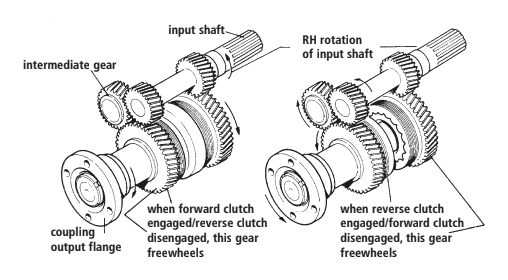
The Hurth HBW transmissions, which are commonly married to marine power plants, are wet-plate clutch types with rotating clutch units, one for forward and one for reverse. The shifting of these units is controlled mechanically, and they are lubricated by a splash system. In all but the smallest models, when the engine is running, the transmission fluid is cooled by the heat exchanger, but when the engine is not running, the fluid heats up with rotation of the clutch units and there is no way to dissipate the heat, so there’s a chance of damage to the transmission.
Considerable torque
The way to avoid this problem is to place the transmission in gear opposite the direction of travel (normally reverse). The only problem with this approach is that if the transmission clutch plates are worn, the clutch plates might slip, making things much worse. The propeller generates considerable torque, even at 3 knots under sail. If the propshaft cannot be completely stopped by putting the transmission in reverse, the better choice is to put it in neutral because the friction from slipping clutch plates can generate even more heat and accelerate clutch plate wear. The solution in some cases may be to use a shaft lock. The transmission can then be in or out of gear and no damage will be done. Or you may wish to simply check your shaft and coupling occasionally to make sure that when sailing with the transmission in reverse, the coupling and shaft do not rotate at all.
Not all transmissions operate like the Hurth HBW. Check your manual. We specifically asked Don Moyer of Moyer Marine what was the best way to treat the Atomic 4 transmission, and he said that since the transmissions will not lock in reverse, the choices are forward and neutral, and as far as he could tell, the transmission would not be harmed in either case.
Why lock the transmission in reverse when going forward? In the case of the Hurth HBW transmissions this is the recommended practice. That is the simple answer. The complicated answer is that the mechanical servo shifting mechanism in these transmissions has a ball ramp device that uses the transmission’s own output torque to lock up either the forward or reverse clutch. This servo mechanism works properly when the engine is driving the prop but does not help in clamping the clutch plates when the prop is trying to drive the transmission. By selecting the reverse clutch pack instead of the forward one, the ball ramp servo system works to clamp up the reverse clutch pack and prevent the shaft from turning. Something analogous and easier to understand (but in no way mechanically similar) is to thread a nut onto a bolt. With the bolt turning clockwise (viewed from the bolt head end) if there is drag in the nut it treads up onto the shaft and stops when it runs out of threads (clamping imaginary clutch plates). Keep turning the bolt and note which way the nut turns. Now stop turning the bolt and keep turning the nut in the same direction.
The nut now unthreads itself from the bolt (loosening imaginary clutch plates). If you could at this point magically change the nut and bolt from clockwise to counterclockwise threads while continuing to rotate the nut in the same direction as before, you would drive it back up the shaft and again clamp the imaginary clutch plates. Selecting the reverse clutch pack accomplishes something analogous to this, although the actual mechanisms are not the same.
My old Atomic 4 had a manual transmission that could only be locked in forward. Reverse would only work with constant pressure on the shift lever, so my options were limited to forward or neutral. I always locked the gear in forward, and it prevented shaft rotation. This boat had a two-bladed propeller that created much less torque than the three blades on some good old boats. My current boat, a 31-foot sloop, has a three-bladed propeller and a Westerbeke Short-Profile Sailing Transmission. I lock it to minimize wear on the gear, stuffing box, and cutlass bearing. According to the Westerbeke manual, I can allow the shaft to rotate freely with no potential for damage, but I prefer to prevent it from rotating under sail.
As is apparent, there is no one answer to the question “in gear or out?” under sail. I thought of trying to compile a list of transmissions, but there are too many makes and models. The best advice is to read the owner’s manual for your own transmission and follow the recommendations. If there is any doubt in your mind about the specific requirements of your particular transmission, lock the shaft. If you want to reduce propeller drag and you have a two-bladed prop and a full keel, mark the shaft when the blades are vertical behind the deadwood and lock the prop in that position. With a fixed three-bladed prop, we’re stuck with drag. In most cases, with a three-bladed prop, the drag is a little higher locked than with it rotating, but it’s a trade-off in terms of speed loss versus transmission wear. I do not have to pay for speed lost, but I will have to pay for transmission wear someday, so I lock my prop.
Start in gear?
If the transmission is kept in reverse while sailing, in some cases the torque from the prop may make it difficult to shift it into neutral. If that is the case, it may be necessary to head up, lose speed, then shift out of gear and start your engine. This does not seem to be a problem with all boats and transmissions.
In my research, I found there were as many opinions as there were people asked. It is an issue, so it is best to consult the owner’s manual and know what is appropriate for your transmission. If in doubt, call the motor manufacturer or transmission builder and ask them; then follow their advice. I called several marine transmission distributors and in certain instances they gave advice contrary to that in the manual. Don’t rely on someone else’s opinion. Read the manual or call the manufacturer. If you cannot do this, lock the shaft.
Personally, I much prefer to lock the shaft, because I find that the sound of rotating gears with little lubrication ruins the peace of a good sail.
Bill Sandifer is a marine surveyor and boatbuilder who has been living, eating, and sleeping boats since he first assisted at Pete Layton’s Boat Shop in the ’50s. He’s worked for Charlie Morgan (Heritage) and Don Arnow (Cigarette). And he’s owned a commercial fiberglass boatbuilding company (Tugboats).
Thank you to Sailrite Enterprises, Inc., for providing free access to back issues of Good Old Boat through intellectual property rights. Sailrite.com