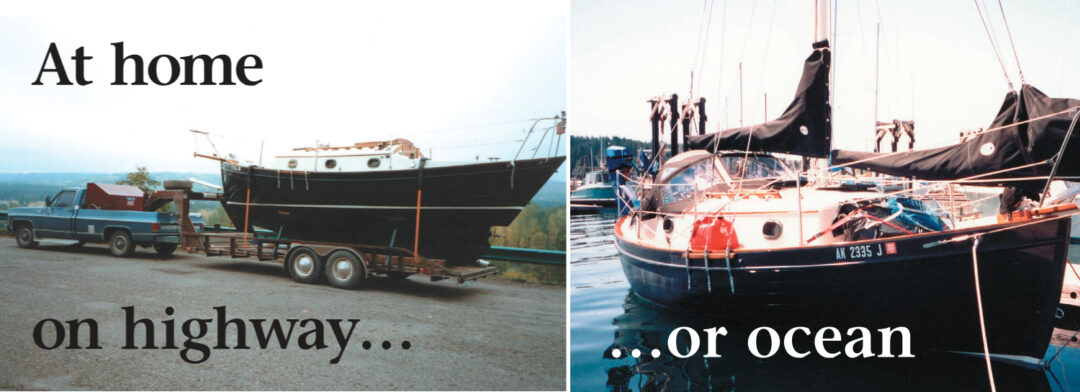
…or ocean
Issue 11 : Mar/Apr 2000
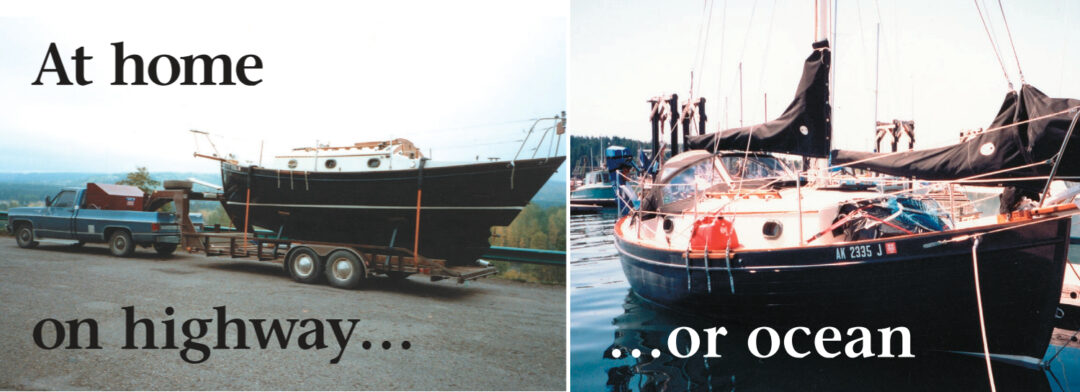
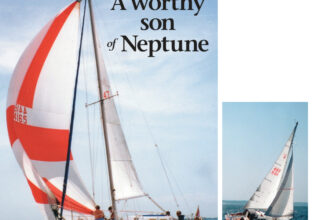
The Pacific Seacraft 25 is a dark horse. She’s not built any longer, except perhaps to special order, and comparatively few people know her, yet she is remarkable in this respect: she is a trailerable sailboat that is fully fit to take on the ocean.
A Cruising World article once described this cocky little 25-footer as “the perfect trailerable offshore family cruiser offering seaworthiness, ease of handling, speed, comfort, and years of safe low-maintenance voyaging.”
The magazine went on to say that “her traditional double-ended hull is patterned after the famous No Man’s Land boats of the 19th century, which were able to carry heavy loads and sail swiftly and safely in all types of weather.”
Well, perhaps the author of that glowing account had his or her rose-colored spectacles on that day. Perfect she is not, neither is she swift. But one has to admit that the hyperbole this rugged cruiser generates among her admirers is very infectious. And if she’s not actually perfect, it hardly matters because she exudes that magical combination of allure and seduction that makes perfection quite unnecessary.
Although she’s trailerable, she’s not the sort of weekend trailersailer you take to the lake for an afternoon’s relaxation. This boat weighs more than 2 tons and draws more than 3 feet, so it would take time and planning to launch and retrieve her. On the other hand, you can haul her out, take her home, and leave her in your driveway for the winter. You can see her every day then, and drag the neighbors in to admire her. Like many fine cruising yachts, she shows her workboat heritage in her simple, no-nonsense lines. With a nearly plumb bow and mildly raked stern, she avoids the wasted space in long overhangs and has a long waterline for cargo-carrying capacity. No chrome, no tinsel, no smoke and mirrors, just good solid oak, teak, and bronze. She has the mien of a voyager about her, a restless, purposeful appearance. She wants to go to sea.
Basic design
The Pacific Seacraft Corporation’s 25-footer looks as much like a ship’s lifeboat as a fishing vessel. She’s apple-cheeked and buoyant up forward, and her topsides are probably a little higher than those of a fishing boat but do not detract from her handsome looks. Her rudder hangs on a sharply raked sternpost, like a Folkboat’s, and it is a measure of this boat’s ruggedness that the rudder’s oak cheeks are fastened in place by no fewer than 11 bolts.
The hull is hand-laminated with a high glass-to-resin ratio for extra strength, and the topsides are scored lengthwise to resemble wooden carvel planking. The decks and cabintop are balsa cored for lightness and strength.
The forward face of the cabin trunk is high, boxy and unrelievedly white. It glares at you with a baleful blank stare, daring you to spray graffiti on it. It’s probably the least attractive part of this boat but its looks could be improved considerably with the clever use of paint or a strip or two of teak.
There is a gunwale of sorts: it’s a couple of inches high at the bow and gradually fades out to nothing at the cockpit. It’s topped with a teak caprail almost wide enough to skateboard on.
Her keel is a modified traditional shape, a full-length keel cut away at the forefoot and also (because of the rake of the sternpost) at the heel. Nevertheless, a long straight section remains, flat on the bottom for a good length, so that she will take the ground without falling flat on her face.
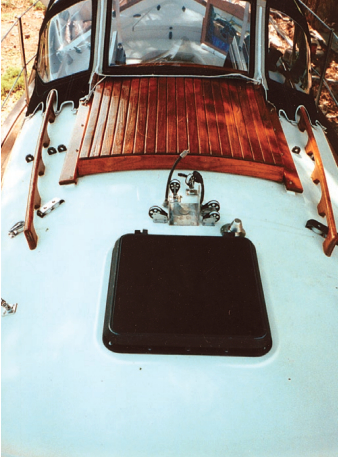
The cabintop, although rather high, is not unduly obtrusive, except at its forward edge, as we have mentioned already, and the sidedecks are reasonably wide — getting wider, in fact, as you move forward. The sliding cover over the companionway hatch runs in deep grooves, but lacks a seahood, or turtle, to prevent heavy spray from driving underneath it and entering the cabin.
The self-draining cockpit is snug and solid. It has a very pleasing feeling of security; and here, as everywhere else on this boat, the metal fittings are substantial hunks of stainless steel or bronze. It has two drains at the forward edge — it could probably do with two more for serious sea work — but it has no bridgedeck, only a 9-inch sill to keep water from flooding below. This means you’d need to keep one or two companionway washboards in place while you were at sea, and you’d have to make sure they were fixed in place with barrel bolts or some such arrangement.
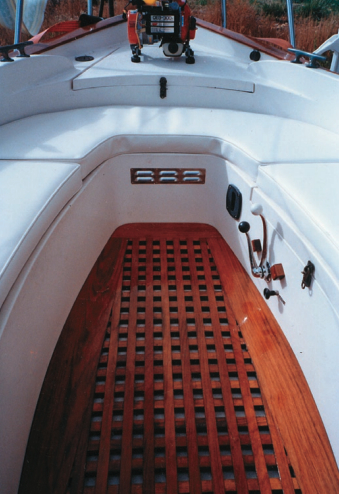
The whole of the cockpit floor is one big hatch cover with downturned flanges that fit over a sill with upturned edges. If you undo 25 fat screws, you can lift it out and gain splendid access to the engine and the stuffing box, but it is a large area to seal satisfactorily, and if it isn’t watertight it will admit large portions of the ocean when a wave fills the cockpit.
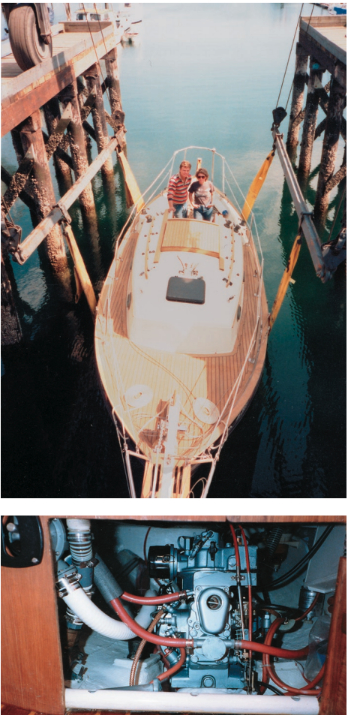
The standard engine is an 8-horsepower Yanmar diesel that fits into the space under the cockpit as a finger fits in a glove. Access from the cabin is minimal; if you remove the companionway step you can peer at the engine hopefully and wipe its little face, but that’s about all. If you’re desperate enough, you can undo four screws and remove a panel adjacent to the starboard quarterberth. Then you can get to the engine, or at least to one side of it, either by leaning around the corner awkwardly or by lying full-length on your side in the quarterberth.
Accommodations
It’s surprising, given the height of the cabintop, that there isn’t more headroom down below, but it’s just as well that the impulse to make the cabintop even taller was resisted, for that would surely have turned her into a duckling so ugly not even her mother could have loved her. As it is, the headroom is about 5 feet, which is of no consequence when you’re at sea and which you can endure with good grace in port if you are a person of even temper and likeable nature. There are no overhead beams to hit your head on — it’s covered with a zippered headliner.
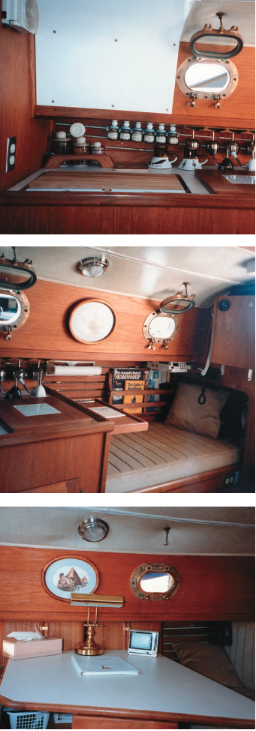
Right up forward in the fo’c’s’le there’s a pretty teak door you should open with caution. It allows access to the chain locker. If the chain is piled up high, it will spill out all over you as soon as you slide back the barrel bolt.
Aft of the door is a V-berth in the form of an isosceles triangle. If you and your partner have sharply tapered hips, legs, and feet, it will fit you fine. Otherwise it’s best left to kids. The hull up here is covered with a glued-on fabric that the kids will probably pull off. There is a deep storage locker under the V-berth.
Also in the forecabin are a head, to port, and a half-length hanging cupboard with a shelf on top, to starboard. A curtain on a swinging arm separates the forecabin from the main saloon.
Probably the most prominent feature of the saloon is the portside dinette, an arrangement of two thwartship seats with a raised table in between. The forward seat accommodates two people side by side, the aft seat just one. The outer edge of the table is tapered to fit neatly between them. The table can be lowered to turn the seats into a double berth, which, although it, too, is tapered, offers more foot room than does the V-berth.
To starboard, convenient to the double seat, is a galley of generous size with a two-burner alcohol stove, a sink, and neat teak racks for dishes, mugs, and cutlery. There is stowage for provisions beneath the stove and in an enormous louvered locker under the double seat.
Aft of the galley is a snug quarterberth, bringing the total number of berths to five. That’s three too many for a dedicated cruising boat of this size, but fine for family vacation cruising or short coastal hops.
The joinerwork is first-class, as is only to be expected from this manufacturer, and the fittings are substantial. Six solid bronze portlights, all opening, and an overhead hatch bring light and plenty of ventilation to both cabins. The cabin sole is oak parquet on a plywood backing.
The rig
The Pacific Seacraft 25 is a masthead cutter or sloop with a sail area of 250 square feet. Her bowsprit is quite short, and the staysail stay comes down to the stemhead, so there is not a lot of breathing room for the jib in the cutter version. Nevertheless, since she badly needs the extra area of a large genoa jib to keep her moving in light weather, it must breathe as best it can.
The spars are painted aluminum, and the mainsail is equipped with slab reefing. The mast, which has a single spreader and fore-and-aft lower shrouds, is stepped on deck in a tabernacle that allows the spar to be dropped and raised quickly. A substantial wooden compression post attached to a half bulkhead transfers the downward thrust of the rig to the keel.
The main boom is fairly short, so no boomkin is needed, just a split backstay, bowsed down to the quarters, to give the tiller swinging room. The shroud chainplates are placed on the outside of the hull and secured by four bolts each. The mainsheet runs through quarter blocks on either side of the tiller and is easily accessible to the person at the helm. Tracks for sliding foresail sheet blocks are screwed to the caprail on either side of the cockpit.
Performance
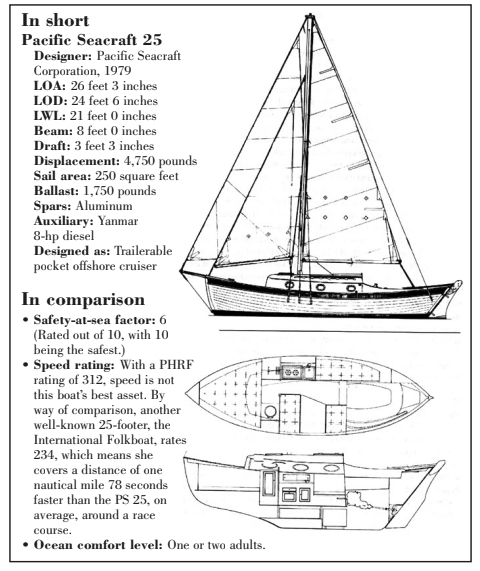
The fact that the PS 25 has earned a racing handicap rating must prove something, even if her PHRF number is 312, but no tactful person mentions speed and PS 25 in the same breath. Luckily, there are other facets to performance, and it is in these that she shines. Her buoyant ends will keep her dry, and her long keel will make her track straight and true. She’ll heave to well and run before big seas in safety with just a windvane steering her.
Her little Yanmar produces more than 3 horsepower per ton of displacement, so she will reach her hull speed of 6 knots with ease in calm weather, although she might struggle just a little against a strong wind and heavy seas. It is important to fit the correct propeller — one that will allow the engine to reach top revolutions (and therefore produce full power) in heavy going. Yes, the PS 25 performs well, no doubt about it. She’s just not known for speed.
Known weaknesses
- Check the cockpit floor for leaks.
- Check the main sliding hatch cover for leaks from driving spray, and fit a top cover if necessary.
- Install fittings that allow the two lower dropboards to be securely fastened in place at sea.
Owner’s opinion
Steve Way, of Tacoma, Washington, owned a Pacific Seacraft 25 for nearly two years. He sailed her many hundreds of miles all over Puget Sound and the Canadian Gulf Islands and completed two circumnavigations of Vancouver Island in her.
“She was a great little boat,” he said. “She was fun to sail. I sailed with kids, and they could handle her easily. I would take a PS 25 across an ocean without hesitation.”
There’s weight behind those words. Between 1993 and 1997, Way circumnavigated the world in a boat not much bigger than the PS 25. She was a Laurent Giles-designed bilge-keeler, a Westerly 26 named Lookfar.
His PS 25 was rigged as a sloop and had no bowsprit. “She was initially tender, he recalls, “but after heeling a little, she stiffened up. She wasn’t a fast boat, but she went well on a reach.” He carried a cruising spinnaker and found it an asset in light weather.
She behaved impeccably in heavy weather during one of Way’s cruises around rugged Vancouver Island. “We were on the West Coast, which is wide open to the North Pacific, and it started to blow out of the north. The swells built up, too, and eventually we were running under storm jib only. She handled the swells beautifully with no tendency to broach. I don’t know what the windspeed was, but a large powerboat came into port after we did and reported winds of 45 knots.”
What about the lack of headroom? “It was a non-factor. It never bothered me.”
Way has owned several boats since then, but he still recalls that his PS 25 was well finished and very strong. “She also had a sweet little single-cylinder Yanmar engine that you could start by hand. It gave her full hull speed.”
The one piece of advice he has for anyone intending to go to sea in a PS 25 is this: “Keep the two lower dropboards in place all the time. Secure them well.”
Conclusion
You should be able to buy a used PS 25 for between $15,000 and $20,000 depending on her condition and upgrades. That makes her very reasonably priced for an ocean-going boat. Her tough construction makes her cheap to maintain, and the fact that you can pull her out on a trailer any time you want means you’ll save on boatyard bills. If you’re short of time, the trailer will also enable you to spend sailing vacations in exotic spots you’d never have time to reach ordinarily.
The PS 25 is a sweet-natured little boat and a good singlehander. It’s almost certain she’d still be in production if she had the standing headroom that modern sailors have become used to. Meanwhile, if you don’t mind doing the PS 25 crouch now and then, she’s a bargain waiting to be snapped up.
John Vigor is a freelance journalist based in Oak Harbor, Wash. He has raced, cruised, and written about boats for more than 30 years. He’s the author of two new books, The Seaworthy Offshore Sailboat: A Guide to Essential Features, Gear and Handling (International Marine), and Twenty Small Sailboats to Take You Anywhere (Paradise Cay), which is the source of this and other reviews in this series. He also wrote Danger, Dolphins and Ginger Beer (Simon and Schuster), a sailing adventure novel for 8- to 12- year-olds; The Practical Mariner’s Book of Knowledge (International Marine); and The Sailors’ Assistant (International Marine).
Thank you to Sailrite Enterprises, Inc., for providing free access to back issues of Good Old Boat through intellectual property rights. Sailrite.com