A handsome and stoutly built offering from Canada
Issue 40 : Jan/Feb 2005
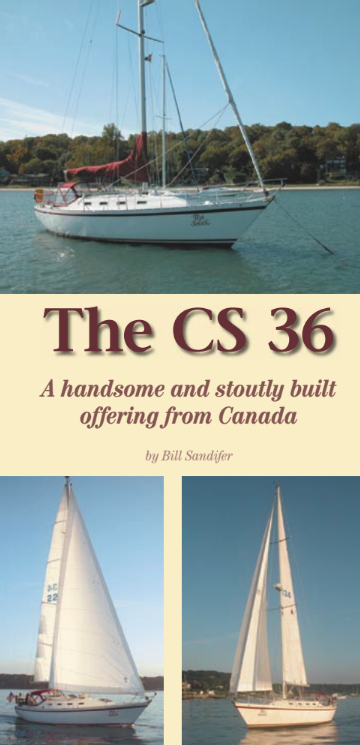
The Canadian Sailcraft 36 is one of the best-built boats I have yet sailed. That it is underappreciated is evidenced by the fact that even in its home waters of Long Island Sound, New York, where there are literally thousands of boats, there are only two Canadian Sailcraft 36s. Where you can find them, these boats are very well built, sail well, are fairly priced on the market, and are a sheer joy.
Design and construction
What is so good about the boat? In a word, quality, both in design and in construction. The boat was designed by Raymond Wall, of Camper & Nicholsons fame. Raymond had previously designed the CS 27 on commission for Canadian Sailcraft and company owner Paul Tenneyson. He eventually became the in-house designer for Canadian Sailcraft. However, he eventually left Canadian Sailcraft as he felt “things were moving too fast for the quality required during different phases of production.” The company appointed Tony Castro, a Ron Holland protégé, to replace Raymond as the head designer. Tony produced a number of smaller and larger designs, but the CS 36 is all Raymond Wall’s design and it shows.
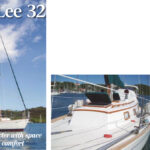
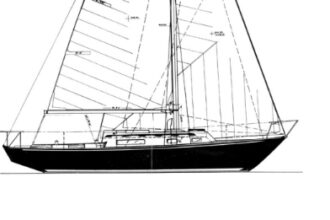
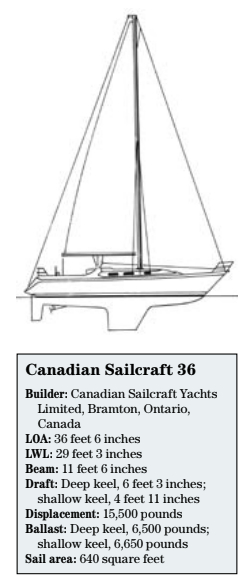
The CS 36 is a good-looking design with reverse-angle transom. It is a sloop with a double-spreader rig and all stainless-steel hardware on deck. No teak is evident on deck. In today’s market the design is slightly dated, but as the sea has not changed, good design always remains in style. The proportions of the boat put it in the middle of the spectrum, neither being too beamy nor too narrow. The keel is a fin type with detached rudder mounted on a partial skeg. The boat steers as though on rails and comes about like a dinghy, quick and agile. The hull itself has a nice shape to it, not flat-bottomed, and does not pound when it encounters large wakes of passing powerboats. The day we sailed the breeze was only 8 to 10 knots, so it was hard to know how the boat would handle bigger waves. Based on how it handled the powerboat wakes, I would say this boat would be comfortable at sea.
On deck
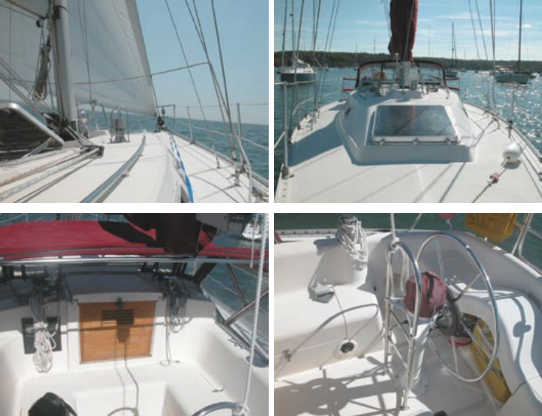
The boat is set up for easy handling with all sheets and halyards led to the cockpit. The halyards are served by single-speed Lewmar 30s to port and starboard on the aft end of the coachhouse roof, with a series of stoppers that allow one winch to handle the halyards, dual reefing lines, and mainsheet, which is rigged for mid-boom sheeting. Genoa sheets are handled by a pair of two-speed, self-tailing Lewmar 44s on the cockpit coaming.
We cranked in the genoa sheet hard, and the sail flattened out visibly. Owners Stacy and Lori Aslan are considering a new set of sails for the boat for next year. The main is fully battened and has a Doyle StackPack for ease of furling. The day we sailed, the original monofilament StackPack had broken due to age, but Stacy says the system works well when operational.
The mast is keel-stepped and has a neat connection at its base to direct the water that enters the spar into the bilge. Small things like this point to the quality and pride with which the boat was built. A look around the deck shows well-bolted lifelines, a well-thought-out flush anchor locker, and a large T-shaped cockpit with a 36-inch stainless-steel destroyer wheel.
The rig
The only negatives on deck are the shrouds adjacent to the mast. All shrouds attach to chainplates that project through the deck in the middle of the passageway. If they were outboard, you would lose sheeting angle but gain a wider walkway. If they were inboard, they would be next to the cabinhouse with a better, slightly sharper sheeting angle, and one could walk outboard of them on the way to the bow. Located as they are in the middle of the walkway, they present quite an obstacle for those going forward.
The chainplates are well secured belowdecks. The mast is a heavy-duty aluminum extrusion with a tie rod forward of it tying the keel and the deck together. The tie rod helps keep the deck from buckling upward as the mast pushes downward and the chainplates pull upward.
Under way
We got under way from a mooring at the Centerport Yacht Club in Centerport, New York, and were quickly pushed to sea by the Westerbeke 30 diesel married to a V-drive under the cockpit. This engine is well suited to the 36-footer. Stacy thought that the two-bladed prop that came with the boat could be improved upon and may go to a three-bladed feathering prop next year.
Belowdecks
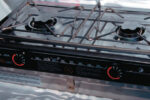
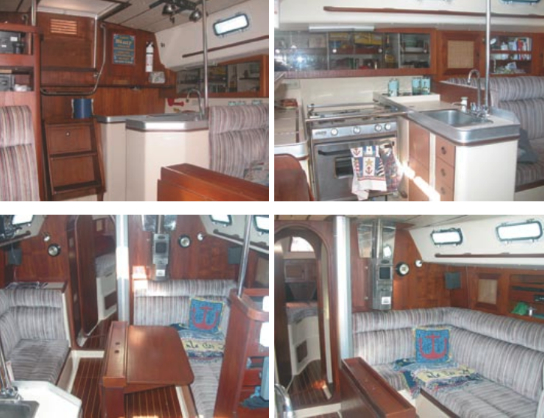
When going below, one is immediately impressed by the open and neat accommodations. The layout is conventional with a V-berth forward, followed by a head to starboard and a limited hanging locker to port. Moving aft, there is an L-shaped settee to starboard and a straight settee to port. The galley is to port aft, with the navigator’s station to starboard at the head of the quarter berth. There are two really notable areas in the belowdecks arrangement. The first is the head and shower in that they rival ones on most 40-foot or larger boats. The head is really big, usable, and well laid out. The sole is a teak grate with a drain to a dedicated shower sump. The shower curtain is on a rod overhead to protect the entire head from getting wet.
The second remarkable area is the icebox. This 36-footer has no refrigeration, but the icebox is the best-insulated box I have ever seen. There is a molded fiberglass liner in the box with a three-part top, drain, and interior shelves. The icebox drain is connected to an electric pump that discharges melt water from the icebox into the galley sink through a dedicated fitting.
While I was there, Stacy noticed water left in the bottom of the icebox. He simply turned a switch, and the box was quickly drained into the double sink on the opposite side of the galley . . . a thoughtful touch for a production boat. These touches are more like those found on a Hinckley or a custom craft than on a production sailboat.
The interior of the lockers is well finished and the molded-in liner is neat wherever you find it. Access to the storage areas below the V-berths is typical of the whole boat: clean, neat, well-thought-out, and smoothly finished.
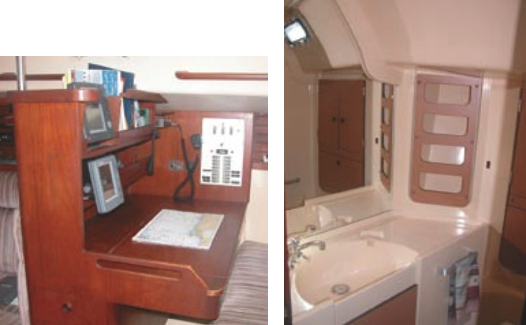
Stacy was having new teak-faced lockers built over the V-berth, as the boat came with open-bin lockers that dump their contents during a hard sail. The new teak lockers will match the rest of the interior of the boat and be finished bright. There is a teak locker in the galley. This is another nice touch that is unusual on a production boat.
Stacy had to have a new cabin sole installed in the boat when he bought it, as the old one made of teak plywood had rotted from exposure to bilge water. The CS 36 has a shallow bilge, so water tends to wind up under or on the cabin sole. The new sole is beautifully finished in clear varnish, semigloss, and should hold up better than the original. That it held up for 24 years is not bad for a plywood sole.
There are bronze ball valves on all seacocks in the bilges. These valves were not standard; the earlier ones were replaced at some time by a previous owner. Tanks are well secured, and all electrical and plumbing systems are neatly done.
The engine
Several areas are open to criticism in the engine layout. Access is just plain impossible. The previous owner of this boat assumed the engine was raw-water cooled because he could see water coming out of the exhaust fitting at the transom. He never checked the freshwater cooling system, as he did not know it had one. One has to lie on one’s side in the quarter berth, head aft (it’s a V-drive remember), remove a panel in the side of the quarter berth, and use a small cup to fill the reservoir of the freshwater system.
The saltwater circulating pump is under the manifold and might be accessible from this position, but I doubt it. To get to the other side of the engine to check the oil, one gets into the cockpit locker if one fits (I didn’t) and removes a panel to find the dipstick. The aft end of the engine is accessible by removing the companionway ladder, but there really is little here that needs attention.
Things to watch for
The final criticism I have is of the ladder from the cockpit down into the cabin. It is a two-part vertical ladder that has the lower two steps set oververtical, a little aft of the top step (see photo on Page 6). This means that you descend a more-than-vertical ladder to get to the cabin sole. I had to look carefully where I put my feet. After many similar maneuvers even Stacy traverses the ladder slowly. If this boat were moving in a seaway, this ladder could cause a fall. An improved angle would obstruct the galley. Perhaps shimming the bottom two steps out a little to an actual vertical rather than over-vertical would help.
Summary
This is a beautifully built sailing boat of high quality. In its review in 1999, Practical Sailor did not harp on engine access as much as I did, but the engine layout did not get rave reviews either. The boat behaves well under sail; is easy to move on about the deck, except for the shrouds; and is a real joy. I definitely would recommend it to anyone.
Thank you to Sailrite Enterprises, Inc., for providing free access to back issues of Good Old Boat through intellectual property rights. Sailrite.com