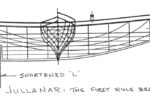
The Pearson Triton occupies a niche in the maritime hall of fame
Issue 12 : May/Jun 2000
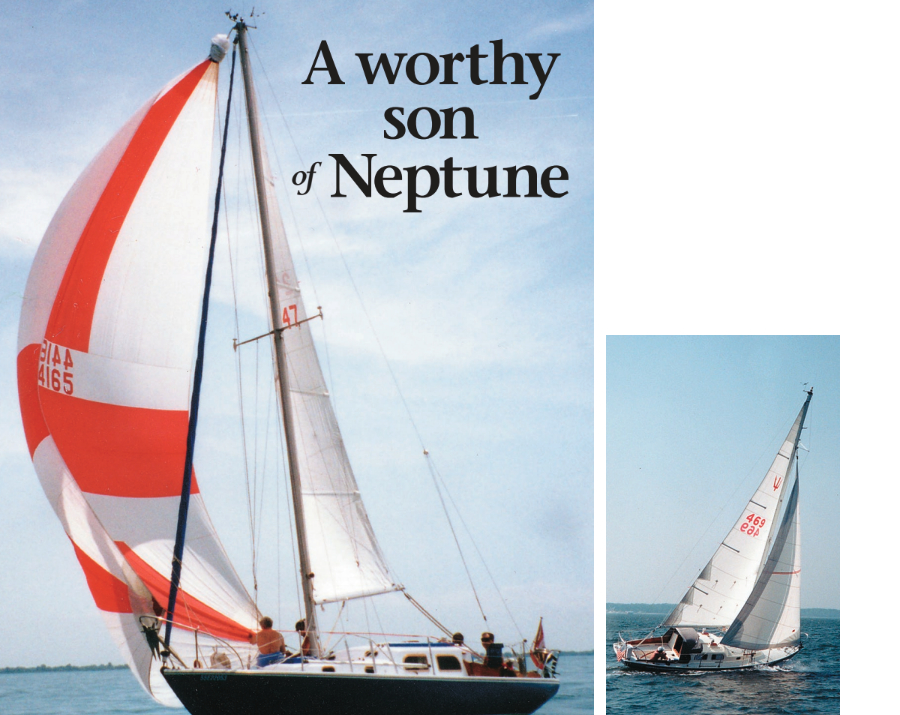
They’re everywhere. More than 700 Carl Alberg-designed Tritons were built between 1959 and 1967 by Pearson Yachts in Rhode Island and Aeromarine Plastics in California, and most of them are still floating. Many have undertaken serious voyages, for this skinny Scandinavian was designed to be at home on blue water.
Alberg was of Swedish descent, and much influenced by European standards of seaworthiness as they had evolved in working boats over the centuries. There’s a little of the Viking longboat in the Triton, and more than a little of the Folkboat.
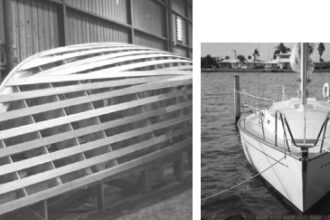
Not just because of her distinguished designer, the Triton has her own niche in the maritime hall of fame. She was one of the first boats in the United States to be built of fiberglass, a technique so different from traditional wooden boatbuilding methods that it stood the whole industry on its head.
At 28 feet overall, with a displacement of about 8,000 pounds, the Triton is on the verge of being a splendid cruising boat for two people. She teeters on the verge only because of her small interior (inevitable in a boat so skinny and short on the waterline), not for any want of seaworthiness. Even the small interior wouldn’t matter quite so much if a bit more of it were devoted to the galley.
She does have low freeboard, it must be admitted, so she isn’t as dry on deck as are some of her more modern sisters when the wind is on the nose, but she makes up for it in looks. Those of us who studied the Triton’s lines on paper for years before we saw a real, live one, were belatedly surprised by her good looks. Her delicate stern and gentle sheer had always seemed to be badly marred by that tall, slabsided doghouse protruding skyward at the aft end of the cabintop. But, upon closer acquaintance, that doghouse wasn’t nearly as repulsive in reality as it had been on paper, and if you stationed yourself off to one quarter while she waltzed away from you, flirting and showing her gorgeous transom, your gaze never reached the doghouse anyway.
But we must not get fixated on looks, important as they are. The two major assets of the Triton are these:
•Even after all these years, most Tritons are capable of going to sea. Many do. At least one has circumnavigated. Some will need to be upgraded, and those that haven’t been properly maintained will need a thorough refit, but basically they are sturdy boats of inherently seaworthy design that will look after you in bad weather.
•They’re cheap. You’ll find bargain-basement Tritons going for $10,000 or less and nicely fitted-out Tritons for $15,000.
Basic design
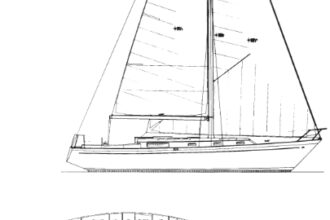
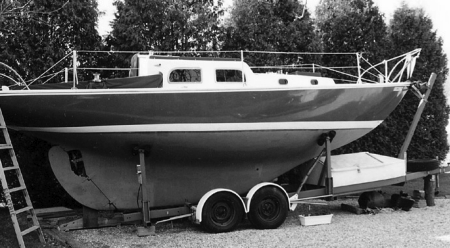
Like many boats of her era, the Triton’s design was influenced indirectly by the Cruising Club of America (CCA) rule (refer to Ted Brewer’s article on Page 18). Quite coincidentally, this rule fit well with Alberg’s basic design philosophy. He was a proponent of the type: large mainsail, small foresail, low freeboard, and moderately long overhangs fore and aft. To this he added a traditional full keel, except that he cut it away up forward and sloped it inward from the stern, so that it appeared to be starting the metamorphosis toward a fin keel (see photo on Page 49).
Most noticeably, Alberg made her beam quite narrow so she would slip through the water more easily. In this respect, he sacrificed accommodations for performance; but in those days it didn’t matter because almost all boats followed the same pattern. It wasn’t until a decade later that the boats considered to be “normal” began to be wide and shallow, rather than deep and narrow — and the sacrifice these newer boats made for the interior space they gained was seaworthiness.
Within reasonable limits, narrow and deep is safer at sea than shallow and wide, although if you’re not planning to cross an ocean, as most production-boat owners are not, you can afford to sacrifice a certain amount of safety because you’re never far from help and shelter.
The hull of the Triton is solid fiberglass, varying from about 3/8 inch at the sheerline to about 3/4 inch in the keel area. The decks are also fiberglass, cored with end-grain balsa. Early boats had external ballast keels and keel bolts, but a little over halfway through the production run a change was made to a cast-lead keel encapsulated in the fiberglass hull. The ballast amounts to about 40 percent of total displacement and gives her a wide range of stability. Although the Triton has reasonably hard bilges, which spells good form stability, her narrow beam causes her to heel over 10 or 15 degrees before the keel really starts to show who’s in charge.
Her foredeck is wide and reasonably clear of obstructions, and while it would be wonderful if a fairy could wave her magic wand and make the sidedecks wider, it isn’t going to happen except in your dreams. About all you can say of them is that they’re manageable. You might also wish that if the fairy could spare a second wave of her wand, something aesthetic would happen to the doghouse, that upward step in the coachroof. It’s more likely, however, that her wand would short out or blow a transistor when faced with a task of such magnitude.
The cockpit is more than 6 feet long, but it has a bridgedeck to keep water out of the cabin, and it is narrow enough that it ships no water when the boat is laid on her beam ends. In any case, owners report that it doesn’t hold enough water, even after a pooping, to threaten the safety of the boat.
The original rudders were wooden, made of mahogany, and while they have many advantages, they do tend to deteriorate over lifetimes as long as those the Tritons appear to be enjoying. You can have a new rudder made of fiberglass, but you can also laminate a new one from marine plywood if you have the time and inclination.
The original engine was the venerable Atomic 4, a 30-hp, four-cylinder gasoline engine designed from the very start for marine use by the Universal company. By today’s standards, it’s quite crude — but that gives it certain advantages denied to modern diesels. If you have even the most rudimentary knowledge of how an internal combustion engine works, you can usually coax an Atomic 4 into life. It will absorb an extraordinary amount of abuse and still get you home on two cylinders. You can attack it with crude wrenches that would cause thousands of dollars’-worth of damage to a finely engineered diesel, and take pieces away to your local blacksmith for repair. Parts are still available, as are reconditioned engines and books on repair and maintenance.
Thirty horsepower is far more than the Triton needs, of course, but it means you’ll achieve hull speed with half the noise and a quarter the vibration of a comparable diesel.
Accommodations
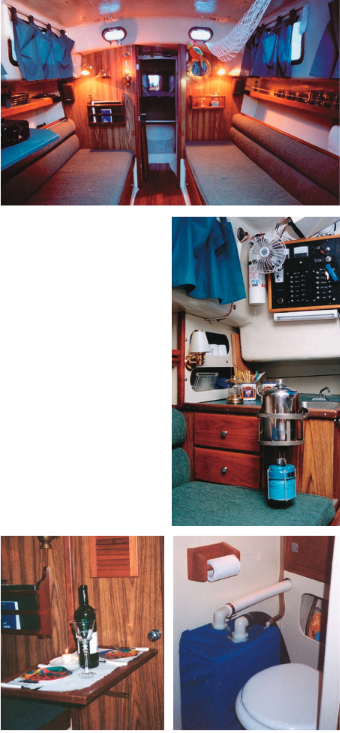
For a boat only 20 feet long on the waterline, the Triton has a reasonable, if not generous, amount of room below, thanks largely to the high cabintop. You’ll find more than 6 feet of headroom beneath the doghouse roof in the main cabin, and a little less as you move forward.
The usual V-berth resides in the fo’c’s’le, but it’s not really usable at sea, and in port it’s probably better left to the kids. Aft of the V-berth there’s a separate, but rather small, head compartment (designated on Pearson’s plans as a rather posher-sounding “toilet room”) with a linen locker; and opposite, to starboard, a capacious hanging locker and shelf.
The settee berths in the main cabin are 6 feet 3 inches long and awkwardly wide — too wide for sitting without something to support your back and too narrow for a double berth.
In the vertical step between the cabintop and the doghouse, Pearson built in two opening portholes. These not only greatly help ventilation below but offer you the chance, when you’re anchored in a heavy blow, to stand on tip-toe down below in the comfort of your own cabin and see the other boats dragging down onto you.
Aft of the settees, we stumble across the Triton’s disaster area, the galley. Although the Swedes are not renowned for haut cuisine, it’s hard to believe that Alberg so hated food that he refused to leave space for a permanent cooker. No doubt it was the usual pressure from Pearson’s sales staff for the greatest possible number of beds that forced the decision upon him. In any case, most Triton owners have had to fend for themselves. Most use portable stoves, which is not a solution for a deepsea voyager. Others have bolted a gimbaled, single-burner to a bulkhead. That works, but it isn’t exactly clever or efficient. It’s a sad thing, but the galley of the Triton will never be recognized as Alberg’s magnum opus.
The rig
Most Tritons are Bermudian sloops, but a yawl rig was available, and a few were built. Some sloops — in fact all the early ones — were fractionally rigged, with the forestay joining the mast about three-quarters of the way up, where the mast was beefed up with jumper struts. Later, Pearson offered a masthead rig with a shorter mast. The earliest Tritons, the first 100 or so, had only single lower shrouds, but after complaints that they were inadequate, Pearson changed the rig to double lowers. The sail area of the fractional sloop is 371 square feet, with 231 square feet of that in the mainsail and 140 square feet in the working jib.
The aluminum mast is stepped on deck and therefore prone to the usual problem of crushing the cabin beam supporting it. The narrowness of the gangway below makes it difficult to slide past a keel-stepped mast, but if you’re thinking of buying a Triton for long-distance voyaging, you might want to consider installing a solid compression post from directly beneath the mast step to the ballast keel, even if you have to suck in your tummy to get past it. It’s the quickest, easiest, and strongest solution to a vexing problem.
The boom is 14 feet long and covers most of the cockpit, so the anchor point for the mainsheet is conveniently far aft, on the little lazarette deck, where the sheet is out of everybody’s way.
Performance
As the Triton heels, her long overhangs dip into the water and lengthen her waterline. As the maximum speed of a displacement boat is directly related to her waterline length, the Triton should be capable of faster maximum speeds when she’s well heeled over than when she’s upright. That is the theory, anyway, and it is frequently propounded by shallow thinkers.
Deeper thought will reveal the fact that, in practice, she’ll rarely reach hull speed under sail while heeled far over (except occasionally on a broad reach, when everybody else is going fast, too) and her performance at less than full speed might even suffer from heeling because she’s immersing more hull area and creating more drag. No matter. Suffice it to say that the Triton is a reasonably fast boat if she has good sails and you sail her well. Her performance to windward is probably better than that of most cruisers, and as for the rest of them, it simply isn’t fair to compare her with racers or modern coastal cruisers of similar size. They’re faster, but they pay for it in other ways. Her PHRF rating, for what it’s worth, is about 246.
She seems to be a little tender at first, which is the sign of a comfortable sea-boat. She heels over quite easily to 10 degrees or a little more, after which gravity wakes up the sleeping ballast keel and puts it to work. She becomes increasingly more difficult to tip over, and owners report that it’s not easy to submerge the toerail.
She does carry weather helm as the wind pipes up, however, and your first move to cure it is to reef the mainsail. If you have to go down to a working jib or a storm jib, you will need a deep double reef in the mainsail to keep her balanced.
Apart from that slight weather helm, she appears to have no vices, and steering control remains good
because she doesn’t lift her rudder out of the water when she’s heeled excessively, like some IOR racers we know — and their derivative coastal cruisers.
Under power, with the Atomic 4 slaving away in the bilge, she will easily reach her top speed of 6 knots under almost any conditions. With more than 8 hp per ton of displacement, the Atomic 4 provides twice the power she needs.
Known Weaknesses
- Check the decks and cabintop decks for delamination caused by a balsa core saturated with water. Delaminated areas sound dull and hollow, or flex excessively, when you tap them with the handle of a screwdriver or jump on them.
- If you have an early model with an external ballast keel, check the keel bolts for corrosion.
- Mast compression: Look for signs of cracking, bending, movement, or crushing in the mast-support beam and the timbers that transfer the thrust to the main bulkhead. If the beam has failed, you’ll either have to replace it — a major repair — or ignore it and fit a new compression post.
- Check the whole rig. There have been reported failures of tangs.
- Inspect the wooden rudder for rot or woodworm.
Owner’s opinion
Probably the most famous owner of a Pearson Triton is Dan Spurr, editor of Practical Sailor and a former senior editor on the staff of Cruising World magazine. Spurr lived aboard his Triton, Adriana, and put up with her little faults for five years. Then he launched a program that involved major changes to her interior.
If you own a Triton and want to make similar changes, you are lucky. Spurr gives detailed instructions and descriptions of all the improvements he made to Adriana in his book, Upgrading the Cruising Sailboat, (International Marine Publishers, 1991), which is lavishly illustrated by the well-known marine artist Bruce Bingham, designer of the Flicka 20. With a few basic tools and a few basic skills, you can convert the V-berth to a comfortable double bed, install a new engine, improve the much-maligned galley, and make all kinds of beneficial changes to your Triton.
Spurr also cruised many hundreds of miles in Adriana in the U.S. and the Bahamas, so he knows the boat as well as anybody. If you’re considering taking a Triton for a ride over the horizon, Upgrading the Cruising Sailboat (otherwise known as Spurr’s Boatbook) is not just a good idea; it’s compulsory reading.
Conclusion
The last Triton was built in 1967, so they’re all getting a bit long in the tooth. Nevertheless, if you buy one that has been reasonably well maintained, you’ll have a boat that’s still capable of crossing oceans.
Practical Sailor magazine calls the Triton “the smallest, most affordable offshore boat you can buy. At least one has circumnavigated — Jim Baldwin in Atom — and we know of many others that have made safe transoceanic passages.”
Carl Alberg probably never dreamed his creation would one day earn such a flattering epithet.
John Vigor is a professional journalist. The author of The Practical Mariner’s Book of Knowledge, The Sailor’s Assistant, and The Seaworthy Offshore Sailboat, he has worked for major newspapers around the world and is a frequent contributor to leading sailing magazines. He has sailed for more than 40 years in boats 11 to 40 feet in length and logged some 15,000 miles of ocean voyaging. In 1987 he and his wife, June, and their 17-year-old-son sailed their 31-foot sloop from South Africa to the U.S. This series of boat reviews is based on articles from John’s book: Twenty Small Sailboats to Take You Anywhere.
Thank you to Sailrite Enterprises, Inc., for providing free access to back issues of Good Old Boat through intellectual property rights. Sailrite.com