Few American yacht designs survive the harsh reality of the marketplace, but here are three everlasting classics from ages past
Issue 12 : May/Jun 2000
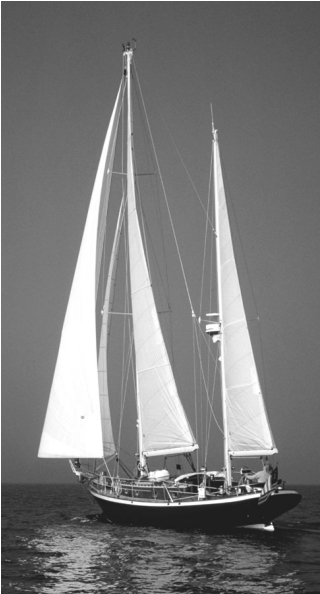
There are surprisingly few classic American sailboats. The boat industry has sloughed off designs by the dozens in past decades. Each new fad and each technological improvement left elephant’s graveyards of abandoned molds strewn about boatyards on both coasts. The classics are those that survived, unaltered, through good decades and bad.
Taiwan took its toll, and boats and yards disappeared with depressing regularity. Under these circumstances, there has been little opportunity, given foreign competition and economic realities, for any boat to survive long enough to become a classic.
If any American boat did survive this harshest of climates, it must have had a lot going for it. The few boats that passaged the decades of attrition had to have the powerful loyalties of buyers who were willing to sail between the dangerous wind of fashion and the tricky current of price. What was it among these few surviving vessels that let them proceed steadfastly on through seas of crashing markets and hurricanes of bankruptcies?
It was first necessary to seek out the boats, those few vessels that are still selling and sailing unchanged after decades. Boats whose buyers do not care that they are by now a bit old fashioned . . . a bit out of synch with the snazzier new offerings. There are only three boats that, by this definition, can be called classic American sailboats. A surprising three with which, no doubt, not all will agree . . . but these three did survive, two are still selling, and each can muster regiments of partisans willing to leap to the barricades. (Since this article was written, one of the three has been discontinued. This one, the Hinckley Bermuda 40, has been replaced by the Hinckley 42, an updated version. —eds.)
All survivors
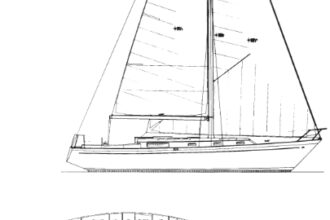
They are (in alphabetic order so as to maintain our objectivity) the Cherubini 44, a ketch; the redoubtable Hinckley Bermuda 40, a sloop; and the Valiant 40, a cutter designed by Bob Perry, and upon which Nate Rothman expended his youth. Cherubini, Hinckley, and Valiant. Survivors all. Why?
I put the question to the builders . . . with surprising results. Rather than stock answers and PR “cow chips,” I found myself confronted with thoughtful and cogent opinions. The builders were themselves a bit surprised at the unlikely survival of their progeny and had pondered on it. Thinking about things hurts. But it is worth the pain, as in this case, where the opinions were refreshing and wonderful.
The Hinckley Bermuda 40
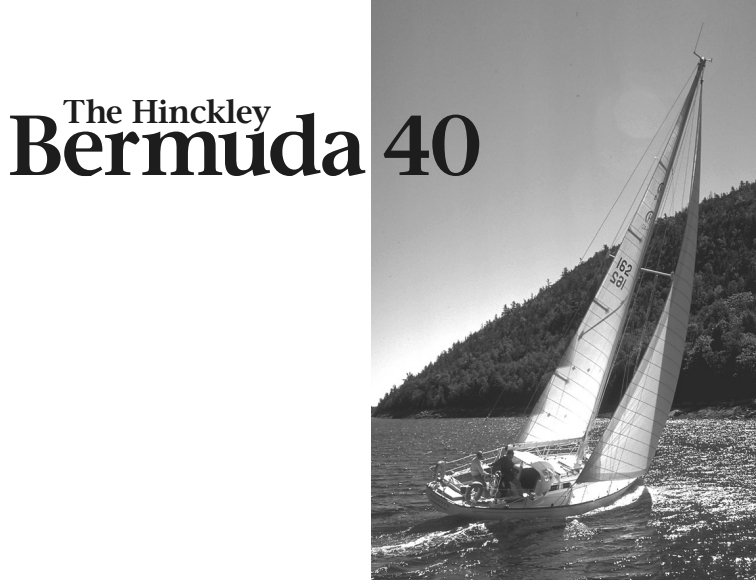
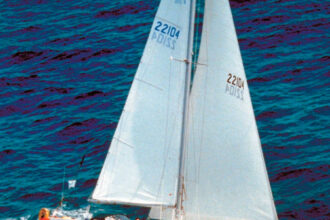
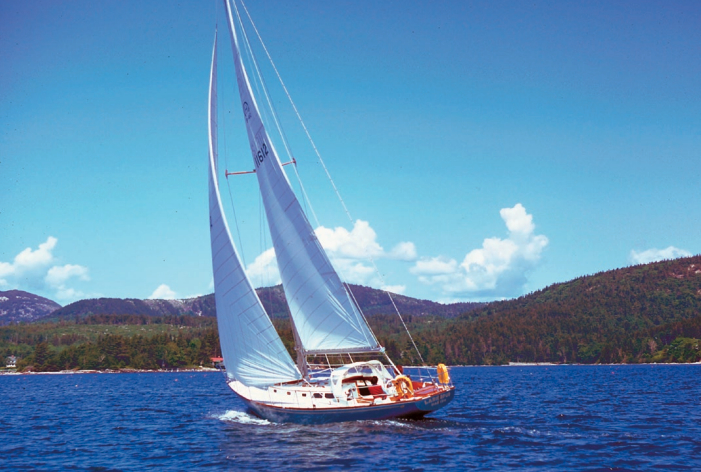
The grandpappy of them all is the Bermuda 40. After all, the Bermuda 40 was, until it was discontinued in 1991, built for decades essentially without change. It is the oldest boat of its class. A total of 203 were built over the years. While new 40s are no longer available, there are many more buyers than sellers for this beloved sailboat. It certainly deserves head-of-class ranking.
I interviewed Rig Reese, who, when the first 40 was built, was beardless and callow, not yet even a teen. Rig has since moved on to other maritime endeavors, but at the time he had that special glint and sparkle that some men only get from a torrid, illicit love affair. Rig got his sparkle from his surprise and joy in being involved with “the best fiberglass sailing boat ever built.”
Lost wonderment
As marketing manager for Hinckley at the time, and since he had only been with them for a few years, I figured Rig would be more forthcoming than other Hinckley types who, having been so long in the business, might have lost some of their wonderment. He taught me about classic boats and why boats sell and sell and sell . . . against all reason, perhaps even against the economic good sense of clients.
I had called Rig the day before and warned him that I wanted his considered opinion of the staying power of the 40. He was prepared for me, and at his first words I knew that I had struck paydirt.
“The boat must not be extreme,” he declared, and with seemly modesty he added, “the Bermuda 40 is not fast, it does not sleep many, it does not point as high as others. It is not extreme, it is not even the best, except in construction, in any sense.”
I was gratified that Rig chose not to adulate. “Extreme boats . . . boats that are the fastest and the ‘mostest,’ do not last. The boats that last, those that become classics, are those that offer the most reasonable solution to the infinite conundrums of sailing. A sailboat is a bundle of contradictions, pulling every which way, held together by the glue of reasonableness and,” Rig dropped his voice for emphasis and revealed the romantic he is, “truth in labor.
“In addition to reasonable solutions to antithetical problems, a classic boat must be simply . . . simply,” he groped for a special word then settled for the ordinary one, “beautiful.”
Enduring beauty
“She need not be stunning. Everyone in the ballroom need not drop dead when she enters, but she must have that same enduring beauty which, again against all reason and most instinct, causes men to love and marry.”
Love and marry? Was Rig not waxing too poetic, even for a sappy romantic?
“No,” he explained, “The Bermuda 40 is like the woman you finally choose to marry . . . not the sexiest, not the fastest, not the most brilliant. The women men marry are forgiving, nurturing, reliable, loving, and,” again he rooted for a word, “comely. These qualities, those of great and satisfying women, are the qualities of the Bermuda 40. She is not a confrontational boat. She is, like a satisfying life mate, accommodating.”
Of the 203 Bermuda 40s built, only one came a cropper. One boat, crewed by a young and inexperienced couple, sailed out against advice into the very foggy and heavily traveled channel under the Golden Gate Bridge and was never heard from again. All the other 40s still sail. All the other 40s today are worth varying multiples of the original prices paid. All the 40s are regularly welcomed back into the womb of the Hinckley yard, whence they sprang, for a fountain-of-youth treatment that the Hinckley men have devised. “The 40s will go on forever,” said Rig. I believe him.
“The Bermuda is an expensive boat. Twice what similar good boats cost and three times others not so good. She has 8,000 hours in her — 8,000 honest hours, put in by men and women whose parents built 40s before them, and whose children are building Hinckleys today.
Counted lucky
And then he revealed a startling fact. “We never earned so much as 1 percent, if that, on any Bermuda 40. We counted ourselves lucky for the years when we did not lose anything on the 40s we built.”
I expressed surprise. Rig explained, “It’s true, unfortunately, it’s true. If we were to maintain the original quality of the 40, if we wanted them to go on forever, then there was no money to be made on them.”
I arched an eyebrow and suggested that tight-fisted folk from Maine rarely descend to charity in business. It was hard for me to believe that Hinckley was in business for the pure love of it. What about “Down-East economics”?
“Oh, we make money on the 40s now. We make money on the reselling of them. Every time we broker a 40, and we broker most, we pop 10 percent. By building a boat that will last forever, we guarantee Hinckley’s future. Maine folk are not entirely stupid.”
The cat was out of the bag. The Classic Bermuda 40 was bought at exactly what it cost the company to manufacture it. It was purchased, uninflated, directly from the manufacturer himself — no middlemen to pump up the price. The first price people were quoted was the last price; there was neither margin nor inclination for a “deal.” As a result, the Bermuda 40, even at its dazzling price, was a screaming bargain.
If you are one of the hundreds of owners of Bermuda 40s, then you are not only the owner of a beautiful vessel that will last forever and be the envy of all the kids on your block, you are also the shrewdest boat buyer in America.
The Valiant 40
Great ideas are born of dreams. The people who dream them are “the unacknowledged legislators of the future,” the folk who sketch out how that future will look to our children.
Dreamers are out of step . . . out of synch with common knowledge and common taste and are often so unlikely in their person as to be, perhaps not ludicrous, but something close.
So was the dreamer who fashioned, out of his own private passions and needs, a boat that was to become one of the American classics. The boat was the Valiant 40, and the dreamer was Nate Rothman.
While not quite ludicrous, Nate is one of those fellows who just never looks right in a blue blazer and red pants. Nate is the son of immigrants and a child of the roughhouse streets of the Bronx. What, you may well ask, was a Bronx Jew doing in the very sniffy company of the Herreshoffs and the Hinckleys?
What Nate was doing was dreaming up a boat of which there was simply no prototype in the yards, or even in the minds of the naval architects at the time. Like so many immigrants who come to love this country wildly, Nate developed a passionate need for a chunk of American history. He yearned for a yar, fat, lumbery looking boat in the tradition of the designers who traced their origins to Colin Archer. A boat that caught Nate’s eye was the Westsail 32, sometimes dubbed the “Wetsnail.” But Nate had sucked up enough design theory that it took only a glance at her tubby hull shape, more particularly her entrance, to disenchant him. The boat was beautiful . . . but it simply would not go anywhere very fast. The immigrant in Nate was in a hurry, as newcomers usually are, and he transferred his newcomer need for celerity into his dream of a boat.
Fast and lovely
The fast cruisers of his day were full of cranky angles and unlovely lines, the ocean cruisers were dumpy and slow, the racing machines could not touch the poet in him. He turned to Bob Perry and put the question to him: “Why do beautiful boats have to be slow? Why are only ugly boats fast?” Bob, God bless him, listened to this Auslander, and the two of them together drew the first sketchy, hesitant lines that were to give birth to the Valiant 40.
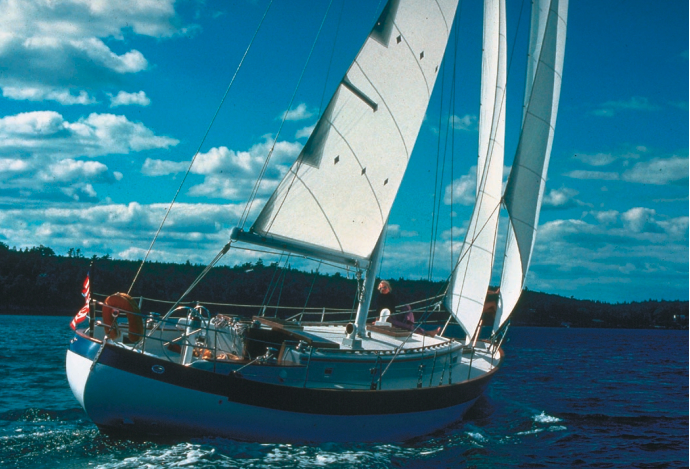
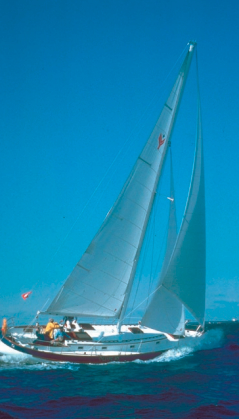
From the waterline up, Nate demanded tradition. The boat should look like it could not get out of its own way. It could look 100 years old. It could look like it needed half a circle to come about, but it had to be beautiful. They drew the most elegant sheer of any boat ever made in America. They stretched out the cabintop so that it melted into the gunnel and drew a sweet curve that was to become the sexy, rounded little tail end of the Valiant, a satisfying canoe stern that had been lost from designers’ tables for 50 years.
Nate was getting the look he needed . . . a Yankee look. Now to make it go fast. So Nate and Bob built a “schizoid boat” . . . really two boats. One from the waterline up, and one from the waterline down. One day, Nate dreamily recounted to me his fantasy of revenge and comeuppance. In his mind’s eye, he would lumber alongside a whooshy looking boat full of deck apes. No two sailboats have ever come abreast without engaging in a little race, and it was no different in his dream.
Insulting dare
In this dream, the fast racer laughingly challenged Nate’s dumpy boat to a race. “Give ’ya five boat lengths to the point,” was the insulting dare. Nate offered, in his dream, to start even, and the whoops of derision were soon replaced by the other skipper’s querulous, “What the hell . . . we draggin’ an anchor?” Nate was proud.
Today, when racy skippers out for blood sight a Valiant 40, they usually find they have other places they would rather be.
Nate and Bob shared their plans and intentions with sailing friends. The response to the boat’s delicious paper lines was . . . “If it’s half as fast as you claim, build me one.” When the boat was finished, Nate remembers that he was scared to death. Would it move? Would it point? Were he and Bob, youngsters both, trying to do something at which their elders had failed?
They secretly launched the boat and secretly took her sailing . . . they two alone . . . lest the dream become a nightmare. In her first sea trials, she proved as fast as a B girl and as satisfying as a first love. They whooped and hollered, as boys will, and came back to the harbor knowing that they would not disappoint good friends.
The Valiant 40 is the ultimate Walter Mitty boat. It is the ultimate tyro’s boat. it is the choice of the sailing novitiate who wants not only to join the club but also to show his sailing betters his cute stern.
The folk who eventually bought Valiants knew little about boats, and in spite of this they all wanted to cross an ocean, or so they claimed. In his dream, Nate was no different. Nate wanted to cross oceans, too, but Nate was a very careful sailor, almost timid in his respect for the sea, so his boat was belt-and-suspenders built. Tough and heavy, compared to the featherweight chichi of the day, and perfectly capable of taking care of herself . . . even if the man at the helm knew little about sailing.
Osmosis problem
The Valiant 40 has lived up to Nate’s dream and now, years later, she has survived not only the vicissitudes of the marketplace and the invasion of the Taiwanese, but also a disastrous couple of years when a fireproofing option led to extreme and incurable cancering on some hulls, a cosmetic condition which did not affect the integrity of the hull but buried Valiant in bad publicity.
The last of the blister-prone hulls was laid down in 1981. There has been no repeat of the sickness since then. Since the scabrous boats have little support from a market that puts looks first, they are offered at very deep discounts (see Good Old Boat, March 1999). A dealer told me he has a long list of buyers waiting for “bad” boats. Like the old saw, “Looks awful but feels great,” even unsightly Valiants have found lovers.
Members of the Worstell family are the present keepers of the Valiant flame. They have thought long and hard over the mystique of the boat. Rich Worstell, especially, since it was his love that bought Valiant at its nadir and brought it back.
“My buyers want a boat that will change their lives. They do not want to make design decisions which could prove a disaster at sea. They want a boat that will be fast and look good, but more than that they want a boat that will take care of them when they finally push off and face a thousand miles of empty water.”
Secret heroes
“It has become a cult boat, a boat which so satisfies the dream life as well as real life that people who own them can see little else than their Valiant. A deep need, a void, has been satisfied in them. The boat makes them into the secret heroes they all long to be.
“When Valiant owners get together, a bonding takes place. They join a club . . . they paid their fee, they felt the thrill of what they consider the best. There are no strangers among the Valiant folk.”
One owner, blinded by love for Nate’s dream, shared his thoughts with me. “Nate designed a classic. From the waterline up she’s all staid, proper, ladylike. But from the waterline down . . . Man, let’s boogie!”
The Cherubini 44
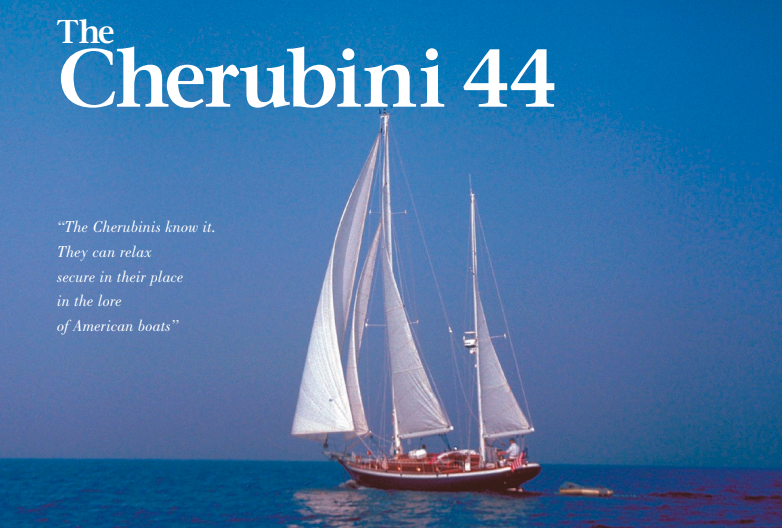
Only about 40 boats of this type were built, and of these only about 20 have ever been resold by their original owners. All the rest remain firmly in the hands of the folk who came to Cherubini with mountains of cash in hand, dazzled by the sweet lines of a boat that was already obsolete before World War II.
Why pay too much for a boat that is so old-fashioned? Why spend years lining up for one of only a few Cherubinis built each year when good boats from other builders can be bought off the rack at half the price?
In a candid moment of rare and refreshing frankness, Frit Cherubini allowed as how anybody could sell two boats a year for too much money, “just so long as it looks like Herreshoff drew it.”
“It’s the looks that hook ’em,” Frit said. “We could build for half the money [in materials] and still sell as many. Then we might get rich . . . ’stead of bein’ stubborn enough to stay in the business and do an honest piece of work.”
Frit was getting a mite South Jersey cantankerous about his boat and boatbuilding in general. But the calm, white-fringed face, punched through by smiling neon eyes, belied his cranky reflections. But he did keep saying that he was just too stubborn to get out.
Cherubini is the generation past . . . his father built boats, his brother John, now dead, designed the Cherubini 44, and his son, Lee, represents the current generation of Cherubini builders. It is too easy to sniff a bit of ennui and resignation in Frit Cherubini, a pose he likes to suggest. But all the nonchalance passes as he leans back in the Cherubini office, his son beside him, and glances at the 44s that march photographically up one side and down the other. And especially when he describes his latest trip in his own personal 48 (“Annapolis to here . . . 9.4 knots average”), Frit lights up like a corn fritter.
Come in, No. 6
The boats are all referred to by number. “Number 6, that there one behind me, went through the hurricane that smashed at Charleston a few years back. The owner took some bad advice and tried to anchor off the bar. That old sea just plucked his two storm anchors out like candles from a birthday cake and slammed the boat 200 feet up onto the beach. Nothin’ much happened to the boat. Just bounced around a little and settled into the sand. Went through four high tides, waves slamming into her broadside for a couple of days.”
There had to be more to the story, but Frit is anything but loquacious. “And . . .?” I prompted. “Well, when the weather settled down they sent out this big tug, tied hawsers onto Number 6, and just plain dragged her 30,000 pounds of dead weight out of the suck of the sand into deep water. Floated off, good as new, sans rudder.”
“Come on . . . good as new?”
“Yep, ’cept that there was no more gelcoat, varnish, or paint on the whole damn boat, scoured off it was; good as new she was otherwise.”
After the tale of the hurricane and hull Number 6, it was clear that Cherubini 44s, despite Frit’s tongue-in-cheek tale, were not built for looks. These are simply the best modern “antique” boats built in America. In my book, that means they may be the best-built boats in the world.
Sharpie guy
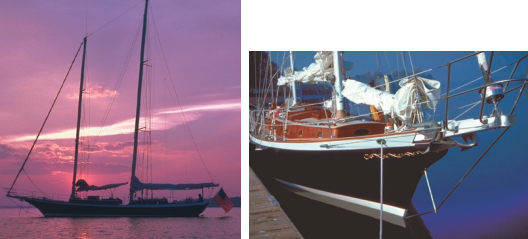
The Cherubinis know it. They can relax secure in their place in the lore of American boats while other builders are frantically trying to build more, and arguably worse, boats every year. Lee tells of “this sharpie guy” (his term) who came along and hustled them to get all fired up and build 10 boats a year. “Improve your market presence,” he told them. Lee Cherubini summed up this advice in two words. “Market presence,” he spat.
I asked the younger Cherubini what was the best year the firm ever had. Like everything else about the clan, his answer was a surprise. “Don’t know what the best year was, but I sure know what the worst year was. That was the year that we built six boats. Near killed me and near killed the Cherubini. Had 35 people working, and I just lost touch with my boats. Boats need hands-on by real people . . . not boards, and committees, and hired labor. My family builds these boats. Me, and Frit, and Frit’s brother, and my cousin, and my sons, and all our women who wait for us to come home . . . which we rarely do. Six boats . . . damn. Market presence . . . baloney.”
Nobody builds a boat like the Cherubinis. “Nobody,” as Frit Cherubini would say, “is that crazy.” So why keep building them? “Dunno,” he said, knowing, but reluctant.
The answer came from his son. He still wears a romantic heart on his sleeve.
Tough old goat
“We have this guy who owns a 44 that’s here in the yard for refit. Had a terrible year. Heart surgery and all. Didn’t think he would make it. His doctors gave him up a couple of times but he’s a tough old goat, and he pulled through. He was miserable in the hospital, and then miserable at home in Florida where he was recuperating. Miserable.
“The doctors gave up and dumped him off to a shrink. First session, the shrink asks our friend why he thinks he’s depressed. Our guy goes blank for a minute, gets up, puts his coat on and heads for the door. On his way out he yells at the shrink, ‘I know why I’m depressed. I don’t have to think why. I’m down here in Florida, and my damn boat is up with Cherubini.’ ”
As Lee tells it, the client is on the next plane north, heart trouble and all, shows up at the yard, and spends the next two weeks at hard labor, fooling around with his boat.
“You want to know why I build boats?” Lee asks. “Here’s why: after the refit, the guy with the heart trouble came to the office, paid his bill and, as he headed for the dock to sail to Florida, he said, ‘Lee, that boat is my shrink . . . never felt better in my life.’ So that’s why I build boats. That’s why I build Cherubinis.”
The Cherubinis not only build the best boat in America, they also have the best stories. You don’t get great stories out of mediocre boats . . . only the classics generate them. The one that dotted the “i” of my belief in the Cherubinis is a sad, but enormously insightful, tale.
Tragic end
A client they had come to love, a hard-drinking, hard-sailing, hard-living man whose Cherubini was the center of his life, called one day and told them to sell his boat. “But to a good man, mind you . . . a good home.”
Lee asked why, and was told to butt out and do as he was bid . . . sell the boat. It didn’t take long. There had been a buyer waiting for five years for a secondhand Cherubini. The client met the buyer, a man not unlike himself in his love for Cherubinis. The deal was done. Papers signed, money paid, title transferred.
The next day, after seeing his beloved vessel pass into good hands, the former owner killed himself.
Another tale, not so dramatic, but in its own way perhaps as clear, was of the owner who sold his boat because his kids were not giving it the care he felt a Cherubini deserved.
We talked for a while, the Cherubinis and I . . . and I felt that tug of family that must involve a Cherubini owner. The owners become members of the wedding. They get to join the most exclusive sailing club in the world. They get to sail boats built by artists . . . did I mention that the Cherubinis are accomplished musicians?
My fantasy is that the Cherubinis, musicians all, build their boats to the structured and logical music of Bach . . . complicated, intertwined, interdependent, and perfect. But just before I left, I learned the real music to which this passionate family has, for four generations, been building boats. It seems that a great-grandparent back in the old country, one Luigi Cherubini, wrote the music for “Ave Maria.”
“Ave Maria” . . . so that’s how the Cherubinis (in Italian, “Little Angels”) build such heavenly vessels. They’ve got help.
Thank you to Sailrite Enterprises, Inc., for providing free access to back issues of Good Old Boat through intellectual property rights. Sailrite.com