A shipshape Halsey Herreshoff cruiser
Issue 77 : Mar/Apr 2011
On Rathbun Lake in Iowa, a single lightning strike in 2007 severely damaged a Bristol 29.9. She was declared a total loss, but that didn’t deter local boat maintenance and repair expert Larry Wilkinson from purchasing the boat at a bargain price. He brought her all the way back, restoring her faithfully to original condition inside and out. She is literally and figuratively in Bristol fashion.
When Larry put the boat on the market, she caught the eye of two Burlington, Iowa, river rats, Gary Smith and Bryan Schulte. They owned and sailed a Venture Newport 23 and a Catalina 25 on the Mississippi River, but the newly restored Bristol 29.9 was too alluring to resist. They became her new owners and named her Rozinante.
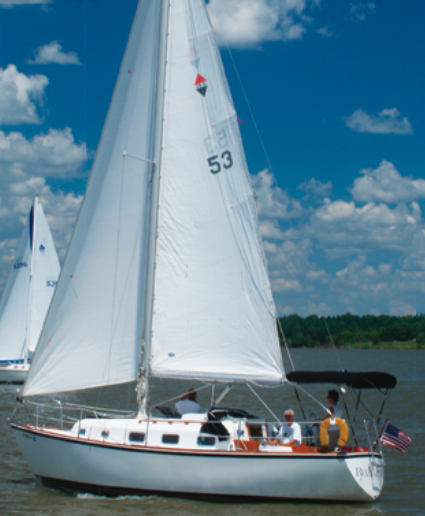
In July of 2010, my wife and I joined Bryan and Gary for a test sail on Rathbun Lake. The very active Rathbun Yacht Club includes members with a wide variety of cruisers and racers. RYC commodore, Karl Fenton, skippered his Catalina 28, Second Wind, as the photo chase boat. Bryan’s fiancée, Jane Wilson, helmed Rozinante.
History and design
In 1956, cousins Everett and Clint Pearson founded Pearson Yachts. Grumman Allied Industries gained a controlling interest in Pearson Yachts in 1961, and Clint stepped away in 1964, eventually forming his own company — Bristol Yachts, in Bristol, Rhode Island. The new company’s fi rst production boat was a Carl Alberg design. Bristol models followed from the boards of John Alden, Ted Hood, Dieter Empacher, and Halsey Herreshoff. The company built a long line of quality boats until the business closed in 1997.
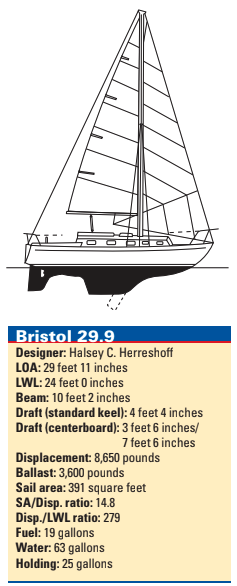
The Bristol 29.9 is one of the last of several models designed for the company by Halsey Herreshoff. It has a conservative profile and hull form with a fairly high cabin trunk, moderate freeboard and a nearly plumb counter transom. The company offered two keel configurations. The standard keel was a low-aspect-ratio fi n with a draft of 4 feet 4 inches and the centerboard model had a board-up draft of 3 feet 6 inches, which seems curious since the board-up draft offered only minimally better gunkholing capability than the standard keel.
The rudder is protected by a skeg, with the propeller turning in a skeg aperture. The boat has a relatively small single-spreader rig and displaces 8,650 pounds. The resulting displacement/LWL ratio of 279 and sail area/ displacement ratio of 14.8 position the boat as a moderate-displacement cruiser.
Between 1977 and 1986, 216 boats were produced.
Construction
The Bristol 29.9 has a sturdy hull of solid hand-laid fiberglass and balsa-cored decks. A modern builder would likely reduce the hull thickness to save weight and cost, but Bristol was committed to building boats that would last. The hull and deck are joined on an inward-turned hull flange. The joint is sealed with a butyl strip and through-bolted vertically. The bolts are closely spaced, resulting in a strong and secure joint. Except for some cutouts to clear backing plates for stanchions, I found no variance along the length of the joint.
The keel is molded integrally with the hull. The lead ballast is placed within it and contained by glassing over from the inside. This has some advantages during construction and eliminates the hull-to-keel joint problem found on many boats.
Unlike many builders, Bristol did not use molded-fiberglass hull liners for the interiors. A built-up plywood interior is generally stronger, quieter, and drier . . . but more expensive. Bulkheads are securely tabbed to the hull. Their location and spacing provides for a very stiff overall structure. A benefit of this method of construction is that most of the inner hull surface is readily accessible.
At first, Bristol Yachts used luan mahogany plywood for the interior joinerwork in the 29.9 but switched to teak in later production years.
On deck
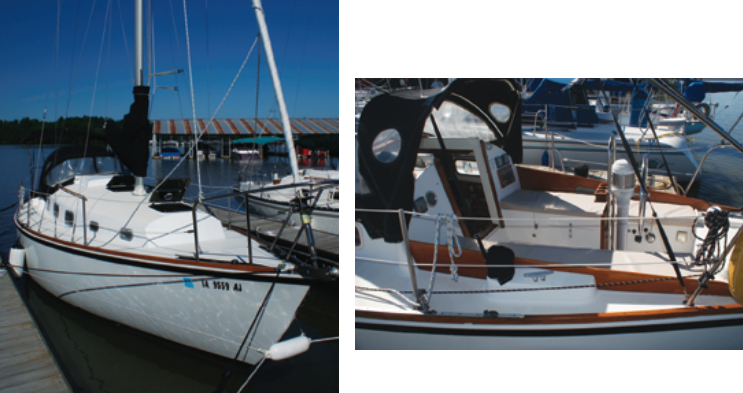
The deck plan is practical and provides adequate sidedeck access for crew going forward. The chainplates for the dual lower shrouds and the cap shrouds are mounted at the rail, attached to knees that are built into the hull-to-deck joint. The chainplates and the stanchions are just inboard of the substantial teak toerail. Scuppers are cut into the toerail but they appear small and sidedeck drainage rates may be less than optimal.
There’s a covered anchor well forward and large aluminum cleats mounted well back from the stem fitting along the insides of the toerails, which terminate at aluminum chocks. Port and starboard navigation lights on Rozinante are mounted atop neatly formed bulges in the toerails aft of the chocks. While this is an attractive installation, a higher mounting on the beefy stainless-steel bow pulpit would offer better visibility. Bristol recognized this and moved the navigation lights to the higher position later in the production run.
Single lifelines with gates were standard, but most boats were fi nished with dual lifelines, as on Rozinante.
The cabin trunk is fairly high and rounded. Teak grabrails extend about halfway forward from the aft end of the cabin but end before they can provide a foothold for crew working at the mast. The cabintop is uncluttered with just two Bomar hatches, one over the saloon and one over the forward cabin. There are no Dorade vents on Rozinante, although Bristol did offer them as an option.
The mast and boom are aluminum. The mast is keel-stepped and has a single halyard winch. At least one additional halyard winch — so halyards for the mainsail and headsail can be handled separately — would be desirable.
The reefing line for the mainsail clew leads from a block aft on the boom to a cleat well forward, near the ram’s horn fitting at the gooseneck. Since this requires crew to go to the mast to adjust the reefing line, installing a single-line reefing system would be a good improvement project.
The attachment point for the mainsheet is mid-boom. The traveler is mounted across the aft end of a substantial sea hood that protects the companionway hatch. There is no cabintop coaming.
The companionway sides have only a slight taper and to go below you must step over a sill about half the height of the cockpit seat. This half step doesn’t qualify as a full bridge deck. At a minimum, the lower dropboard should be left in place when the boat is under way in rough conditions.
The cockpit is fairly wide but somewhat short. It can comfortably seat four along with a fifth at the helm. The seats are just over 6 feet long. Vents along either side of the helm seat make it difficult to sit to one side when steering.
The rather small 22-inch wheel mounts on an Edson pedestal. A larger wheel might provide easier steering control but would restrict movement around the helm. Engine shift and throttle controls are mounted on the vertical face of the cockpit well to starboard of the pedestal.
There is a shallow cockpit locker to port over the interior quarter berth. Another locker beneath the helm seat offers stowage and access to the emergency tiller connection. Under the starboard seat is a deep sail locker. A removable panel inside this locker provides access to that side of the engine.
Accommodations
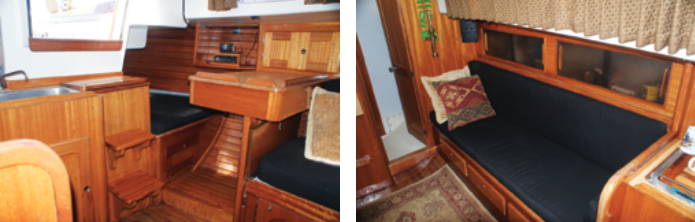
The cabin provides full standing head-room of more than 6 feet. Rozinante’s cabinetry and hull ceilings are mahogany and the joinerwork is above the quality seen on most production boats. A molded headliner brightens the interior.
Two cabin layouts were available with the primary difference being the configuration of the galley, which in both is on the starboard side. The initial design placed the galley sink forward of the two-burner stove with the icebox aft of the stove. The second layout was a modification that served to increase the length of the starboard settee by moving the galley sink aft and inboard of the icebox. To accommodate this change, the companionway steps were offset to port. The majority of Bristol 29.9s were ordered with this modification.
To port of the companionway ladder is a decent-sized chart table. It faces forward, with the the navigator’s seat at the head of a quarter berth. A locker extends forward along the port side from the chart table above the settee. A double door above the chart table and sliding panels above the settee will retain stowed items in a seaway.
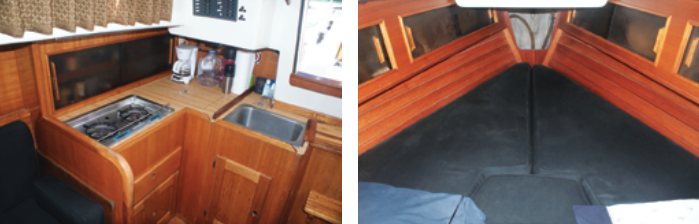
The saloon table stows against the forward bulkhead. It has a Formica top surface and is sized to provide dining space for four. The port settee extends slightly beneath the chart table, making it long enough to serve as a berth. When the saloon table is stowed, the seat slides out, over a track forward and a swing-out support aft, to form a double berth. In the aft-sink galley confi guration, the starboard settee is long enough to serve as a single berth.
The cabin sole is teak-and-holly-veneer plywood from the companionway ladder to the forward saloon bulkhead. A door offset to starboard provides access to the head and forward cabin.
In the head compartment, which spans the boat, the marine toilet is to port on a raised wooden platform above a fiberglass sole insert that follows the hull contour. The stainless-steel sink is forward of the toilet on a cabinet with stowage beneath. Drawers and storage compartments with sliding doors are fitted along the hull. An ample hanging locker is to starboard. Its location and the fiberglass sole insert make it a suitable place to hang wet gear for drying. The standard holding tank is 25 gallons.
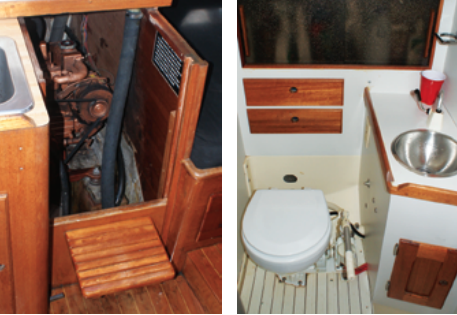
A second door provides privacy for the forward cabin. The V-berth is more than 6 feet long and nearly 7 feet wide at its aft end. With the center insert in place, it serves as a reasonable double berth. This cabin has the same finish as the other living areas. Stowage is provided along the sides, enclosed behind sliding doors.
There are opening portlights on both sides in the head compartment and in the forward cabin. Ventilation below is an issue, however, because the saloon has fixed portlights and just a single overhead hatch and there are no deck-mounted vents. The opening portlights in the head and V-berth areas may be adequate in combination with the forward hatch, but the narrow door between that area and the saloon restricts air flow. Mold and mildew may be difficult to control without ventilation improvements, and guests in the saloon berths might find a warm night uncomfortable. The addition of efficient fans would be a welcome upgrade.
Propulsion
The original engine for the Bristol 29.9 was the ubiquitous gasoline Atomic 4, but diesel engine options were quickly made available. Most of these boats are equipped with Yanmar or Universal diesels. Rozinante has a 2-cylinder 16-hp Universal diesel. It’s beneath the cockpit sole and access is somewhat restricted. The top, center, and bottom-step panels of the companionway ladder must be removed to gain front access to the alternator and engine-coolant cap, and a door under the galley sink provides the only way to get to the seawater pump for an impeller change. Checking the oil requires the panel in the starboard cockpit sail locker to be removed, which means moving all the gear stowed in the locker.
Access problems aside, Bryan and Gary report that the engine is reliable and able to move the boat at near hull speed in flat water. As we returned to port under power from our test sail, I thought the boat handled and tracked solidly and responded well to the throttle. I didn’t have to pay constant attention to the helm to maintain a straight course.
Some prop walk is evident under power in reverse, but with sufficient sternway to make the rudder effective, along with judicious use of the throttle, the boat can be controlled well.
Since the Bristol 29.9 displaces more than 8,600 pounds, an engine with slightly more horsepower would be better, especially in coastal areas where one frequently has to power into large seas and high winds.
Under sail
For our test sail, the wind blew a steady 10 to 12 knots. Rozinante tracked evenly and steadily on all points of sail. The fairly long fin keel and skeg-hung rudder provide very good directional stability. This configuration can sometimes result in a sluggish response to the helm, but I noticed no such tendency. While she did not spin in her own length like a modern racing design, turn rates were quite acceptable.
We sailed Rozinante to windward on both tacks and found that she would point to nearly 40 degrees apparent before feeling pinched. The boat is not particularly tender and would settle in at a heel angle of around 10 degrees in the steady breezes. While the Bristol 29.9 is not a racing design, she was nevertheless fast enough to be enjoyable to sail.
When we eased the sheets and fell off on a beam reach, Rozinante accelerated to a steady 5.5 knots, the angle of heel lessened, and minor adjustments in sail trim resulted in small but observable improvements in speed. The motion was comfortable and the helm smooth and responsive.
A carefully sailed Bristol 29.9 will be an adequate coastal cruiser. While some owners do race these boats, the PHRF rating of 183 found on the owners’ association website seems very optimistic, given the boat’s moderate displacement and small sail area. Regional ratings vary between 186 and 212. The smaller rig might help the boat sail to the lower rating in heavier winds, but in average conditions, other 30-footers, like the shoal-draft Sabre 30 with a rating of 168, will likely outperform the Bristol 29.9.
Pricing and availability
In late 2010, at least 10 Bristol 29.9s were on the market. The asking prices ranged from $15,000 for a 1979 boat to $30,500 for a 1977 boat. It’s notable that the highest asking price listed was for a boat from the first production year. That is testimony not only to the owner’s maintenance regimen but also to the overall build quality of the Bristo 29.9. The low asking price for the 1979 model may be due to deferred maintenance. The average asking price among the boats offered was slightly more than $25,000.
Tom Wells and his wife, Sandy, own and sail a 1979 Tartan 37, Higher Porpoise. They have been sailing together since the 1970s and look forward to cruising upon retirement. Tom’s musical contributions at the Annapolis boat show have earned him the title of Troubadour with Good Old Boat.
Thank you to Sailrite Enterprises, Inc., for providing free access to back issues of Good Old Boat through intellectual property rights. Sailrite.com