What it is and what it does for you and your engine

Issue 43 : Jul/Aug 2005
Most boaters have probably heard about biodiesel as an alternative fuel but never actually seen or used it. As long as our auxiliary engines are working well and diesel fuel is available when we need it, we’re happy. However, developments in national energy policies may force changes in where and how alternative fuels are used. We have already seen federally mandated reductions in sulfur content in diesel fuels. Other changes in composition to help achieve air quality standards are probably not far behind. This might cause a change in the composition of the fuel at your fuel dock.
Biodiesel is one of the more attractive and heavily promoted alternative fuels. Here’s a closer look at what it is, the known benefits, and the issues that may be important to boaters.
What biodiesel is
In one sense, the use of biodiesel is a return to the history of the diesel engine. In his early work on a compression-ignition engine, Rudolf Diesel used a variety of vegetable oils, including peanut oil. Biodiesel can be manufactured from vegetable oils, recycled cooking oil, greases, or animal fats.
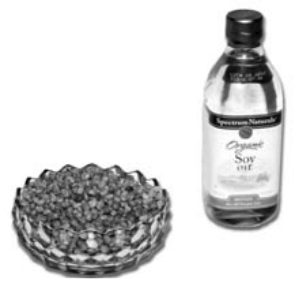
Soybean oil is the primary source of biodiesel in the United States, while rapeseed oil (a close cousin of canola oil) is frequently used in Europe. In their original form, these oils have relatively high viscosity and cannot be directly substituted for conventional diesel in most engines. However, some owners of vehicles with diesel engines have installed conversion kits that heat used cooking oil to reduce its viscosity and allow the engine to be switched over to the vegetable oil after the engine has been started on diesel or a biodiesel blend.
To make biodiesel, the starting vegetable oil is reacted with an alcohol (usually methanol) in the presence of a catalyst (commonly sodium or potassium hydroxide). This process is referred to as transesterification. The result is a combination of fatty acid methylesters. These are hydrocarbon chains, usually C16 – C18, with two oxygen atoms attached to each chain. The presence of the oxygen contributes to the more complete combustion of biodiesel fuel as compared to petroleum diesel.
A byproduct of transesterification is glycerin, which is separated from the biodiesel and sold into other markets (0.15 pound of glycerin for each pound of biodiesel). A second major byproduct from soy-based biodiesel is soybean meal. About 4.5 pounds of meal are produced for every pound of soybean oil.
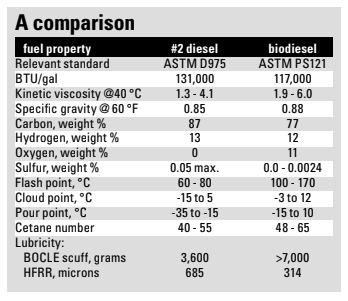
Recycled greases and animal fats require a different process that involves sulfuric acid and methanol. The American Society forTesting and Materials (ASTM) specification for biodiesel requires that any residual methanol be removed so it does not suppress the flash point of the fuel. The values in the table on Page 22 were extracted from a National Renewable Energy Laboratory report on biodiesel.
Advantages of biodiesel
Blending: One attractive characteristic of biodiesel is that we do not face an all-or-nothing situation. Bio diesel is miscible in conventional #1 or #2 diesel fuels in any ratio. Because biodiesel has a slightly higher specific gravity than diesel, it can be “splash blended” by adding it to the top of a partially filled container of diesel. A 20 percent blend of biodiesel in #2 diesel, called B20, is the most common blend. For most fuel properties, the variation is linear with the percent of biodiesel in the blend. The most noticeable exception is lubricity, where most of the possible benefit is achieved with as little as 3 to 5 percent biodiesel.
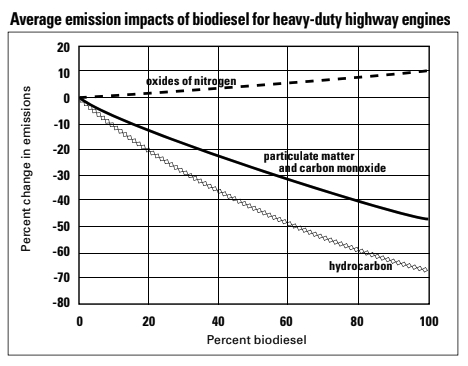
Cleaner exhaust: This is one of the biggest benefi ts of biodiesel and clearly one of the reasons that the Environmental Protection Agency (EPA) is encouraging its use. Testing in heavy-duty diesel engines (such as would be used in long-haul trucks and buses) has shown significant reductions in carbon monoxide, hydrocarbons, and particulates. In addition, the starting biodiesel has very low sulfur content compared to #2 diesel and thus has correspondingly low sulfur emissions. Reductions in tailpipe emissions for biodiesel blends with petroleum diesel tend to vary linearly with the concentration of biodiesel used in the blend. The changes in exhaust-gas composition with biodiesel blends were summarized in an October 2002 EPA report (see graph on Page 23).
In addition, a simple “sniff test” confirms that the exhaust gases are qualitatively different. Diesel exhaust gases contain a long list of aromatic ring compounds that account for the characteristic smell of the exhaust. Several of these compounds are of concern as possible causes of cancer in humans. Biodiesel does not contain any of these aromatic ring compounds; hence, its exhaust gases are easier on the nose and on the environment. The obvious benefit for sailors is the improved exhaust odor when motoring in a light following breeze, but the associated health benefit may be even more important.
The improved quality of the exhaust gases is evident even with B20 blends (a blend of 20 percent biodiesel in #2 petroleum diesel). The St. Johns, Michigan, school system switched its fleet of 31 buses to a B20 blend in April 2002. The garage foreman and head mechanic, Wayne Hettler, was quoted as saying, “When the drivers start their engines in the morning for their pre-checks, the air in the lot is much clearer, thus making it more pleasant for the drivers to complete their checks. Also, the maintenance staff recognized the immediate improved air quality in the shop when we changed the buses to B20.”
Another aspect to air quality shows up in a total life-cycle analysis. When biodiesel and petroleum diesel are burned in a diesel engine, they generate similar amounts of carbon dioxide per horsepower-hour. However, in the case of biodiesel produced from vegetable oils, the plants consume much of this carbon dioxide during the production of oil seeds or beans. Hence, the use of these biodiesel fuels can substantially reduce the net increase in atmospheric carbon dioxide, which is an important greenhouse gas.
Better biodegradability: Biodiesel consists of various fatty acids, all of which have two oxygen atoms attached to the hydrocarbon chains. This makes them very biologically active when compared with the alkane and alkene hydrocarbon chains in diesel. In addition, the enzymes and microorganisms needed to break them down into carbon dioxide and water are naturally occurring. Pure biodiesel degrades about five times faster in an aquatic environment than #2 diesel. A further benefit of biodiesel use is that the degradation of the petroleum diesel in a blend with biodiesel is accelerated by the presence of the biodiesel.
Taking this one step further, the CytoCulture company has developed a product, the CytoSol Process, composed largely of vegetable-oil methylesters that are similar to those in biodiesel. The product is used to help clean up spills of crude oil. It has been licensed by the California Department of Fish & Game as a “shoreline cleaning agent.”
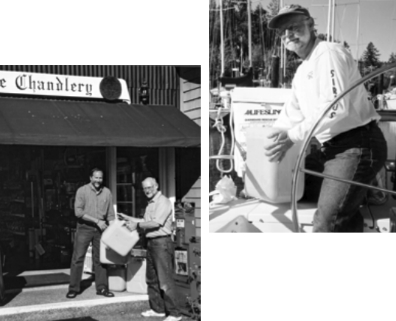
Marinas located in environmentally sensitive areas may have difficulty securing a permit for a fuel dock. For boaters, the greatly improved biodegradability of biodiesel might make the difference between having fuel conveniently available or not. The marina at the head of Eagle Harbor inlet on Bainbridge Island, Washington, does not have a fuel dock. However, The Chandlery at Winslow Wharf in Eagle Harbor is able to provide soy-based biodiesel in 5-gallon containers for boaters in the marina.
Improved lubricity: Biodiesel fuels have lubricity superior to #2 fossil diesel. This is important because some critical components of diesel engines rely on the fuel for lubrication. These include the high-pressure fuel pump and injectors. The former is a particularly costly component, one that is not easily serviced by boat-owners. Lubricity assures long service life.
There are two industry standard tests for lubricity of fluids. One is the Ball On Cylinder Lubricity Evaluator (BOCLE) scuff test. For this test, the reported result is the load in grams at which failure to maintain hydrodynamic lubrication occurs. Here, higher numbers are better. Another standard test is the High Frequency Reciprocating Rig (HFRR), where the reported result is the length of the wear scar. Here, lower numbers are better. When the refining process for diesel fuel was changed to reduce sulfur content, these industry-standard tests confirmed that the lubricity of the resulting fuel was reduced.
Even with the reduced lubricity, most well-maintained marine diesel engines will run long enough that individual owners will probably not be aware of the increased probability of injector pump failure. However, field data confirms this loss of lubricity. For example, a webpage for Shell Canada states:
“The process of removing sulfur from diesel can also remove certain trace compounds which help to provide the fuel’s natural lubricity. As a result, there has been a corresponding rash of complaints in the U.S. of failed diesel pumps and injectors, as well as some seal failures, associated with the use of low-sulfur diesel.”
Other support for concerns about lubricity of low-sulfur diesel comes from Stanadyne Automotive Corp., the leading manufacturer in the United States of diesel-fuel injection equipment. The company’s quality systems manager, Paul Henderson, supported an initiative in Kansas to require that biodiesel be added to petroleum diesel. His letter of support contained this statement:
“There have been numerous examples from the field where lack of lubricity in the fuel has caused premature equipment breakdown and, in some cases, catastrophic failures. This problem will be more dramatic as the EPA moves to further reduce the sulfur levels in petrodiesel fuel.”
Fortunately, the improvement of lubricity in biodiesel blends is one case where the change in property is non-linear with the amount of biodiesel in the blend. Essentially all of the benefit of 100-percent biodiesel is achieved with just 3 to 5 percent biodiesel blended with #2 diesel.
Renewable fuel: This is another major reason that biodiesel receives strong support at a federal level. Recent rapid increases in fuel prices have highlighted the consequences of small changes in the balance between oil supply and demand. Furthermore, the rapid increases in global demand and the prospects of global oil production from wells peaking out in the not-too-distant future make it prudent to seriously consider renewable fuel sources.
The National Renewable Energy Laboratory produced a detailed study of the Life Cycle Inventory of biodiesel and petroleum diesel. Life Cycle Inventory means that all materials and processes from the initial extraction of the feedstock to the final use of the product are included in the analysis. This report, issued in May 1998, provides some useful numbers by which to compare and contrast these two, quite different, fuel sources.
In this report, the authors concluded that the current Life Cycle Energy Efficiency for petroleum diesel in the United States is 83.28 percent. This means that for every 100 BTUs’ worth of crude oil in the ground, 83.28 BTU of diesel fuel becomes available at a pump at your favorite station. The bulk of the difference is the energy required to process (refine) the crude oil into diesel. However, the energy cost to extract the crude is not insignificant and will grow as the average age of oil fields increases.
A second ratio of importance when evaluating alternative fuels is the Fossil Energy Ratio. This is the ratio of the fuel energy to the fossil energy used in its life cycle. For petroleum diesel, the Fossil Energy Ratio is 0.8337. This number is slightly higher (expressed as 83.37 percent) than the Life Cycle Energy Efficiency because some of the electricity used during the processing of crude oil is supplied by hydroelectric and nuclear power sources.
The corresponding Life Cycle Energy Efficiency for a soybean-based biodiesel in the United States is 80.55 percent. The largest consumers of process energy for biodiesel are soybean crushing (and soybean meal production) and soy-oil conversion to biodiesel (about 34 percent each). The next largest process-energy step is sustainable production of the soybeans (about 25 percent). Transportation energy costs make up the balance.
Although the Life Cycle Energy Efficiencies for these two fuels are very similar, their Fossil Energy Ratios are quite different. The ratio calculated in this study was 3.21 for soy-based biodiesel versus 0.83 for diesel. It seems that the Fossil Energy Ratio should approach infinity for a truly “renewable” fuel. However, current biodiesel conversion in the United States today generally uses methanol derived from natural gas. If a producer were to switch to a renewable source for the methanol, then the Fossil Energy Ratio for the resulting biodiesel would increase considerably. Even at a ratio of 3.2, it is this leveraging of the use of fossil fuels that makes biodiesel an attractive alternate fuel.
Safer handling and storage: Key factors here are the higher flash point, which reduces the risk of fires, and the fact that biodiesel is nontoxic to humans, which reduces concerns about ingestion or contact with skin or eyes. This can contribute to a skipper’s peace of mind when lashing on a canister of extra fuel for longer cruises.
Disadvantages of biodiesel
Higher cost: Even with the tax breaks offered in many states and localities, biodiesel is more expensive than #2 diesel. (The price in 5-gallon containers at The Chandlery is about $3.25 per gallon.) Although retail costs may fall as volumes increase, the price of biodiesel is likely to remain above that for petroleum diesel for years to come.
Greater solvency: This can cause a variety of problems. Older vessels may have significant deposits on the walls of their fuel systems. Switching to high biodiesel blends in such vessels may cause these deposits to be flushed out and lodged in the primary filter. Regular monitoring and replacement of filters is required to manage this problem. The greater solvency can also make spills more damaging to painted surfaces. CytoCulture recommends particular caution about spills on teak decks with polysulfide seams.
Swelling of fuel lines and gaskets is a possible concern for high-biodiesel-content blends. This is more likely to occur with older engine installations because the fuel lines are often composed of materials (natural rubber products) that are more vulnerable than the synthetic compounds used today. If such problems do arise, they can be resolved by replacing the fuel lines or gaskets with newer materials. These problems are much less likely to occur for B20 or lower biodiesel content blends.
Reduced energy content: Biodiesel fuels have a lower heat content per gallon than #2 diesel. This translates into reduced engine torque and power and higher fuel consumption — usually in the 5 to 8 percent range for most published studies. These differences in engine power are sensitive to operating conditions. Operation at low speed and high load significantly reduces the difference in power produced.
Cold weather problems: The flash-point temperature of biodiesel is typically 100°F higher than that of #2 diesel. This probably means that the minimum combustion chamber temperature for ignition will be higher for biodiesel (although I have not found any measured values for this factor).
A higher minimum combustion chamber temperature could lead to cold-weather starting problems for tired engines with low compression that do not have glow plugs or other forms of pre-heating. The higher cetane rating for biodiesel might be an offsetting factor since a higher cetane rating means that there is a shorter time delay between injection and ignition of the fuel.
Cold-weather problems are more likely to be a concern for motorists than for boaters. The cloud point, pour point, and cold filter-plugging point are all higher for biodiesel than for petroleum diesel. Engines operated in areas with winter temperatures well below freezing may experience problems with fuel flow through filters when using blends with high biodiesel content. These problems are more severe for biodiesel derived from animal fats than for those derived from vegetable oils.
For those who want to operate in severe winter conditions with biodiesel blends, one solution is to use #1 diesel as the blending stock rather than #2 diesel. It is a common practice for motorists in some northern states to blend #1 and #2 diesel during the coldest winter months.
Space availability: It is still rare to find a fuel dock with biodiesel or a biodiesel blend. These are slowly becoming more common for vehicles. This could change rapidly if use of this kind of fuel is mandated as part of a national energy policy.
What about our engines?
Engine performance and life: Many studies have been published that compare the short- and long-term performance of biodiesel and petroleum diesel in large engines, such as would be used in urban buses and long-haul trucks. This is to be expected, since these applications have the most impact on urban air quality. These applications also account for a large fraction of the diesel fuel used in the United States and should figure prominently in any discussion of national energy policy.
Because small auxiliary diesel engines are significantly different from those used in buses and heavy trucks, studies on vehicular engines may not be relevant to sailors. A 1995 report from the University of Idaho did feature smaller diesel engines that are closer to those used in sailboats. The short-term studies in this report were done with a John Deere #4239T four-cylinder, direct-injection, turbo-charged diesel engine (3.9 L, 82 hp). The long-term studies were conducted using a Yanmar #3TN75E-S three-cylinder, direct injection, naturally aspirated diesel engine (0.94 L, 20 hp). Each test sequence used eight different biodiesel fuels — the methyl and ethyl esters of soy, canola, and rape-seed oils and of beef tallow.
The findings using relatively small displacement engines are in general agreement with those that used large engines. They found lower peak torque and power production associated with the lower heat content of biodiesel fuel and lower smoke density for the biodiesel, particularly at low rpm/high load conditions. Interestingly, the smallest difference in power was for low rpm/high load running conditions where the largest difference in smoke density occurred. (At 1,300 rpm, engine power was essentially the same for all fuels used.) The bottom line for boaters? More complete combustion with biodiesel, a win for the environment, and probably a win for our engines as well. However, we can expect to burn a bit more fuel per hour.
As part of the short-term studies, the engine was repeatedly torn down to evaluate coking on the injector tips and carbon deposits on the pistons and valves. The results were mixed.
As compared to low-sulfur #2 diesel fuel, the various biodiesel fuels were found to cause more coking on the injector tips and more carbon deposits on the piston heads, but fewer deposits on the intake and exhaust valves. There’s probably no benefit here for our diesel auxiliaries in term of carbon deposits. But read on.
The long-term tests using Yanmar engines included wear measurements on many of the engine components. Each of the three engines was used for a 200-hour test sequence with three of the nine fuels (eight biodiesels plus the reference #2 diesel). Each engine was disassembled and measured before and after each test sequence. No detectable differences between the fuels were found for wear on wrist pins, cylinder walls, valve stems, main bearings, camshaft lobes, or crank-shaft journals. A significant difference in wear rates was found for the ring sets (two compression rings and the oil control rings) with all the biodiesel fuels showing reduced ring wear. The authors attributed the reduced ring wear rates to the superior lubricity of the biodiesel fuels.
The ring wear rate averaged across all eight biodiesel fuels was one-eighth of that for the reference diesel. No replicates were run, and the measured amounts of wear were small. Therefore, one should be cautious about the absolute wear rates. Nonetheless, the significantly lower wear rates found for 100 percent biodiesel fuels in this study are grounds for optimism regarding the benefits of using biodiesel blends in our diesel auxiliaries. We can expect that the superior lubricity of biodiesel will increase the service life of the piston rings and high-pressure fuel pump in our diesel auxiliaries.
Engine warranties: The position statements of the major engine manufacturers are carefully ambiguous on this point. They usually emphasize that the engine manufacture warrants the engine and not the fuel used and that, as long as the engine is used with fuels that meet the relevant ASTM standards, then the warranty against manufactured defects will remain in force. In this regard it is encouraging that Yanmar was one of the sponsors of the 1992 Sunrider Expedition. During this around-the-world voyage, Captain Bryan Peterson piloted his 24-foot Zodiac rigid inflatable boat nearly 40,000 miles between his departure from Pier 39 in San Francisco on July 4, 1992, and his return on September 8, 1994. The expedition consumed over 18,000 gallons of soy-based biodiesel. A picture of the craft and details about the route are found on the website for the National Biodiesel Board (http://www.biodiesel.org/). Search for “Sunrider Expedition.”
Other equipment aboard: What about other equipment on our boats that is fed from the main fuel tank — auxiliary generators, diesel cabin heaters, and so on? Low-percent blends (20 percent or less) will probably cause few concerns. For higher concentration blends, the greater solvency of biodiesel may again become an issue depending upon the composition of the fuel lines and gaskets. For older equipment, sailors will probably not be able to get useful information from the manufacturer and will have to sort it out independently. Another issue may arise with diesel heaters that use glow-plug ignition. The higher flash point temperature of biodiesel might cause ignition difficulties for high-concentration blends.
Not long ago, I installed a Wallas 30D in my sailboat. The distributor for these marine heaters did not have any information available from the manufacturer regarding its use with biodiesel. On his own initiative, he had done a brief test and found that these units would run on 100 percent biodiesel but not always start reliably. I did my own tests before installing the heater using soy-based biodiesel from Imagine Energy in Washington state. Using a fully charged, group 27 gel cell marine battery, reliable ignition occurred for all blends up to 100 percent biodiesel.
Fuel stability and microbe growth: Sailors with auxiliary diesel engines typically use very modest amounts of fuel during the boating season. Old fuel may remain in the tank for extended periods. Hence, fuel stability is a major concern. The Office of Naval Research funded a study of diesel fuel stability using 10 and 20 percent soy-based biodiesel. The most significant form of fuel instability during storage is the formation of solids that can plug filters and injectors. The authors of this study started with petroleum reference fuels that were known to be stable and unstable. The blends with 10 and 20 percent soy-based biodiesel were subjected to the relatively severe conditions in the ASTM 5304 test matrix. The presence of soy biodiesel was found to enhance the stability of all the blends. At the 20 percent level, the stability of the blend using the known unstable petroleum diesel actually improved enough to pass the test matrix.
These results give some comfort to sailors. We should still be concerned about microbial growth associated with water in our fuel tanks, however. We might need to be even more careful with biodiesel blends given the high biodegradability of biodiesel.
What to expect from biodiesel
Experiences of other boaters: CytoCulture surveyed 100 boaters (97 sail and 3 power) using biodiesel in the San Francisco Bay area over a four-year period. Of these users, 87 reported no problems. The most common reported problems were with old sediments clogging filters or swelling of fuel lines. This is not surprising in view of the fact that over 40 percent of the engine installations in this survey date from the 1970s. The full report can be found on the website for CytoCulture (<http://www.cytoculture.com>). CytoCulture also produced an informative handbook for marine biodiesel that can be downloaded there.
Another study of boaters’ experiences with biodiesel comes from Germany’s Lake Constance region. Starting in 2000, 24 participants were monitored over three years. The most common engines were Volvo-Pentas and Yanmars with one, two, and three cylinders. Four boats experienced problems, about the same ratio as found in the CytoCulture survey. The report states that the problems that occurred were easily corrected. The detailed discussion of those problems was a bit much for my school German.

The bottom line
With a 5 percent biodiesel blend, expect an improvement in lubricity that will contribute to longer life for the high-pressure fuel injection pump and probably lower piston-ring wear as well. But there should be no immediately evident changes in engine performance or significant differences in the appearance or smell of the exhaust. For 20 percent blends (B20), expect a noticeable difference in the exhaust smell and visual appearance. There may also be fewer soot deposits on the hull, so your boat no longer hails from “MinneapolSmudge.” (Note: Hey! That was a direct reference to the editors’ C&C 30. See photo below. –Ed.)
The cleaner combustion and corresponding reduction in particulates may also help keep the oil looking clean longer. The Michigan school system mentioned earlier was able to extend oil change intervals, as based on oil analysis, when it switched to a B20 blend. The higher biodiesel content may contribute to further reduction in ring wear, although I have not yet found any engine wear life studies that used blends to confirm such a relationship. There will probably be no issues with the greater solvency of biodiesel at this concentration for most boaters.
For higher-concentration biodiesel blends, expect further improvements in exhaust characteristics. Fuel consumption may increase by a few percent. Monitor the fuel filters in case old deposits in the fuel system are carried out of the fuel tank and fuel lines. There may also be some swelling of fuel lines or gaskets depending upon the age of the engine and the materials used. Changing the fuel filters will be somewhat improved since the fuel that inevitably gets on your hands will smell better and be easier to clean up.
My wife and I are using about a 30 percent blend. We appreciate the improved exhaust odor and the reduced tendency for the transom of our boat to wear a sooty mustache. We do not have enough hours of running time to be able to comment on the other expected benefits of using biodiesel but anticipate that the improved lubricity and cleaner combustion of this blend should contribute to a longer engine service life.
Thank you to Sailrite Enterprises, Inc., for providing free access to back issues of Good Old Boat through intellectual property rights. Sailrite.com