A contrarian view from a practical mariner
Issue 43 : Jul/Aug 2005
Like most boaters, I’ve been exposed to many ads for binoculars and come away convinced that most of what I’ve read has been written by copywriters who would become seasick in a bathtub. Here is a contrarian view of most of the hype. It should help you read the ads with a discerning eye. The material is based on nuggets of wisdom I scraped from the floor and walls while working for a military/aerospace consulting firm during the height of the Cold War. Most of the recommendations came from real experts in optical design and manufacturing. The only thing I can claim for my own is the two-binocular theory.
From an optical point of view, the binocular is a relatively simple instrument. It’s basically a pair of matched telescopes joined together in an adjustable frame. Each telescope consists of an objective lens, a prismatic image-inverting system, and an eyepiece. Binoculars differ in light-gathering power, degree of image magnification, optical quality, and eye relief.
Boaters typically use binoculars to view buoys or harbor entrances at a long distance in a very humid environment. They want marine binoculars to be reasonably watertight and resist the knocks of bouncing around in a boat cockpit. Bird watchers, on the other hand, want binoculars with high magnification and light weight. Since the boating market is very small compared with general sports use and birdwatching, design decisions are typically optimized for the other guys.
The basic problem in binocular manufacture is to match the optical characteristics of each telescope. The magnification of each tube must be the same, and they must be mounted parallel to each other. Modern optical manufacturing techniques can match the telescopes to within 5 percent with minimal human intervention or adjustment. For each 1 percent improvement, the cost doubles, due to the additional labor content. This explains the sharply increasing cost curve of fine optics. You can buy a minimally adequate pair of binoculars for $30, a good set for $200, or a really fine set for $1,000. The trick is to select the cost level that gives sufficient quality for the task at hand. Cheaper, and the glass won’t do the job; more expensive, and the liability in case of loss or damage is too great.
Conflicting requirements
Material selection is critical in the marine environment, but durability and usability requirements work against each other. A marine bronze frame will last a very long time but will be too heavy to carry. Aluminum is light but relatively short-lived. Die-cast zinc disintegrates in salt air. Optical purists may disagree, but I feel that glass- or carbon-fiber-filled polycarbonate is the best structural material for a binocular and also one of the cheapest materials available. A fine binocular lasts forever if it is never used. Use it in a marine environment, and it lasts just about as long as a cheap one. A practical mariner regards a pair of binoculars as an expendable tool with an indeterminate, but limited, life span. When it fails to perform, he fixes or chucks it.
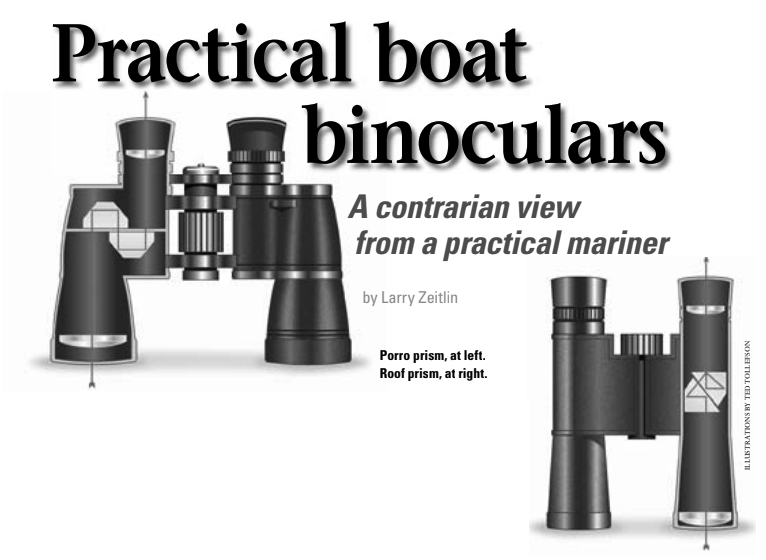
Variations in binocular design are more apparent than real. They serve the marketing department more than the user. The binocular is, after all, a mature instrument, whose basic principles were established a century ago. Prism configuration is the variable that has the greatest influence on binocular shape, but in the long run, all prism systems are equivalent. All they do is erect the image formed by the objective lenses. Right-angle Porro prisms make for a short, wide binocular with the objective lenses either further apart or closer together than the eyepieces. Roof prisms produce a slimmer, longer binocular with the objectives and eyepieces in line. Fine binoculars are made in either configuration. The competitive pressure of the marketplace is an inherent equalizer. Most binoculars in the same price range will perform about the same.
Binoculars are described by a pair of numbers. The first number is the magnification, the second number the diameter of the objective lens. A 6 x 30 binocular has 6 times magnification and a 30 mm-diameter objective lens. A 7 x 50 Navy binocular has a 7-power magnification and a 50-mm objective lens. The single most important factor in the cost, size, and weight of a pair of binoculars — all else being equal — is the diameter of the objective lens. The bigger the objective lens, the more light it gathers. Does more light-gathering ability always mean that the binocular is better or more useful? Perhaps not.
More expensive
At a first approximation, the cost of an optical instrument is proportional to the area of the glass surfaces. Thus, a binocular with 50-mm objective lenses is almost always more expensive than an equal quality binocular with 25-mm objective lens lenses. The big objective binocular is also larger and heavier, perhaps double the weight and size of the smaller instrument.
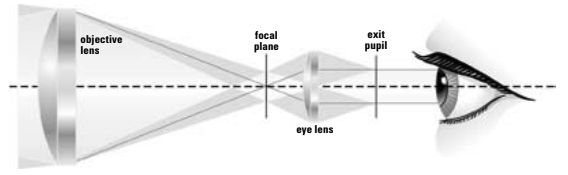
The sole function of a large-diameter objective lens is to provide a large exit pupil. This determines how much of the light gathered by the binocular reaches the eye. The size of the exit pupil can be calculated by dividing the diameter of the objective lens in millimeters by the magnification of the binocular. A 6 x 30 binocular has a 5-mm exit pupil. A 7 x 50 binocular has an exit pupil slightly greater than 7 mm. The cone of light entering the eye is limited by the eye’s own pupil; therefore, a large binocular exit pupil is of use primarily under low light conditions when the eye’s pupil enlarges to its maximum diameter. Since the pupil of the average eye rarely enlarges beyond 7 mm even under the dimmest conditions, the 7- mm binocular exit pupil of the 7 x 50 binocular is the largest practical size.
This large an exit pupil is of use only in very poor light. In most dawn-to-dusk conditions, the eye’s own pupil is considerably smaller than 7 mm, usually only 2 to 3 mm. A binocular with a smaller exit pupil will usually suffice. Most binoculars intended for daylight use have 4- or 5-mm exit pupils. Included in this category are the 6 x 24, 6 x 30, 7 x 35, and 8 x 32 binoculars found on dealers’ shelves. In 98 percent of all marine situations, they provide an image every bit as clear and bright as the Navy type 7 x 50 night glasses, yet are considerably smaller, lighter, and cheaper. Remember that an optical binocular can never provide an image that is brighter than that seen by the unaided eye.
One often-cited advantage of a large exit pupil is that it permits the eye to be poorly centered behind the binocular eyepiece. This is an advantage only when the eye is free to move with respect to the eyepiece. This is the case with a binocular mounted on a pedestal on a ship’s bridge. In most normal situations, the eye centers itself behind the eyecup of the eyepiece, and there is minimal relative movement between the eye and the instrument.
Stabilizing systems
Few boats shorter than 100 feet can be considered stable platforms. Boat motion and engine vibration make it impractical to hand hold optical instruments with greater than 8-power magnification. The shakes can be lessened by binoculars that use a stabilizing system at a $200 to $400 premium in price. But be warned that these go through batteries like a pig eating popcorn. For smaller boats, in any sea state other than dead calm, the absolute upper hand-held limit for an unstabilized binocular is 8-power, with 6- or 7-power preferred. When I was in the Army many years ago, we ran tests on binocular-assisted target recognition from moving vehicles and verified the efficacy of the Army standard-issue 6 x 30 binocular for most daylight conditions. Eyes and binoculars haven’t changed much since then. Obviously, a ship is more stable than a moving tank, so the Navy standardized on 7-power for hand-held binoculars. My own peak efficiency on my roll-prone motorsailer, balancing image motion and magnification in reading buoy numbers, comes at 6-power. My wife, on the other hand, likes 7-power. We both agree that 8-power is too much.
The single factor most important to user enjoyment of a pair of binoculars is the quality of the optics. Well-made binoculars provide clear, distortion-free images over the entire field. Good alignment permits long periods of headache-free use. Unfortunately, the best optical quality costs a lot of money. Unless you are the type of person who enjoys playing with expensive toys, the best optical quality is overkill in the marine environment. Bumps, knocks, salt air, and the ever-present danger of submersion are extremely hazardous to long binocular life. Reading buoy numbers or identifying shore features requires only that the central portion of the visual field be clear and sharp. Alignment need only be good enough to permit a few minutes of continuous use without eyestrain.
Lessened acuity
The best optical quality is even less important if the binocular is used at night. The visual acuity of the eye decreases so dramatically under low-light conditions that optics made of old tumbler bottoms would suffice. A number of years ago, my firm designed the prototype of the gunsight telescope for the new Army battle tank. Rather than wait for expensive optics to be handmade, we scavenged the objective and eyepiece from a $29 binocular straight from the shelf at Sears and discovered that they provided more than enough optical quality to deal with night-visibility conditions. The final product, with optics several hundred times more expensive, did no better. It is the eye, not the binocular, that determines the resolution of night vision. The only way to see better at night is to compensate for lowered visual acuity by providing higher magnification. Then, of course, motion and vibration become an issue. The battle tank used an 8-power scope in a gyro-stabilized turret. Today the night-vision issue is almost moot anyway because of the availability of reasonably priced light-magnification instruments.
There is a magical quality imputed to various optical coatings to reduce glare and/or increase contrast. In reality, coatings are important only on the internal surfaces of the optics to reduce internal reflection. A speck of salt spray on the exterior of the objective lens or eyepiece negates the effect of the surface coating. The solution is to keep your lenses clean, wipe off salt spray with a tissue dampened with fresh water, wear Polaroid sunglasses to minimize surface-reflected glare, and hold the instrument so your hands form a sunshade to prevent direct sunlight from entering the objective lens.
Adequate eye relief is essential in a good pair of binoculars. Most binoculars are intended for use without glasses. Designers anticipate that the eye will be positioned about 10 mm from the eyepiece and maintained in position by slight pressure on the eyecups. Under these conditions, the exit pupil of the binocular will be superimposed on the pupil of the eye. In practice, however, few sailors over the age of 40 get along without spectacles or sunglasses. Even with the eyecups retracted or folded, eyeglasses position the binocular’s exit pupil in front of the eye’s own pupil. This results in the vignetting of the binocular’s field of vision, providing the impression that one is viewing the scene through a fuzzy tunnel.
Eye relief
With the use of special eyepieces, it is possible to provide more than 20 mm of eye relief. For eyeglass wearers, such binoculars offer an unrestricted field of view and are a delight to use. Since long eye-relief eyepieces are about twice as expensive to make as standard eyepieces, they are not often found on lower-cost binoculars. The eyepiece, however, is one of the cheaper parts of a binocular. Given the demands of an aging, eyeglass-wearing population, manufacturers are beginning to incorporate long eye relief into their middle- and higher-priced lines at about a 15 percent premium in price. For years, German manufacturers have identified long eye-relief glasses with the letter B as a suffix to the specification. Thus, Zeiss 7 x 35B identifies a long eye-relief binocular. Check the eye relief in the specifications. Anything under 14 mm is too short for use with eyeglasses.
My personal binocular strategy, refined by years of boating and some applied optical experience, is to use two sets of glasses. First get a high-quality, 6- or 7-power, daytime binocular with moderate-sized objective lenses and long eye relief. These are usually called sports glasses. They are sharp and small enough to keep with you at all times. They hang around your neck without causing spinal deformity. Most moderately priced sports glasses are not truly waterproof, but they can be shoved in a parka pocket if things get wet. If you hunt around, you can get a really good set for about $150 to $200. Nikon, Minolta, Bausch and Lomb, and Pentax make suitable models. Leica and Zeiss make excellent sports glasses but charge three to four times as much.
Then get a set of 7 x 50 marine glasses from any of the cut-rate marine stores. Adequate quality, costing from $50 to $70, is good enough for the few instances in which 7 x 50 is required. This is the 30-minute period at dawn and dusk characterized as deep twilight. After twilight, the dark-adapted eye has about 10 percent of its daylight visual acuity. The high precision of the optics in the Zeiss, Leitz, and Swarovski glasses is overkill.
Specialized tasks
Differences in light transmission, so heavily advertised in the manufacturer’s literature, are almost irrelevant under these conditions. Just about any pair of 7 x 50 glasses will show you all that you can see. If you want to see more, buy a light-magnification scope.
At a total cost of less than $300 or so, you have two binoculars, each specialized for its particular task. If one is damaged, you still have the other. Dropping a set overboard is less of a financial heartache than deep-sixing a Zeiss glass. And when one of your guests asks to use a pair of binoculars, you can hand him (or her) your marine glasses with minimal anxiety.
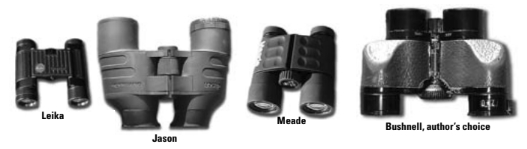
Finally, remember that binocular selection is a personal matter. How it fits the hand is almost as important as how it fits the eye. My own favorite is an old 6 x 24 Bushnell Custom Compact. You might remember this as the one that was advertised as the backup glasses on an Apollo moon mission. If I had the time and money, I would haunt pawnshops to find a 1950s era Leitz 6 x 24 Trinovid. When my son was a naval officer, he used a personally purchased pair of Meade 8 x 32 binoculars on his bridge duty watches instead of the Navy issue 7 x 50s. While I can’t guarantee that you could read the Bible engraved on the head of a pin at 100 yards with any of these glasses, you should be able to decipher the numbers on buoys and markers with relative ease.
Thank you to Sailrite Enterprises, Inc., for providing free access to back issues of Good Old Boat through intellectual property rights. Sailrite.com