Treat them with care and they’ll serve you well
Issue 42 : May/Jun 2005
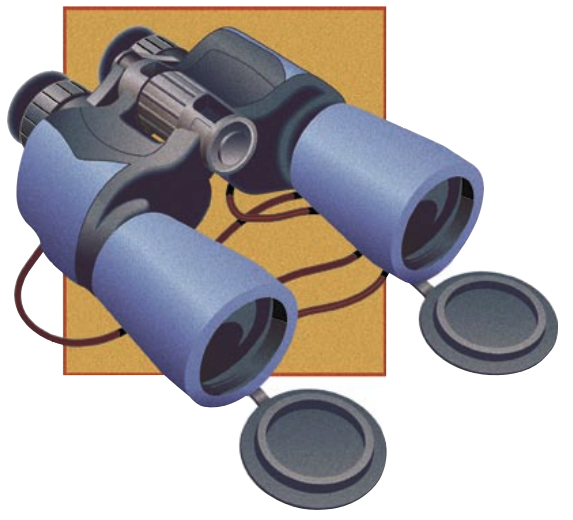
A binocular is an essential piece of boating equipment, and the selection of this item of navigational gear requires some basic knowledge of terminology as well as options available.
Optical terms
Three sets of numbers are used to describe a binocular’s characteristics. The typical marine binocular is a 7 x 50. This gives a field of view of 7.4 degrees, or one that covers 188 feet at 1,000 yards. The 7 specifies the magnification: seven times. For on-board use, seven is about the highest magnification that is practical, since a higher one would make it difficult to hold the image steady enough to see details, such as a buoy number; and in rough seas, even a magnification of seven is sometimes too much.
The 50, in the 7 x 50, is the diameter in millimeters of the front lens of the binocular, the objective lens. The larger this lens, the greater its light-gathering capability.
The third number, which is often unlisted, is also expressed in millimeters and describes how far the binocular’s eye lens can be held from the observer’s eye while still enabling the observer to see the entire scene. If eyeglasses must be worn when using a binocular, this number should be at least 18 mm.
Coated lenses
A proper binocular, like a good camera, has optical coatings on its lenses and prisms. This magnesium fluoride coating reduces internal reflections and increases clarity and brightness. The higher the quality and number of the coatings, the better the image reaching your eyes. Inexpensive binoculars may have no coating, with less than half the light reaching your eyes, while an expensive pair may have as many as 20 layers with more than 90 percent of the light being transmitted.
Waterproof
A binocular that is completely waterproof — not “water-resistant” or “splash-proof” — is desirable since, inevitably, the binocular is going to get soaked. This feature can also prevent internal fogging of the lenses or prisms due to moisture entering the case. With a totally waterproof binocular, you are also able to wash the case and lenses with fresh water after rough use. After washing, it’s a good idea to clean the lenses carefully with lens tissue.
High-quality, completely waterproof binoculars are often filled with dry nitrogen gas and have O-ring seals. One manufacturer even submerges each binocular in 12 inches of water for two weeks to check these seals. Some of the completely waterproof ones also have positive flotation in case you drop them overboard.
Focusing
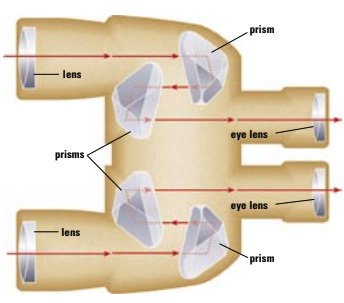
Often a user will have a different prescription in each eye. Binoculars with a main focusing control should also have one of the scopes focused separately to compensate for this. Some binoculars only have individual eye focusing, with no dual focusing control; but since the binocular is usually used only to observe distant objects, this individual focusing rarely needs to be reset. The individually focused binocular is also more likely to remain completely waterproof than its counterpart.
Electric focusing, with a small motor in the binocular doing the job, is also an option.
Covering
Unfortunately, on small boats a binocular takes a beating. To help protect this delicate optical instrument, the outer case of the binocular is often rubber.
Image stabilizing
An electronically stabilized binocular allows the use of a higher magnification power than a non-stabilized one. This makes reading buoy numbers and identifying navigational hazards possible at a much greater distance. Whereas a non-stabilized binocular has a practical limit of about 7 magnifications, an image-stabilized one will generally have a magnification of 14. Originally this stabilization was accomplished by incorporating small, power-hungry gyroscopes into the binocular, but that original system has now been replaced with systems that use piezo-electric crystals that sense movement and send digital signals to a set of gimbaled servos which adjust the optical platform. These systems generally use AA batteries as a source of power, with a battery life of several hours of usage.
The ability of image-stabilizing binoculars to correct for unwanted motion is expressed in the maximum number of degrees of correction possible, such as +/- 1 degree or +/- 5 degrees. Whereas the +/- 1 degree units can correct for hand-tremor, the +/- 5 degree units will also help correct for boat motion. Some models can be switched between “Land,” where +/- 1 degree is fine and conserves power, to “Onboard,” which gives maximum correction.
Although the best of these image stabilizing binoculars are expensive (in the $1,000-plus range for image-stabilized waterproof ones), many users count them among their most valuable navigational tools.
Specialized binoculars
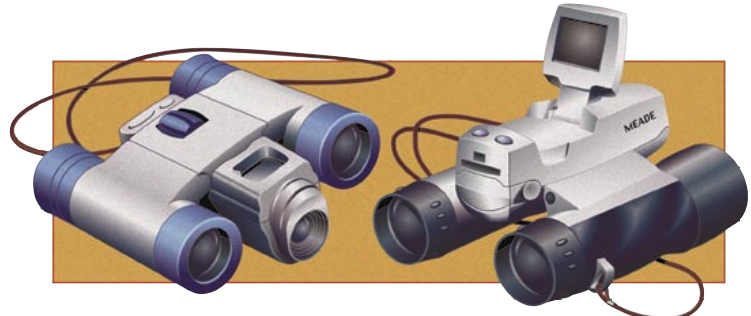
Binoculars are also available with a built-in bearing compass display (some are digital), in which you can simultaneously identify a navigational point and determine a compass heading. There are also binoculars available with a range-finding reticule which, if you know the height or width of the object you’re looking at (such as a lighthouse), will let you determine its distance.
A recent innovation is a binocular with a digital display that can take digital pictures of the object you’re viewing.
Regardless of the type of binocular on board, it should be treated as the delicate optical instrument that it is to ensure a long life and clear view.
Thank you to Sailrite Enterprises, Inc., for providing free access to back issues of Good Old Boat through intellectual property rights. Sailrite.com