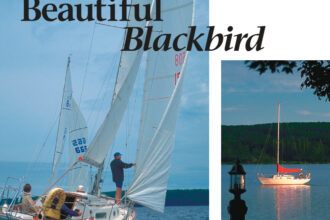
A trailerable pocket cruiser from a legendary designer

Issue 42 : May/Jun 2005
In the late 1960s, we owned one of the first Rhodes 22 sailboats manufactured by General Boats Corporation. We sailed our small cruising sailboat along the New Jersey shore, both intracoastal and offshore, on Long Island Sound, through New York Harbor, and 150 miles up the Hudson River to the Erie Canal. So it was like visiting an old friend again when going aboard a Rhodes 22. But our old friend has had a radical makeover since then and, except for the lines of the hull which haven’t changed, it’s a different boat from the one we owned more than 35 years ago.
The Rhodes 22 is designed for those sailors who want the amenities of a large boat but without the expense and hassles of one. It is an all-purpose, trailerable boat with innovative thinking that went into its detail, improvements, accessories, and gadgets. Perhaps this is why Rhodes 22 owners seem to be especially enthusiastic and loyal about their boats.
Stan Spitzer and his brother, Elton, both in their 70s, display their creation at boat shows throughout the east. Don’t look for men in blue blazers with svelte models lounging in the cockpit. More likely, one of the Spitzer brothers will be wearing bluejeans, worn at the knees. There will be no need to wait in line for a boarding pass with your shoes off; you’re welcome to just go aboard.
The Rhodes 22 is not advertised; there are no brokers and no glossy brochures. Instead, the handout is a 22-page single-spaced photocopied description of the Rhodes 22. This will answer most questions. If it doesn’t, Stan and Elton are happy to talk about their baby. Stan’s owners are his sales staff; word-of-mouth is the primary method of advertising.
“This is our only model,” says Stan, “and we want to give you as much on a 22-footer as you want. Our niche is either somebody who’s very new to sailing, is a bit afraid, and wants a boat that’s safe and easy to handle and can’t capsize or sink . . . or those who have owned big boats and want to get back to the fun of sailing a small boat, but don’t want to give up the amenities they have gotten used to on their big boat. They want an enclosed head, a galley, and shorepower. So our niche is at these two extremes.”
The boats are assembled in Edenton, North Carolina, on Albermarle Sound. Stan and his wife, Rose, who is office manager, live nearby. “Our factory is open seven days a week to anyone, no appointment necessary,” says Stan, “If we’re not there when you arrive, just call us at home.”
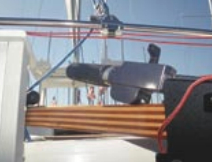
Fiberglass layup
It takes 27 separate fiberglass molds to construct a Rhodes 22. A cored deck and transom, each about 1-inch thick, are incorporated for stiffness. Very few boats of this size have positive flotation, but the Rhodes is made unsinkable by two molded-in foam sections under the forward bunks and beneath the cockpit sole.
This is one heavy, tough boat. The hull weighs more than 1,500 pounds, and the glass on the bottom is almost 1⁄2-inch thick. When a new boat is ordered, the interior and accessories installed virtually customize each boat, based on the options each customer selects.
The Rhodes has a slightly reverse sheer and an unusual flared hull. It’s a design similar to the Picnic 17, General Boats’ first boat. This flare makes the hull stronger and keeps it drier. It also makes for comfortable hiking seats and provides extra buoyancy that makes the boat virtually uncapsizable under sail. When hit by a strong gust, the boat may heel over, but when that flare hits the water, that’s as far as it will go. The downside is that the interior cabin space is less than it would be if the hull sides came straight down.

Sail plan and rigging
The Rhodes 22 is a masthead sloop and, when equipped with Stan’s mainsail furling, the main is loose-footed. But don’t ask Stan for a sail plan for the Rhodes 22. There is no standard sail plan, since each owner selects from a wide choice of available masts and booms — roller-furling as well as standard rigging. When it comes to a published sail plan, Stan says, “Nobody believes we never had one.”
Nine stays and shrouds
While many sailboats of this length have six stays, the deck-stepped mast on the Rhodes is supported by nine stays, each with its own chainplate. The Rhodes is the only 22 available with either a conventional mast or “Innermast Furling,” General Boats’ name for their roller-furling in-the-mast mainsail.
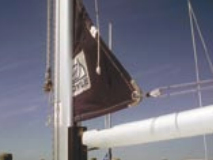
Most Rhodes 22s are sold with a 175-percent roller-furling genoa and with Innermast Furling (IMF), which allows the total sail area to be adjusted between 0 and 300 square feet (more than any other trailerable in its category). The ability to furl the genoa and the mainsail lets the skipper adjust sail area and balance so the boat can be sailed in all wind conditions.
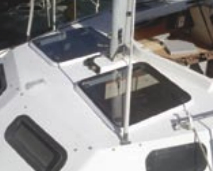
The IMF option for the main is similar to that of roller-furling jibs. The mainsail furling tube is inside a mast chamber; the amount of sail is controlled with the furling and outhaul lines. Stan is so sure buyers will love the furling mainsail that they can buy the mainsail furling option and, if dissatisfied, he will switch them to a conventional rig, free of charge.
With the Innermast Furling system, sailors have the ability either to raise the boom and furling system within the mast 18 inches, so it will be above the pop-top, or they can lower it when the pop-top is down. When raising or lowering the boom, the entire mainsail furling system within the mast (roller and sail) is raised or lowered along with the boom. The downside to IMF is that the mast extrusion is larger than if there were a standard main.
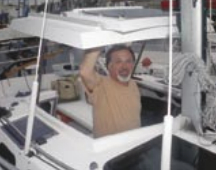
This increases windage slightly as well as increasing the weight aloft. As with everything in sailboat designs, it’s a trade-off. When a conventional mast and mainsail are used, the boom can be used to roller-furl the main.
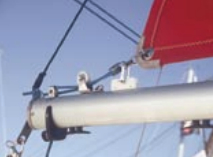
The placement of a mainsheet traveler on a boat with a tiller has always been a vexing problem, especially if the mainsheet is fastened to its optimum position at the end of the boom. The Rhodes solves the mainsheet and traveler problem by building sockets into the split backstay; a 5-foot stainless-steel bar is inserted into these sockets, and the car of the traveler travels on this bar, giving it a very wide run. Above the traveler is a backstay tension adjuster.

The anchor is hung on bow pulpit brackets, and the anchor rode goes down through a deck fitting into a V-shaped tray in the forepeak. Alternately, some owners prefer to store the rode in a bag next to the anchor on the bow pulpit.
Cockpit
The cockpit is large and very comfortable with open storage under the seats. The table in the cabin can be moved to a pedestal socket in the cockpit for meals outdoors. An optional boom tent can enclose this large cockpit and create an additional large living area when at anchor or in a marina during inclement weather. Stan dubs this tent the “boom-room.” With the tent installed, this extra cockpit area can be used for dining, showering, or sleeping. When used as a bedroom, with the whole cockpit transformed into a mattress, it can sleep two or three in a luxurious 7-foot 4-inch long bed.
Keel and centerboard
The Rhodes has a combination keel/centerboard. With the board up the boat has a 20-inch draft. The ballasted keel is molded as part of the one-piece hull, giving it the strength of a T beam. The uniquely shaped kick-up centerboard, which Stan calls a diamondboard, is solid, with resin and encapsulated ballast. At 70 pounds, it is heavy enough to remain down when sailing, yet when immersed in water, it’s light enough that a child can pull it up without a winch. Its kick-up feature is ideal when sailing in shoal water.
Recent rethinking of sailboat keel design has prompted a complete reshaping of the Rhodes’ centerboard and centerboard trunk. The diamond-board is a keel/centerboard that has a diamond-shaped cross section, resulting in decreased drag. Among other things, it increases pointing ability compared to traditionally shaped centerboards. The diamond-board is also uniquely mounted. It is installed into the keel from the top, from inside the cabin, and can be removed or installed while the boat is on a trailer. When installing the centerboard, the pivot-pin’s V-slot automatically aligns the board. A reusable gasket goes over the centerboard trunk flange, and the trunk cap screws down over this gasket, keeping the centerboard trunk watertight.
Motor mount
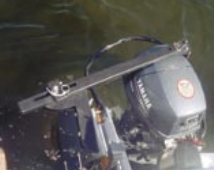
A particularly nice feature is the outboard motor mount on the port side of the transom, which will appeal to anyone who has ever hung over the stern of an outboard-powered auxiliary and hassled with raising a recalcitrant motor. The engine slides up and down on plastic tracks on the port side of the transom. A 6:1 purchase “magic box” raises and lowers the motor with little effort. The height of the motor can also be locked into any position for motoring in very shallow water. This motor mount is proprietary to the Rhodes 22 and is built by General Boats. For those with bad backs, raising or lowering the motor can be done electrically.
Another convenience is that the outboard motor controls are mounted on the tiller, so if you’re on the starboard side, there’s no need to rush around to the port side for throttle or shifting changes. On the starboard side of the transom is a boarding ladder.
Kick-up rudder
One of the frequent problems on boats with an outboard rudder and an outboard motor next to it, is the possibility of the propeller hitting the rudder when turning. Stan solves this problem with an adjustable bar that joins the rudder and outboard, so that turning the rudder also turns the outboard. This eliminates the possibility of the two coming in contact and increases steering control enormously.
The rudder is a kick-up style with a unique rudder clutch that allows sailors to set the kick-up tension.
Belowdecks
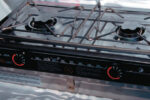
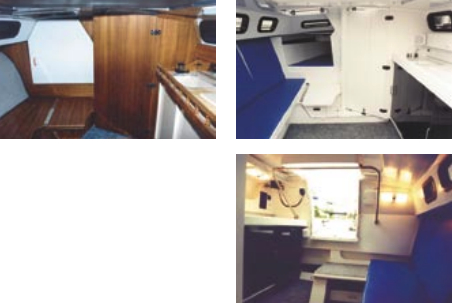
The galley is a modular unit that can be removed from the boat for major remodeling. It has a 15-gallon deck-filled water tank under the V-berth and an electric on-demand water faucet. The large countertop has a deep fiberglass sink and a gas stove with a cutting-board cover. Sliding cabinet doors give entry into a very large storage area.
A 12-volt DC outlet and a GFI 110-volt shorepower outlet make it handy to use galley accessories. Under the aft end of the counter is a built-in, yet removable, icebox. As an alternative, AC/DC refrigeration is available.
On the port side of the cabin is a long settee that can be converted into a 6-foot 6-inch double bed. There is sitting headroom enough for the tallest NBA player. The cabin table is mounted into a recessed socket in the cabin floor. It can also be used in the cockpit. When not in use, the table is stowed in tracks in the overhead.
The Rhodes has a fully enclosed head with either a Porta Potti or a permanently installed marine head with a 9-gallon holding tank (the tank is under the V-berth). Either a deck pumpout or an optional electric macerator with through-hull discharge is available. Privacy in the head is created by an ingenious three-panel door. A hatch above the head provides light, ventilation, and sitting or standing headroom.
The electrical control panel for the #27 12-volt battery, has additional switches and fuses for future new circuits, and the battery is kept charged with an automatic charger when connected to shorepower. A second battery is an option. For those who spend much of their time on a mooring, two solar panels are also an optional charging accessory. These panels are strong enough to be stepped on.
Variable pop-top
The main hatch on the Rhodes can be raised to create a hard-top pop-top with 6-foot 4-inch headroom. Even when sailing, the pop-top can be used as a shield from the sun or enclosed with side fabric as a dodger. Unlike many of its counterparts, the pop-top can be raised to variable height.
Sailing qualities
Since the Rhodes 22 has short overhangs, its 20-foot waterline enhances its maximum speed. With the board up and a 20-inch draft, the Rhodes sails just fine, though naturally it can’t point as high as with the board down. Both the centerboard and rudder kick up if they strike an obstruction.
With full jib and main deployed the Rhodes sails well in the lightest of breezes. I sailed in Jay Friedland’s Rhodes on Barnegat Bay, New Jersey, on a day with just cat’s paws on the water in the morning — a wind of less than 5 knots. We began with the full 300 square feet of sail. However, the wind slowly picked up as the day progressed, and I could observe the ease with which the sail area was progressively reduced to keep the Rhodes sailing at its most efficient angle of heel without being over-canvassed.
Although not designed as a racing boat, the Rhodes has a PHRF rating of about 258, which makes it a bit faster than the Catalina 22, O’Day 22, or Chrysler 22, but slower than the J/22.
Revitalization program
A new Rhodes-22 sells for $28,000 on up, depending on the options selected. Stan also purchases used Rhodes sailboats, has them shipped to the factory in Edenton, and puts them through a two-step revitalization program that ensures that each boat can be resold under a new-boat guarantee. The final pricing is a function of the year of the boat and the upgrading options selected by the new owner. This rebuilding program is a major part of General Boats’ operation; refurbished boats that leave the plant are indistinguishable from new ones. These rebuilt boats sell from $8,000 and up, depending on their age, condition, rebuilding required, and new owners’ options. This program makes the resale value of the Rhodes the highest in the industry, since General Boats competes to buy your Rhodes when you are ready to move up to a larger boat.
General Boats also has a program through which potential customers can sail one of the company’s used boats for a season or two, then have their rental money refunded if they buy a new boat.
Thank you to Sailrite Enterprises, Inc., for providing free access to back issues of Good Old Boat through intellectual property rights. Sailrite.com