Issue 14: Sept/Oct 2000
I worked quite closely with Allied Yachts in the mid-1960s when they commissioned Bill Luders to design the Luders 33, and I was favorably impressed with the quality of their construction. Bill and I made several trips into the Catskills to visit the plant, and we were able to see for ourselves the craftsmanship and the strength that the folks at Allied built into their products.
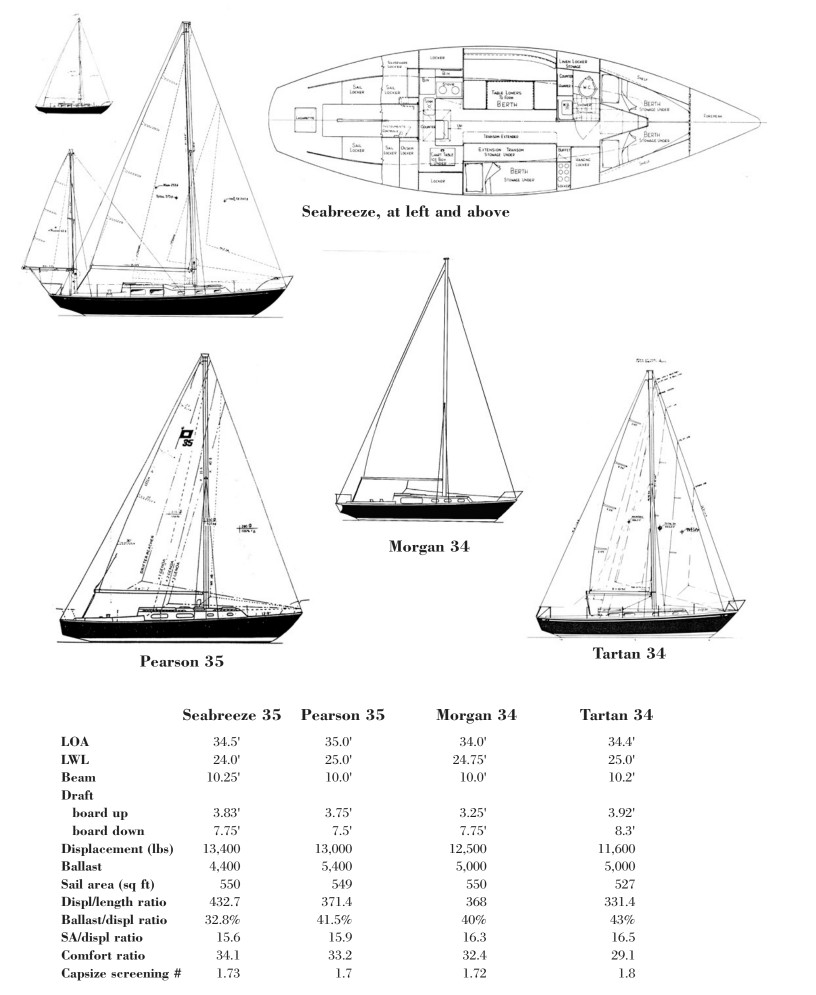
An interesting sideline here is that in order to save money on the tooling for their new boat, Allied did not want to make a new deck mold for the 33. So, with only minor changes at the stern, the mold for the Seabreeze 35 deck became the mold for the Luders 33 deck. That should explain the family resemblance if you ever see the two boats side by side! The numbers comparing the Seabreeze to several other production keel/centerboarders of the late 1960s, early 1970s are shown in the chart on below.
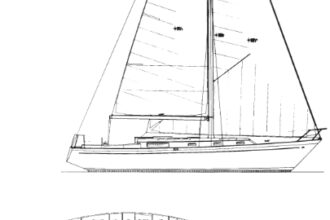
When you study the figures, it becomes obvious that the designers were thinking along the same general lines, producing a type of yacht that was very popular in that era. Only the Tartan 34 has a fin/skeg rudder profile, and the other three are traditional full-keel/centerboarders. In effect, the Seabreeze, Morgan 34, and Pearson 35 are smaller versions of the famous Finisterre, Block Island 40, Bermuda 40, and similar keel/centerboard CCA cruiser/racers.
The Seabreeze is the heaviest of the four and has the shortest waterline, so her displacement/length ratio is very high by contemporary standards, and she would be classed as ultra-heavy today. However, all these yachts have long overhangs and will pick up waterline length as they heel, so the displacement/length figures are somewhat misleading. They will definitely be reduced down to the low 300s, as the yacht heels when beating to windward.
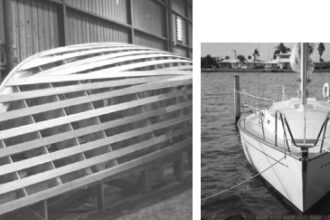
What is a bit confusing about the above figures is that the Seabreeze is not only the heaviest of the group but has the lightest ballast. I expect this is the result of the very husky, thick fiberglass construction that Allied favored. According to Arthur Beiser in his book, The Proper Yacht, 400 pounds of that ballast is in her husky bronze centerboard, and this will lower the center of gravity, adding stability as the board is lowered. (Later models had 350 pounds in the board -Ed.) However, the board will retract back into its slot in case of a capsize so will not add to ultimate safety. In any case, the capsize screening formula for all of these yachts is conservatively below that of the typical light displacement, ultra-beamy, coastal cruisers being produced today, many of which have numbers well over 2.0 and are almost as stable upside down as they are right side up. Indeed, each of these boats is quite capable of ocean passages in experienced hands, and many of them have made extended voyages.
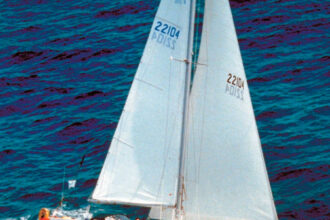
The rigs in our comparison are quite similar in area with the heavy Seabreeze having the lowest sail area/displacement ratio, naturally. Allied did offer the option of a yawl rig, though, with 25 square feet more area, increasing the sail area/displacement ratio to 16.3. That definitely would be my preference over the sloop rig as it allows the skipper to set a very useful mizzen staysail off the wind and, of course, has the other advantages of the yawl rig, not the least of which is that it is just plain handsome.
Still, I expect that the Seabreeze will be slightly outperformed by the others in this group due to her husky displacement and short waterline. The Sparkman & Stephens-designed Tartan would be my choice for the best performer, due to her reduced wetted area, lighter displacement, and high ballast ratio, with the other three boats right on her heels.
All of the boats favor the single-spreader rig with double lowers, a setup that was standard in that era. The Seabreeze mast is stepped on deck, as are those on the Morgan and Pearson. Only the Tartan 34 has a strong keel-stepped rig. The deck-stepped spar is not my favorite setup as it is substantially weaker in compression than a keel-stepped mast. So, a stronger, heavier tube is required to handle the loads, and this adds unnecessary weight aloft. And in case of a dismasting, it is much simpler to set up a jury-rig with a keel-stepped mast, as there is usually a stub of spar left to start with.
Due to their relatively short waterlines and narrow beam, none of these boats can compete with the contemporary 35-footer in terms of inside layout. Indeed, their interior volume is more like that of a 28- to 30-footer of today, so you won’t find double berths or private staterooms tucked under the cockpit. Still, these classic boats can accommodate a family of four in comfort for a week or two and a couple for much longer voyages, and that is what most of us ask of a yacht.
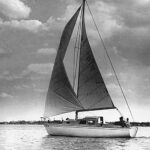
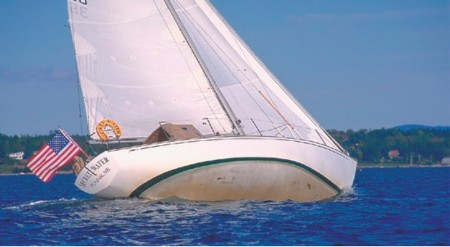
One other thing that many people want in their yacht is beauty, and the Seabreeze 35, with her long overhangs and handsome sheerline, delivers that in spades. Thanks to MacLear and Harris’ design artistry, the 35, like many other older boats, will stand out like Cinderella at a family picnic whenever she sails in company with a fleet of today’s rocket-ship-styled freaks.
Ted is well known as a naval architect and the creator of many good old boats sailing today.
Thank you to Sailrite Enterprises, Inc., for providing free access to back issues of Good Old Boat through intellectual property rights. Sailrite.com