The World According to GRP from Dan Spurr’s new book
Issue 13 : Jul/Aug 2000
Assigning proper credit to the people behind the first fiberglass boats is difficult for several reasons. The fiberglass boat was not a discovery per se, like Alexander Graham Bell’s telephone, or Jonas Salk’s polio vaccine. Rather, it evolved from experiments with various glues and reinforcing materials by many different people and companies.
It is evident that a number of enterprising individuals were working simultaneously around the United States and in other countries to perfect plastics for boats. And precious few kept records that survive today. Indeed, the lack of written documentation is an idiosyncratic shortcoming of the boatbuilding industry. Ask the president of a company when, during the 1970s, it switched from building solid fiberglass hulls to balsa-core sandwich hulls and it’s not unlikely you’ll hear, “Let’s see, that would be 1973, 1974. You could ask Manny, the glass-shop foreman, but he doesn’t hear so good these days.”
Though the yachting periodicals of the day — Yachting and The Rudder — documented the growing industry (in particular, authors “Tony” Boughton Cobb Jr., manager of the Reinforced Plastic Boat Division of Owens-Corning Fiberglas, and Pete Smyth, who knew about, or interviewed, early fiberglass boatbuilders), theirs was at best a sketchy history. Beyond these minimal written sources, there are only the memories of builders, owners, and sailors, however blurred by time, to help limn the picture.
First attempt
By some accounts, the first attempt at building a polyester-fiberglass boat was made by a company in the Bronx borough of New York City. Basons Industries had a commission from the U.S. Navy to build some wherries, or small inshore boats. They made a mold of wood and laid up the first hull, but did not use wax or any other mold-release agent. Of course, the hull would not come out of the mold. After repeated efforts, they grew frustrated and dumped the whole mess into the river, where, presumably, it resides to this day.
In 1960, Cobb wrote, “The earliest fiberglass boat we know about was built in 1944 by Universal Molded Products, in Bristol, Virginia.” It was a 14-foot skiff, still in operation many years later. Cobb referred to it in answering the question of how long a fiberglass boat could last. While admitting that the boats really hadn’t been around long enough to know with certainty, he guessed 20 to 30 years.
And there are a few other stories, none substantiated, of persons converting their wartime knowledge of plastics into boats. Plastic boats had been built since the late 1930s, but none had used glass fiber as the reinforcing agent. How polyester and glass fiber came together in the same hull is a case history of diligence and providence.
Ray Greene
Born in 1913, in Brooklyn, New York, Ray Greene was the son of a Canadian chemist. When Ray was six, his father, Herman Greene, moved the family to Toledo, Ohio, where he became chief metallurgist and director of research for the Willys-Overland Company. “Willys,” Ray recalled, “doubled his salary and gave him a year to build a research facility and come up with something they wanted.”
Suffering in the Midwest from hay fever, Herman “Harry” Greene was looking for a summer place “up north.” Playing poker one night with several Willys executives, he won enough money to buy his “hay-fever haven” in Traverse City, Michigan. Located 600 feet from beautiful Glen Lake, the home Herman bought had been owned by the foreman of an old sawmill that had burned in 1903. Hiking and swimming with their father, the Greene children relished their proximity to water, and for Ray it reinforced his lifelong love of boats.
Though he built thousands of boats in his career, Ray has always pictured himself more the inventor, like his father, whom he greatly admired. Several anecdotes from his childhood illustrate his mettle.
“For a quarter you could buy a Hire’s setup to make root beer,” Ray remembered. “You had to bottle it for a week. I didn’t know about the expansion of gases, but I did know that frozen CO2, dry ice, was the foam in root beer. Father had a 5-gallon thing with a gauge on it. So I filled it and put about two pounds of dry ice in. The gauge went over the top. I told Mother to run. The thing blew up and dropped the sink six inches. We had to repaper the whole kitchen.”
Jugs of hooch
“Later, during Prohibition, I said, ‘Pop, I’d like to make hooch.’ I wasn’t particularly interested in drinking it, just learning how it was made. Mother was horrified. Father said, ‘I can’t think of a better way for him to learn chemistry.’ So I made a couple of jugs.”
Ray built his first boat at age 12, but his father, disappointed in its construction, threw it out.
While still in high school, at age 16, he had formed Ray Greene & Company to build boats in the family’s garage. He was nothing, if not inquisitive, bent on understanding how things work. Like many boatbuilders, he loved messing about in boats. At 18, there was no reason to forever build with the same materials and methods as generations of builders before him: in wood, piece by piece. Some thought preformed plywood panels were a big step forward from conventionally planked hulls, but Ray Greene was interested in a quantum leap. His IQ was reportedly 150, and he was determined to use it.
In 1931, Ray entered Ohio State University, building and selling 15-foot one-design Snipes to pay tuition. As he pursued degrees in mechanical and industrial engineering, his research led him to synthetic resins that then still required the heat of an autoclaving oven to cure, and pressure to remove air bubbles from the laminate.
Lost letters
Herman Greene died in 1934, and Ray, the oldest of four children, was forced to pay his own tuition to finish college, even contributing to the education of the others.
“I wrote to every plastics company in the country,” he said. “The letters I got back were lost in a fire, and I wish I still had them because nearly every one of them said that what I was trying to do was impossible. They’d make good reading today.”
In the mid-1930s, Ray was building small boats using melamine and urea resins with ordinary cloth reinforcement. “In 1936,” said Ray, “I wanted to find a new material for boats. In 1937 I wrote my mechanical thesis on choosing a plastic for boatbuilding.
“I presented a preliminary copy to Professor Moffit. He asked if this thesis was for mechanical design or naval architecture. He suggested I substitute ‘large object’ for ‘boat.’ If I did that, he said, the thesis would be OK.”
The resins by themselves were brittle. The key was finding the right reinforcement to strengthen the resin. Cotton cloth worked, in a fashion, but it lacked tensile strength. Ray said, “I tried screen wire, unbleached muslin, brown paper, and everything else you can think of. For resin, polyester was not yet available so we used urea-formaldehyde.”
In 1941, Owens-Corning Fiberglas began weaving glass fibers for commercial use. Providentially, OCF was headquartered in Toledo. Greene, who had done some experimental work with rocket tubes for the company, was permitted to buy half the initial run of glass fibers. Using urea-formaldehyde and fiberglass, he baked boat models in a three-foot-long autoclave. To make bigger boats, he constructed an “electric box with heaters and baked things that way.” But he was still using resins that required heat and pressure for curing. Not surprisingly, among chemical companies the race was on to develop a thermosetting resin that would air cure in an open room without heat. By now the United States was at war, and the shortage of metals heightened the urgency of inventing alternative materials.
First polyester-fiberglass boat
“In about 1939 I had my plywood sailboat company going, so I started a small autoclave from junk parts,” said Ray. This set the stage for his breakthrough.
“By all accounts,” wrote chronicler Pete Smyth, “it was DuPont that broke the code that gave us the polyester resin we use today, but it was a laboratory batch from American Cyanamid that found its way, via a mutual acquaintance, to Ray Greene and into the world’s first fiberglass polyester boat.”
Ray said, “One of the research men at American Cyanamid sent me about a gallon of polyester cold-setting resin. He said it was half of all they made for the laboratory.”
The year was 1942, according to Smyth. The boat, in all likelihood, was a dinghy, perhaps the 8-foot Tubby Dink or the 12-foot Nipper, which he had been building for some years in plywood.
Ray found his knowledge in high demand. “People always wanted to come in and gas with me about fiberglass. I put it out in the industry that I was available from 8 to 12, Saturday mornings. I met some characters. Had a farmer come down from the middle of Ohio who wanted to build a fiberglass barn. Then there was a woman who, on inspecting one of my dinghies, said, ‘Those aren’t fiberglass! I can’t see through them!’ ”
Oil overhead
“One of the best was a guy who envisioned a car top made of two plastic shells with oil between them. On dark days you’d pump out the oil, and on sunny days you’d pump in a dark oil. He couldn’t get anyone interested in building them. He came to me, and we weren’t thinking fiberglass then, but thermoplastics, acrylics. I told him there isn’t a plastic that will last more than a couple of years. He wanted to give me $3,000 to build the first one. I said I’d make it if I thought it would work, but I didn’t see how.”
Ray continued his work throughout the war, serving first in the Army and later as a commissioned officer in the Navy, where he was an assistant supervisor for the building of small craft. “Art DeFever was my counterpart as a naval officer during the war,” Ray said. “We were so interested in mixing things that we’d send his girl and my wife out to a show while we started mixing pots in the kitchen. After the stuff went off we couldn’t clean the bowls, so we buried them in the garden. For years after, my wife would ask what happened to those bowls, but I never did tell her.”
After the war: the Rebel
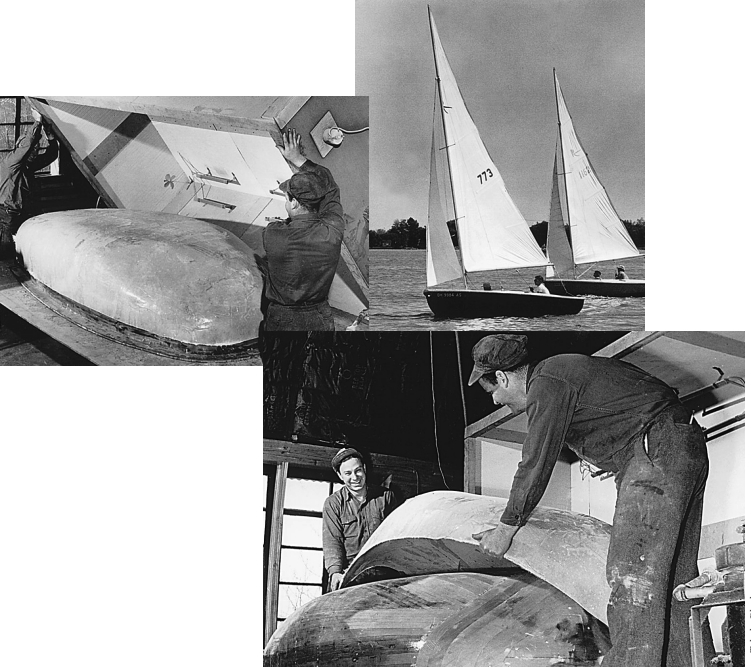
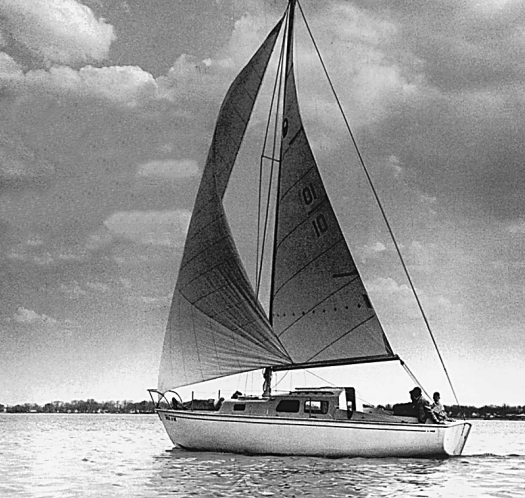
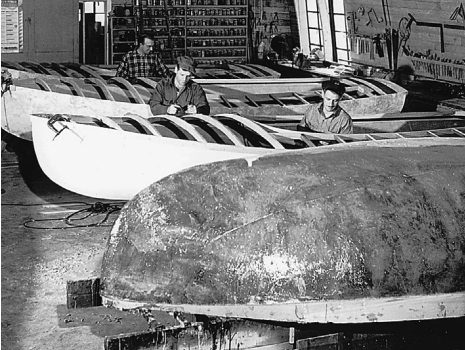
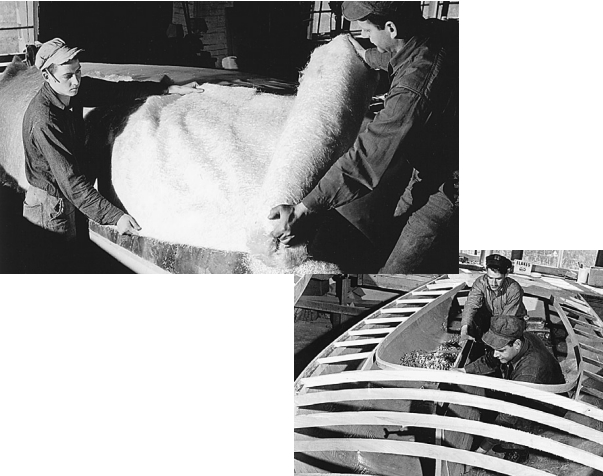
Returning to Toledo after the war, Ray quickly resumed his boatbuilding business. By 1947 or 1948 (Ray’s recollection is unclear) he was building, on a production basis, 8-foot fiberglass dinghies (including the Tubby Dink, introduced in 1942) and the 16-foot Rebel daysailer, a one-design on which he and Alvin Youngquist, a Waite High School drafting instructor, collaborated. More than 5,000 were built, and the boat is still actively raced.
“Twenty-five years later,” Ray Greene would remember, “I was at an alumni meeting when Professor Moffit stood up and said, ‘I’d like to make an apology to one alumnus. Will Ray Greene stand up?’ I was startled. ‘In 1937 he wrote a thesis choosing a plastic for structural work. I discussed it with many of the other professors. We thought the basis of your thesis was silly, but because of your enthusiasm we let you go ahead with it. We all thought it was nuts. It turned out to be one thesis that was the beginning of an industry.’ ”
In the following years Ray’s work diversified, as it would for the small percentage of forward-thinking builders. He built a fiberglass sports car in 1950, which produced some talk with General Motors about building the fiberglass bodies for Corvettes (which would come in 1953, but not by Greene).
Fiberglass Snipes
In the early 1950s, Ray was approached by the president of the U.S. Snipe Association, who expressed interest in building the boats out of fiberglass. He offered to pay the cost of the tooling. Ray countered that if 10 orders were placed, with a $100 deposit for each, he’d bankroll the tooling himself — which he did. After delivering the Snipes, the first ever in fiberglass, he suggested to the association that they license just three builders in the United States so there would be enough orders for each. Instead, the association licensed many more, including, said Ray, “one about 50 miles from me. I said to heck with it.”
The Navy contracted him to redesign its air-sea rescue boat, and it also sent him to Vietnam in 1961 to build swimmer-support boats. And the Coast Guard had him build its pavilion for the 1964 World’s Fair.
Owens-Corning and Ray Greene maintained a relationship for many years. “Owens-Corning wanted to take all the things I’d done and give them to everybody else,” he said, “like making fenders for cars. I’d write a detail on how to do it [a fiberglass fabrication procedure], and they’d publish it so others could make things. I had to do it [explain the process] for the Coast Guard. Once the commandant came up to me and said, ‘You wrote the most beautiful article on building boats, but you didn’t tell us a damn thing.’ I said, ‘That was my intention.’ ”
Disastrous fire
The June 1950 fire at South Byrne Road, Toledo, caused by an inadvertent mixing of catalysts and promoters, destroyed Ray’s office and much of the factory. Deeply in debt and only partially insured, he was devastated and never fully recovered from the loss. Like too many boatbuilders, he was a keen engineer but a lousy businessman. Again, he was an inventor at heart. “If I made a little money in the boat business,” he said, “I’d devote the rest of the year to experimenting. The investment/ inventor people rarely make the money.”
Several efforts to sell the company (including one to Chris-Craft) fell through, but he hung on until he accepted a contract for his land. He retired in 1975 at the age of 62. He spends summers at his place near Glen Lake, Michigan, where his father had taken him as a youth and where he learned to love boats; he spends winters in the Florida Keys.
“Things have to grow old, get mature, and die,” he said. “I made mistakes about 49 percent of the time, and 51 percent of the time I had the right answers. I survived the way I wanted to. And I sure had fun.”
Dan is editor of Practical Sailor and a former senior editor of Cruising World. This article is an excerpt from his newest book, Heart of Glass, just published by International Marine/McGraw-Hill and available from Good Old Boat’s bookshelf. This historical reference book was 12 years in the making. Dan is the author of Spurr’s Boatbook: Upgrading the Cruising Sailboat and Yacht Style: Design and Decor Ideas from the World’s Finest Yachts, both available from International Marine, as well as River of Forgotten Days and Steered by the Falling Stars.
Thank you to Sailrite Enterprises, Inc., for providing free access to back issues of Good Old Boat through intellectual property rights. Sailrite.com