When boats leave the safety of the drawing board
Issue 79: July/Aug 2011
In my more than 50 years designing yachts, I’ve had my share of problems with owners and with boatbuilders, including raw amateurs, custom builders, semi-custom yards, and production firms. My experiences seem to bear out the truth in Murphy’s Law: “What can go wrong, will!”
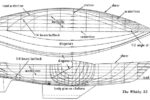
The biggest problem with amateur builders, and even the odd professional, is their refusal to do a proper job of lofting the hull lines. Lofting is simply the process of redrawing the designer’s hull lines full size. When it is skimped, small errors can creep in and take away from the completed vessel by creating unfair sheerlines and other distortions. These are rarely serious enough to affect performance or safety, but they can adversely affect the appearance and trim . . . and they certainly do ruin the designer’s day!
Bad lofting can be even worse than skimping on the process. I recall one wooden 32-foot yawl built in the 1960s where the professional builder fouled up royally through careless, or perhaps incomplete, lofting. The finished yacht wound up with distinct hollows in her forward sections where the designed lines showed a slight convexity. I thought I’d made an error in taking off the offsets from the lines drawing until we made templates from the offset table. When these were applied to the hull, it was apparent that it was the builder’s error, and a rather serious one that could affect both performance and trim to some degree. Unfortunately, there was no recompense available as the one-man shop had little financial backing.

The unexpected
Sometimes things go wrong that cannot be blamed on anyone. I recall the time in the early 1960s when I was working for Bill Luders. He was designing a new 5.5-Metre sloop. These 32-foot open racing machines had to measure in within millimeters or they could not legally compete in the class. I faired the hull lines and made up the offset table. We had two of the yachts built in Canada by the same yard, one for a U.S. citizen and the second for an Italian owner. Imagine my shock when the first boat arrived at the Luders yard after a 600-mile road trip and was pronounced too narrow by the official measurer. I raced up to the drafting room, hauled out the lines drawing, and almost fainted with relief when I placed the scale on it, read off the beam, and found it was correct as drawn: the legal 6-foot 3-inch minimum.
My next move was to jump into my little 1.5-liter Riley and burn up the New York State Thruway on a trip to the builder’s shop to recheck the full-size lofting. It also proved to be the legal minimum, so the lofting was not at fault. We finally decided that the lightly built boats were shipped before the glue in the plank seams had fully hardened. As a result, the long overhanging ends sagged from bouncing down the highway on the delivery trip and this, in turn, caused the midship section to change shape and lose about an inch of beam. I should add that the 5.5s displaced a maximum of 4,520 pounds and commonly had 3,500 pounds of lead ballast, so the 1,000-pound hulls had to be very lightly built to be seriously competitive.
Bill Luders came up with the idea that saved the day: at the measuring point on each side, we drove in a nail but left it protruding far enough to give the required 6-foot 3-inch beam. Then a fair shape was built up to the nailhead using epoxy and microballoons. It worked! The boat was finally measured in and Bingo II turned out to be one of the top 5.5s in the fleet, and went on to win the US 5.5 championship that year and a bronze medal in the 1964 Olympics!

Amateur “improvements”
One problem that can occur with amateur builders is that they sometimes want to modify the plans to suit their own ideas. A recent example of this was the elderly gentleman building a 20-foot plywood sloop. He wanted to add a clipper bow and bowsprit for appearance. That was bad enough, but he then went on to say that he also intended to fit a foot-high solid wooden bulwark along the deck edge for safety and raise the cabin height considerably for better headroom. I patiently explained to him that the bulwarks and higher cabin would add weight up high and this would seriously affect the stability and safety of such a small boat. I can only hope I was persuasive enough that he gave up his rather dangerous ideas.
Even professionals are not immune to making undesirable changes at an owner’s request, unfortunately. To please his client, one builder of a 33-foot wooden cutter ignored the plans, which showed the chainplates inside the rail, and fitted outside chainplates instead. To make it worse, he fitted old-fashioned channels so that the chainplates stood out far enough from the hull for the turnbuckles to clear the toerail. This increased the sheeting angle several degrees, definitely impairing the yacht’s weatherliness and also making an ugly interruption in her handsome sheerline. I was truly annoyed that the change was made without giving me a chance to voice my opinion or suggest alternatives.
More recently, on a large midships-cockpit yacht, the owner decided he wanted more headroom in the aftercabin than the designed 6 feet 4 inches. So, without consulting me, he and the builder came up with something that looked like a cheesebox on a raft. It provided lots of headroom but it certainly did not parallel the lines of the original aft cabin or fit in with the yacht’s sweeping sheerline. I felt a bit sick when I first saw it.
An ignominious fate
Of course, sometimes things happen that sicken everyone — the designer, the original owner, and the builder as well. The 62-foot ketch Traveller III was built under her owner’s watchful eye in 1971, in Hong Kong. The hull was beautifully crafted of teak, ipol, and bronze to standards so high that the Lloyd’s surveyor said of her, “The only man who should be allowed to buy this vessel is one who would appreciate a Duesenberg.”
Traveller III was placed in the luxury charter trade by her owner and his wife, cruising from Florida to the Bahamas. Then, in 1976, they decided to retire and sold the yacht to a “syndicate.” Later that year, I oversaw her very complete refit in Camden, Maine. I thought no more about her until 1978, when I received a phone call from the United States Coast Guard asking if I was the designer of Traveller III. The caller informed me that she had been scuttled off the Maine coast while being chased by a USCG cutter. The next day, a USCG officer came to see me and I gladly provided a set of her plans. Eventually, divers were able to retrieve enough bales of marijuana as evidence to put the crew away for several years. Fortunately, the yacht’s rigged model still sails in my office on a rippled, green-glass sea, and I often look at it and think of better days.
Builders’ embellishments
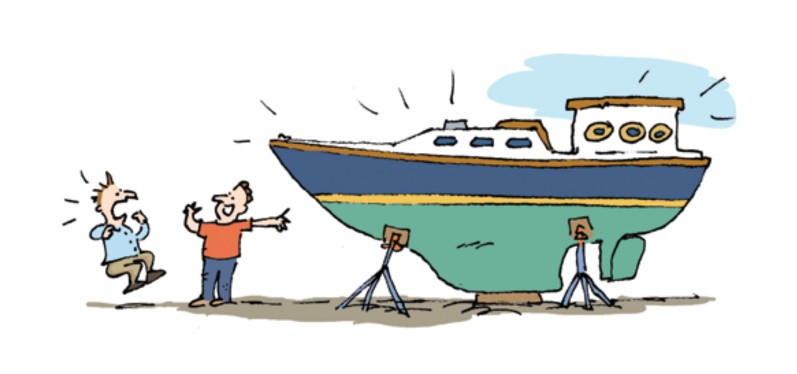
It is a fact that production builders also change the designer’s plans to suit their own ideas or, more often, to save a buck.
When the Luders 33 was designed in the mid-1960s, we drew in a low and handsome trunk cabin. The builder already had a 35-footer in production, and rather than make a deck mold for the trunk cabin as designed, simply altered the deck mold of the 35 to fit. This cabin had a slightly raised “doghouse” aft, which definitely took away from the classic lines that Bill Luders had created. Bill was not pleased, to say the least, and neither was his assistant — me!
On the first large production yacht I did on my own hook, a 42-footer, I drew in what is often called the “Brewer bite,” a cutaway ahead of the rudder to reduce wetted surface and improve the maneuverability of the full-keel hull. The builder eliminated this and drew the keel full length, much to my chagrin. Worse, he did not buy new mast tubes to match the specifications I had calculated for the yacht. Instead, he used tubes he already owned, a mainmast suitable for a 45-foot sloop and a mizzen that was the mainmast for his 37-foot sloop. These oversized tubes added considerable weight aloft and certainly did nothing to improve performance, but they were hell for stout!
Even worse was a rather classically styled 47-foot fin-keel ketch I designed for a private owner. The client contacted a production builder who agreed to build his boat as the first of a series and pay royalties, provided my client paid for the tooling. What a mistake! Things started off fine, but then the builder talked my client into an all-electric, 110-volt yacht with electric stove, 110 VAC refrigeration, freezer, ice maker, trash compactor, and what-have-you. To power this, he installed a heavy 10-kW diesel genset under the cockpit and fitted a heavy bronze watertight hatch in the cockpit sole for access. Naturally, the yacht had to have a teak deck, watermaker, and all modern conveniences. By the time she was launched, she was 6,000 pounds overweight and floated badly down by the stern.
I was horrified, and later, on my advice, the 10-kW genset was replaced by a 5-kW genset, the bronze hatch was replaced by aluminum, and the heavy trash compactor was removed. That helped, but she was never the boat I designed. That builder later went bust, the owner made a deal with Islander Yachts to build the boats, and the molds were shipped west. Amazingly, Buster Hammond, Islander’s manager, built the yachts without all the foofaraw, so they floated at the designed displacement and performed the way they were designed to perform.
Compensation woes
Possibly the greatest lament designers have with production builders is their reluctance to pay the agreed royalties when they build the boats. They don’t seem to mind paying the first few, but after that they tend to decide that the designer has been paid enough, even if they eventually build 200 boats! Indeed, only two or three of the dozen and a half production boatbuilders I worked for were completely honest when it came to paying the royalties they had agreed to pay when they badly wanted the new design. Of course, the designer always has recourse to an attorney, provided he can afford the fees, the court costs, the travel expense, and the wasted time. I never could.
Some of the builders simply went broke, of course. One even wound up in a Philippine jail. Others were such lousy managers that their companies eventually folded (like the one who so horribly overloaded that 47), and more than one builder was just an out-and-out cheating thief.
Despite all the problems, I’ve had a very good 50 years in yacht design. I’ve met and made friends with a lot of great men: designers such as Bill Luders, George Cuthbertson, Olin Stephens, Jim McCurdy, Bob Perry, Gary Mull, Charlie Morgan, Alan Payne, and many others. Once you add in my old partner Bob Wallstrom, my many fine clients, and the superb sailors that I’ve had the pleasure to be shipmates with, it has been a truly wonderful career.
Ted Brewer is a contributing editor with Good Old Boat and a well-practiced and respected authority on the art of yacht design.
Thank you to Sailrite Enterprises, Inc., for providing free access to back issues of Good Old Boat through intellectual property rights. Sailrite.com