Yes, says this seasoned seller, sometimes they are
Issue 54 : May/Jun 2007
As a lifelong do-it-yourselfer, I’ve generally agreed with those who say, “Selling a boat isn’t on a par with diesel-injector engineering. Anybody can do it.”
“Why,” most of us ask, “should I pay someone 10 percent of the selling price when I can keep all that big-time loot in my pocket with just a little extra work?”
For the last 30 or so years, that selling philosophy has served me well — mostly. In unloading nearly a dozen boats, big and small, wooden and fiberglass, I’ve always completed the task on my own. Sometimes it has taken a little longer than I thought it would. Make that a lot longer. There were times of frustration and annoyance and there were some unnecessary expenses. But in the end, I eventually got my asking price — or very nearly so.
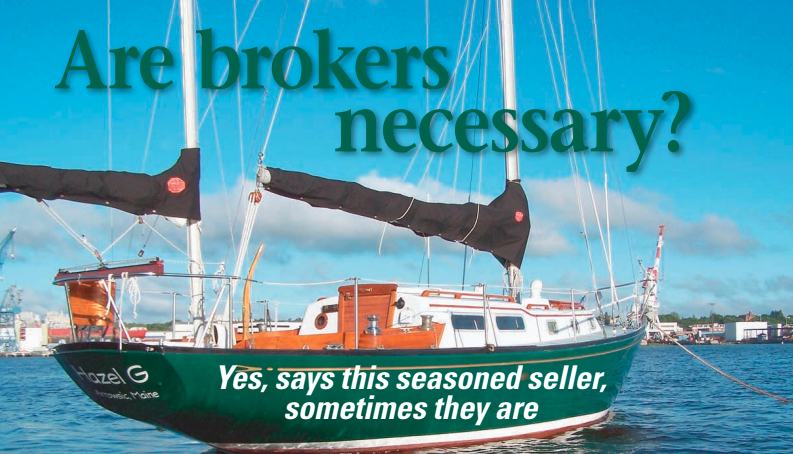
Selling Hazel G, however, was a different project entirely. With this boat, I was definitely in Yacht Territory, not just Used Boat Land. Offering a 1967 35-foot Allied Seabreeze in superb shape meant that I had to wade far into the Sea of Five Figures, rather than just take my usual dip in the deep end of the Pond of Four Dig-its. Still, with an asking price just this side of $40,000, I didn’t foresee any big problems with Hazel. After all, some SUVs cost that much and more and they’re a lot less fun to own or use.
I briefly considered involving a yacht broker. Then I remembered those bad experiences with brokers when I, or a friend, was on the other side of the equation as a buyer. Although they rarely admit it, many brokers are enthusiastic sales agents until you mention the size and/or price range in which you’re looking to buy. If it’s under 30 feet or less than $20,000, I’ve found it gets increasingly difficult to get them to answer specific questions, return phone calls, and even honor appointments to show a boat. This seems to be a matter of economics. A 10 percent commission on $10,000 or maybe even $40,000 evidently doesn’t warrant as much effort as a 10 percent commission on $100,000. I thought Hazel deserved better than that and first tried selling her on my own.
Tried advertising
At the outset, I signed up for a few months of classified advertisements in a big-circulation boating magazine that’s well known for its extensive classified ads. I also tried some ads in my local newspaper and a Maine-based flea market weekly. (Don’t laugh. Boats with $20,000 price tags have been sold in Uncle Henry’s Swap or Sell It Guide.) Feeling pretty frisky about my computer skills, I also tried a couple of online sell-by-owner websites. All this advertising set me back more than $700. But since it was the middle of the boating season, I figured midsummer buyers would be active and enthusiastic, and Hazel would go pretty quickly, particularly since she was in the water, on a mooring, in pristine condition, and ready to be sailed away.
When the ads began appearing I smiled in anticipation. And then there was silence. June passed with nary a phone call. Ditto July. I called the phone company to complain. They laughed and told me my phone line was fine. In August, a couple of people finally called. Both tried to talk the price down over the phone, sight unseen. My smile began fading. Another guy called late one evening to rhapsodize on the old boat he had just sold. He was nearly in tears over his loss when he remembered he was supposed to be asking questions about my boat, which was possibly his next boat.
He asked something about the rig, which prompted me to remind him that Hazel is a yawl. “A yawl?” he said. “Oh, I don’t want a yawl.” After he had hung up, I wondered about his sobriety. One caller actually knew all about the Seabreeze design, its enthusiastic fans, and legendary sailing capabilities. He asked for a full listing of her specifications and equipment that I had made up, complete with pictures and specs similar to a high-end yacht brokerage’s presentation. I sent the package via Priority Mail and never heard from him again.
Low-ball bidder
Word of mouth then smoked out a gentleman who actually wanted to see the boat. After driving five hours up the coast, he spent the entire day aboard Hazel, examining this, harrumphing over that, poking and prodding everything in sight as well as some things that were pretty much out of sight. He asked for a sea trial under power, which I promptly conducted. Then he began hinting that a further sea trial under sail might also be necessary. I drew the line on that one and he said he understood. The next day, however, he called back with an offer 25 percent below the asking price. He explained that he’d need a lot of money left over to make the changes and upgrades he wanted. Drawing again on my seriously depleted well of diplomacy, I suggested he might want to continue looking for a boat more suited to his numerous requirements. I had some more colorful things to say after I hung up.
In early September, when renewal notices for the advertisements started coming in, I began wondering whether I should continue. Then Old Neptune himself stepped in and decided the matter for me. On a whim one afternoon, I went down to our community dock and immediately noticed that Hazel seemed to have sustained a change of address. As the first whispers of the afternoon sea breeze were blowing gently, Hazel appeared to be executing a neat little do-si-do amid the other moored boats. With the remnants of her failed mooring, she was heading up the Kennebec River toward a low-slung iron bridge. My eyes popped. With a pounding heart, I finally caught up with her in my skiff, averting disaster. But there I was, without a mooring and two months still to go in the boating season. Finding my two-year-old mooring in the murky waters of the Kennebec was a dicey proposition at best. And spending some $1,000 on a new mooring for a boat that might be sold in a couple of weeks seemed dopey. So I dropped an anchor and sat down to consider my options. Then the lightbulb went on.
A feasible option
I picked up the phone, dialed, and asked, “Dave, did you once tell me you’ve sold a couple of Seabreeze sloops?” While anchored in the river, I decided the yacht broker option might not be so bad after all. Dave Perry worked at nearby Robinhood Marine Center, a full-service boatyard in Georgetown, Maine. I’d known Dave for a few years. I’d seen him at local boat shows and delivered a few boats for some of his clients through my part-time boat delivery service.
He said he had indeed sold a few Seabreezes in the 20 years he’d been in the business. “Would you like to try to sell the yawl version?” I asked. Having never seen the boat, he cautiously said he’d be interested. Then, with hope springing eternal inside me, I played my self-serving trump card. “We could even put it on one of your moorings and you’d have it right there for any walk-in traffic you get on weekends,” I suggested.
Dave thought that was a fine idea and became even more enthusiastic after he went aboard Hazel and had a look around. “You’ve really done a nice job on her,” he said. “I don’t think we’ll have any trouble finding some- one interested in her.”
And so began my first relationship with a yacht broker. As it turned out, Dave isn’t a yacht broker like those I had dealt with in the tony harbor towns of Connecticut, Massachusetts, and other suspect territories south of Maine. He knew something about a wide variety of boats and, more importantly, a wide variety of boatbuyers.
“I won’t show your boat to just anybody,” Dave said as we signed the listing papers in his office overlooking Knubble Bay. “Every boat has a certain appeal, and you have to match the right people with the right boat.”
Classic looks
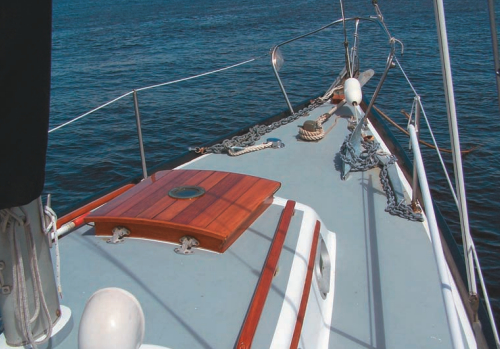
In the case of Hazel G, that meant finding someone who appreciated the classic looks of the Seabreeze design as well as my five-year rehabilitation of the vessel. That rehab effort was guided by my determination to keep the systems and the sailing of a boat simple. I didn’t gum things up with complicated hot and cold pressurized water systems, sub-Arctic refrigeration and freezer options, loads of Star Trek electronic gear, or complex sail furling, battens, and reefing stuff. If you want all the comforts of home, I reasoned, why leave home?
The listing agreement I signed gave Dave six months to sell the boat, after which I could choose to continue to use him as the broker, revert to myself as “broker,” or do something else entirely. Since it was late September, I figured I didn’t want to be advertising the boat through the long, cold Maine winter — a seemingly unlikely time for boatbuyers to be lurking amid the snowdrifts.
As the boating season wound down, potential buyers did indeed become scarce. Although Dave assured me late autumn is a prime season for boats to be bought and sold, only three potential buyers took the time to look at Hazel. But I was impressed with the questions they asked through Dave. All of them clearly knew the Seabreeze pedigree. They asked telltale questions about the centerboard (bronze or aluminum?), the mizzen (useful or spurious appendage?), and the tiller (heavy weather helm or balanced?).
When I finally hauled the boat for the season and put it in our boat barn, Dave became even more optimistic. “Having it stored inside will really show a buyer that you take good care of the boat,” he explained. “That’s important to a smart buyer.”
Selling in winter
And surprisingly, by the end of January prospective buyers were making the trek to Maine to see Hazel. “Do you actually sell some boats in the middle of winter?” I asked Dave.
“I’ve got mortgage payments all year round, so yes, I have to sell boats in the winter too,” he replied.
“Good answer,” I thought. “Here’s a broker who really treats the process as a job.”
By spring launching time, out of perhaps another half-dozen serious, financially qualified lookers, we actually had a legitimate offer. Prior to the legitimate offer, the illegitimate offers were more amusing than offensive. For instance, there was a request to rent the boat temporarily to the prospective buyer, who was going through a divorce and needed a place to live for a few months. That optimistic buyer said the sale would be completed when the divorce was finalized. Another offer was so low that Dave exhaled loudly and expressed relief when I said I wouldn’t even consider responding to it. “I was hoping you’d say that,” he said.
After I accepted the legitimate offer, Dave definitely earned his 10 percent commission. Although the offer was very near the asking price, it was made “subject to survey.” Past experience, both my own and that of others, has taught me that many buyers use a surveyor’s report to whittle down the final selling price. If the surveyor didn’t like the condition of the paint job, the buyer may try to reduce the final selling price by an amount that will pay for new paint. Surveyors can and do find many legitimate problems with older boats. But they also note a lot of tricky-track stuff that has little to do with the boat’s seaworthiness. (Are all your oil-spillage placards in place?)
List of problems
At any rate, the buyers of Hazel did indeed come up with a list of small problems, many of which Dave talked them out of attempting to apply to the final sales price. He pointed out that most of the problems had nothing to do with the boat’s seaworthiness and therefore did not reduce the boat’s value. Some above-the-waterline problems did have a minor impact on Hazel’s seaworthiness, and I corrected them myself.
Below the waterline, there was one problem with the centerboard cable and Dave stepped in on that one. Since the new owners wanted Robinhood Marine Service to perform some dry-dock upgrades to Hazel anyway, Dave volunteered the yard’s help to address, at no charge to me, a cracked swage fitting the surveyor found. In the end, the offer stayed intact until the sale was completed. It took about two weeks between the signing of the purchase and sales agreement and the closing.
Would I use a broker again? If it was Dave Perry, absolutely. Other brokers, though, need to be vetted, especially for boats selling for less than $20,000. That seems to be the point at which many yacht brokers think the 10 percent commission isn’t worth much effort.
So if you are selling a sailboat for which you’d rather not take late-night phone calls from slightly intoxicated sailing romantics, check out your potential broker’s recent history of sales in your price category. Even better, ask if he (or she) has sold a boat like yours before. Then chat at length about your boat’s pluses and minuses. At some point, you’ll know if the broker is for you. Like any do-it-yourself project, the more time and effort you put into working with a broker, the better it turns out.
Thank you to Sailrite Enterprises, Inc., for providing free access to back issues of Good Old Boat through intellectual property rights. Sailrite.com