Here’s one that comes pretty close to ideal

Issue 54 : May/Jun 2007
Space on the deck of any cruising vessel is tight. Because we have so many things to carry and still need space left over to actually do the work of sailing our boats, it seems we can never have everything. This was brought home to us in a big way when we started shopping for our cruising dinghy. Small is best when the dinghy is on deck, but small is quite the opposite of what we want when hauling supplies out to the mooring. Our friends had advice based on strongly held opinions. It seems that sailors feel as sure about their choice of dinghy as they do their choice of religion, and they seem to make both choices pretty much for the same kinds of reasons.
We tried to approach the dinghy problem with open minds. Rather than select a specific approach and then try to see how we could make it work, we tried objectively to list all of the things we hoped a dinghy could do for us. Maybe, we thought optimistically, the solution would then be obvious. The standard solution for dinghy service these days seems to be the 10- to 14-foot inflatable, either a RIB or a hard floor powered by an 8- to 15-hp outboard. This seems to be a functional, useful boat for the job, but we wondered if thinking outside the box would get us a solution more suited to our needs.
Although our boat, Fetchin’ Ketch, is not small (40 feet overall), its center-cockpit design breaks the deck space into smaller sections than an aft-cockpit boat has. The center cockpit occupies the space under the boom where many dinghies live and because it is a ketch, the main-mast is farther forward and the foredeck quite a bit shorter than a sloop of the same length. The mizzen-mast is an additional obstruction.
The wish list
Like any wish list involving boats, several of our desires were mutually exclusive and would have to be compromised.
- We wanted a dinghy that would fit on the foredeck with enough room left over to work the windlass and sails.
- For convenience, safety, and security it should fit on deck in a “ready-to-go” state. In other words, if it was an inflatable, it had to fit fully inflated.
- Our new tender had to be able to carry the two of us, our dog, and a reasonable load of supplies.
- In the water it had to be stable enough to use as a fishing or diving platform.
- We enjoy rowing for exercise and sightseeing, so a good rowing hull was high on our list.
- A sail rig would be a nice plus.
- Durability was important. We did not want to be stranded somewhere by a dinghy with a hole in the side.
- Light enough to get on deck easily.
- Did I mention we wanted this whole magic package at a low price?
While it might seem as though we were asking for a boat to do everything, there were characteristics that we did not consider to be very important to our situation. A high-speed hull was not something we had on our list. We were also not looking for a boat that would fold up and store belowdecks. We did not anticipate towing our dinghy often, so towing characteristics did not matter. All of these characteristics were not considered to be negatives; they were just things we were quite willing to pass on if the rest of our list was a match.
Needless to say, after making this long list the choice was still not obvious. The length restriction seemed to be the one that was the most difficult. To have room to run the windlass we really needed a dinghy to be no more than 8 feet 6 inches overall. Our first try was an 8-foot Fatty Knees. This classically handsome, well-built, and fun boat, is the dinghy of choice for Lin and Larry Pardey. We found that it rowed and sailed very well. After a couple of months of use, however, we decided that it was too small on the inside for the two of us to use in comfort. It also lacked the overall carrying capacity we felt would be needed while cruising. Although as seaworthy as a boat that size can be, it was tender enough that it took some care when boarding, and there was no way we could see ourselves climbing back into it on a routine basis after swimming or diving.
It was beginning to look like we were going to have to compromise and go the route of an inflatable that could be stowed belowdecks.
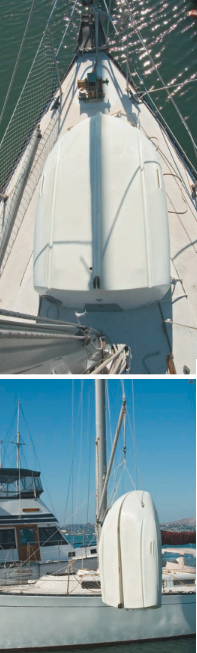
Aha! The solution?
At the spring boat show in 2004 we saw a new dinghy design. It seemed to come as close to meeting all of our criteria as possible and had unexpected benefits. Designed from the beginning to be a useful dinghy and to meet the requirements of a four-man life raft, it met our size needs and looked like it had a good collection of features and a thoughtful design. Unfortunately, the display boat was just a prototype, and the company was not yet ready to take orders. We figured we had some time yet before leaving on our cruise, so we put the Portland Pudgy at the top of our dinghy list and kept our eyes open to see if something else came along in the meantime. Two years later, the Portland Pudgy went into commercial production, and we were among the first to send in our money.
Several well-known authors have expounded on the benefits of using the ship’s dinghy as the primary life safety vessel. If one has to leave the mother ship, it is particularly attractive to be able to sail and/or row toward safety instead of drifting helplessly waiting to be found. The Roths and the Pardeys have made this case, the Pardeys going so far as to create additional flotation and stability for their Fatty Knees tender using fenders. A decade or two ago, the only commercial alternative was the inflatable Tinker. This boat came close but did not match enough of the items on our wish list to get us excited, and this British-made boat was expensive.
The Pudgy is a hard-shell boat, designed to serve the dual functions of everyday dinghy and lifeboat. With its unsinkable construction, the (optional) specially designed sea anchor, and exposure canopy, it seems to meet most of the criteria for a lifeboat. (See sidebar.)
Met the criteria
Plus, this little boat met all of the criteria we set for our dinghy. At just over 7 1⁄2 feet long, it gave us all the room we could hope for on our foredeck. Despite the short length, its wide beam, carried nearly the full length of the hull, offers lots of cargo room, even with two adults and a dog aboard. Admittedly, a Pudgy would get a bit cozy for routine use with more than two people. For a boat of its size, it is amazingly stable, almost as stable as an inflatable. Through the magic of good design, it manages to still look good even with proportions that one normally would associate with clunky.
The boat is double-hulled, with the space below the deck filled with foam for flotation. The remaining space is accessible through three hefty hatches. The sail rig and the oars fit inside the hull with room to spare for emergency supplies or routine storage.
The Pudgy comes with a robust pair of jointed oars. The oarlocks are a clever interlocking design that holds the oars so that a moment’s clumsiness doesn’t send them for an unscheduled swim. For really serious rowing, oars a foot or so longer than the standard 6-foot 6-inch ones would be a good addition, although they would not then store inside the hull. Rowing was obviously something the designer expected to be done in this boat, and the hull form supports that intent.
A deep skeg gives the Pudgy a nice straight track. With one person aboard, the transom is clear of the water, resulting in minimum drag. It slows down a bit when loaded with two full-size adults and gear, but it still moves along in a well-mannered way.
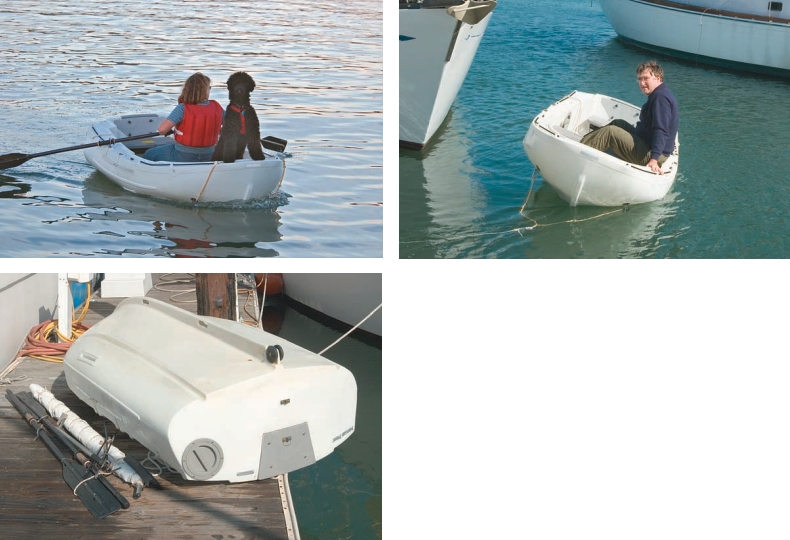
Good stability
The sail rig is a fun addition. The hull has such great initial stability it stands up to sail well even to gusty afternoon winds on San Francisco Bay. Of course a boat with a 7-foot waterline is not going to set speed records, but with the two leeboards and the deep rudder, it does well even to windward. The reefable gaff rig can be carried above the exposure canopy, allowing a shipwrecked crew to make progress toward civilization. We haven’t used it to save ourselves, but we have had a lot of fun with it as a sailing dinghy. Even fitted with the rated 2-hp outboard, the Pudgy will not set speed records, but we are not type-A personalities who need to get somewhere in a hurry.
At 128 pounds, it is neither remarkably light nor heavy for a boat this size. It is not a boat that we can simply manhandle over our lifelines, but using the whiskerpole and spinnaker halyard as a crane, one of us can lift it aboard without help.
Here are current prices: $1,895 for the boat, $895 for the sail rig, $1,298 for the carbon-dioxide-inflated canopy, $295 for the sea anchor, and $99 for a boarding ladder. Other options such as a bailer and solar panel, also are available.
Clearly, no single boat design works for everyone. But all things considered, for our current and anticipated needs, this little boat seems to do everything we require and was the best compromise we could find. Working through the same process could get you a very different “right” answer.
Thank you to Sailrite Enterprises, Inc., for providing free access to back issues of Good Old Boat through intellectual property rights. Sailrite.com