Two boats, one storm, two outcomes
Issue 99 : Nov/Dec 2014
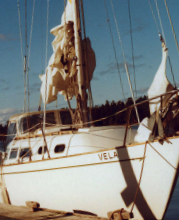
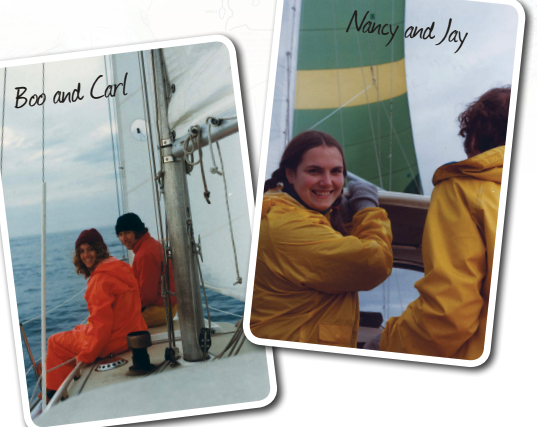
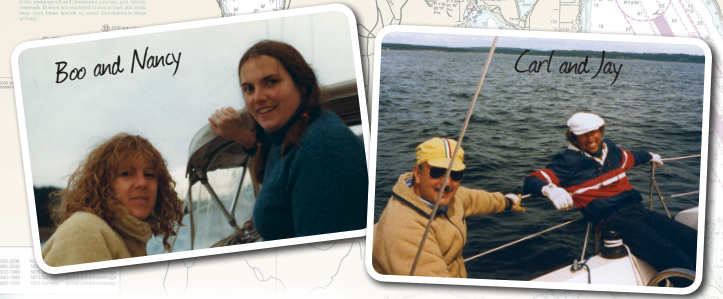
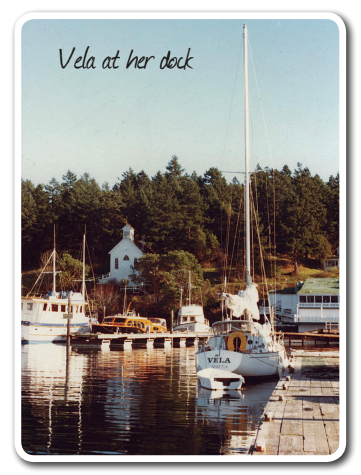
In November 1981, my wife, Nancy (known as Boo), and I chartered a Ranger 33 out of Everett, Washington, with our friends Jay and Nancy. Vela had one headsail, a hanked-on 130 percent genoa. It had one reef point in the main and an Atomic 4 with a mismatched prop. This trip would have been memorable from many aspects, but the events of the last days of the charter eclipsed all others.
The day before our charter was to end, we sailed Vela down Rosario Strait against a strong wind and tide. Rosario Strait flows for 14 miles along the eastern side of the San Juan Islands connecting the Strait of Georgia with the Strait of Juan de Fuca. At times, we took so much water over the dodger we had to bail the cockpit. We would have been wise to hank on a smaller headsail and put another reef in the main, but that wasn’t an option.
We experienced the kind of sailing that made some smile from the adrenaline and others choose to never again leave the security of land. Boo periodically forgot to breathe. Both she and Nancy would much rather have been dropped off at an island to await rescue. Jay and I wore the adrenaline smiles of the foolishly adventurous. The two of us enjoyed the dash to Deception Pass at the southern end of Rosario Strait about 6 miles from Anacortes, Washington.
After transiting Deception Pass at slack, we tied up at Cornet Bay, just inside and south of Deception Pass. This is when things got dicey. NOAA weather radio was predicting a southerly gale after midnight and through the next day. The boat was due to be returned the next day, but we would be heading directly into the gale with the wrong sails and the inability to power. We called the owner of our charter boat on the marina phone (this was, of course, before the days of cell phones). He agreed that it would be prudent to wait a day to return Vela. He cleverly wanted his boat back.
A gamble
The gale hit after midnight. Vela shook, rattled, and moaned all through the night. The morning brought cold gray clouds and continued gale-force winds. We ignored the wind as much as we could and spent the day hiking. Before dinner that evening, we gathered around the radio for the NOAA weather report. The wind would be 10 to 15 by morning. However, another gale was expected well after dark.
We decided to make a run for it. We could be in the Everett marina well before dark. We would leave early the next morning to give ourselves plenty of time. We left at first light to head south down Saratoga Passage, an 18-mile shot to Everett that begins a couple miles east of Deception Pass. The wind was from the south, as predicted. We made quick time beating down Saratoga Passage until we passed Hat Island, as the locals call it. Here is where things changed. We didn’t make it to Everett that day.
A couple miles from Hat Island, the winds increased a bit, but not enough to be worrisome. Our first clue that something was about to change should have been the first distress call. It wasn’t a mayday call in the tradition of mariners. It was more a plea for help. A woman’s voice came over the VHF: “Help, Help! Would somebody please help us? We’re in a 25-foot sailboat with my husband and two children. We’re in Hood Canal. We’re being blown into Admiralty Inlet. We can’t do anything. We can’t control the boat. Would someone please help us!” The Coast Guard came on. They tried to calm the woman and confirm her position.
In the meantime, we were about a mile and a half from Everett when I looked out over the water. I could see a change. More wind was coming. I asked Jay if we should strike the main and sail in under the jib. He thought it wouldn’t be a bad idea. Before we could act, we were hit with a gust of wind like a knockout blow from a champion heavyweight boxer. We were knocked down 90 degrees with the mast in the water. Speech was almost impossible. The noise was like a freight train rumbling overhead and the wind swept the words away as soon as they left our mouths. We let the main and jibsheets fly as the heavy keel struggled to right Vela.
When she staggered to her feet, still heeling 35 or 40 degrees, Jay rushed forward to lower the jib. For a while it wasn’t clear who was going to win, the jib or Jay. By the time he returned to the cockpit, Jay was exhausted. It was my turn to strike the main.
When Jay went forward, I had started the engine. Now, Jay tried to bring the bow into the wind, but was unable to do so with the mismatched prop. I fought to pull the main down. Another gust hit. The boat heeled past 45 degrees. My watch cap flew off. I started to reach for it with the hand that was holding tight to the mast. If I saved the cap, I would go into the water. I could die. I clung to the mast.
We were so close we could see the masts in the marina, but we had no option but to turn and run. I asked Boo to find us a place to hide. She scrambled to the chart table and within a few minutes came back with a game plan. We then settled down for a wild ride.
A run for shelter
We found out later that the first gust to hit us exceeded 60 knots. Later gusts reached 75 knots. The wind didn’t abate as we shot back up Saratoga Passage. We scudded along in a 33-foot sailboat under bare poles at more than 10 or 11 knots. At one point
Boo looked up and said, “What’s that bird doing out here?” It wasn’t a bird. It was our dinghy. The wind had picked it up and flung it spreader high toward the front of the boat. Boo had done her job well. The place she chose was in the lee. It also had mooring buoys. We attached Vela to one and then began jumping up and down, hugging each other. We had made it.
After we made things as shipshape as we could, we settled down to wait. I was in the cockpit when a sailboat came into view. I said to Boo, “Come up here. Look at this. Those guys are out there sailing with no problems.” She looked at me with some scorn and said, “They’re in trouble. Believe me, they’re in trouble.”
I don’t know why I argue with her. The sailboat turned in our direction. By the time it was close, I could see Boo was right. Two people were aboard and they were in trouble. Their faces were tense. Their bodies stiff with anxiety. As they closed, they asked if they could tie up to us.
They came up to our stern and stopped expertly. They tossed a line and then dropped a bombshell. The person on the bow said in a strained voice, “Do you have a VHF radio?” We did. He asked, “Can I use it to call the Coast Guard? We’ve lost two people overboard.” Jay immediately showed him to the VHF.
A tragic ending
We learned their story over the next hour. The two lost overboard were world-class sailors. They had participated in most of the big international sailing events. One of them owned the boat. He had just bought the Olson 30. This was their first sail, a shake-down run.
They had not fully prepared the boat. This was Puget Sound, what could happen? They didn’t have an anchor. They didn’t have a VHF radio. The reefing system didn’t work. The outboard engine didn’t work. They didn’t have any safety harnesses. They didn’t have flares. They didn’t have life jackets or a throwable device.
They were sailing in the same area where we had been, around Hat Island. When the gust hit, it knocked them down with the mast in the water. They said the anemometer pegged at 60 knots. The owner and a crewmember fell off the boat in the knockdown. They were last seen swimming toward each other in heavy seas. The remaining crew could not turn the boat around to pick them up. Nor did they have anything that would float to throw to them. The two in the water had on boots, heavy sweaters, and foul weather gear.
The storm had stretched the Coast Guard’s resources to the point that they couldn’t dispatch a boat or plane to search for the two people lost overboard. However, a large commercial fishing boat, the Captain Sunny, had monitored the distress call. The skipper notified the Coast Guard that he was in the area and would begin a search. We listened to his periodic transmissions. He reported that he was taking green water over the bow onto his wheelhouse. Some years later, I saw the Captain Sunny with its 15-foot bow. I had trouble visualizing green water coming over that bow onto the wheelhouse.
The Captain Sunny kept up the search until it was pitch dark. Even then, he was reluctant to give up. However, he couldn’t see anything. The water temperature was below 50 degrees. Survival for any length of time was not likely.
The bodies of the two lost overboard were never found. We never heard what happened to the family in the small boat in Hood Canal that had made the earlier distress call.
The sea can be a harsh taskmaster. It can make you pay for your mistakes. Sometimes it will take its due with the ultimate payment: a life. Fortunately, most of us don’t have to pay dearly for our mistakes very often. In this tale of two ships, one was lucky and the other wasn’t.
A lesson in preparedness
We were prepared only slightly better than the Olson 30. Our positions easily could have been switched. We both left the docks placing too much emphasis on the accuracy of the weather forecast at a time of year known for bad weather. Neither boat was prepared to face extremely heavy weather. Neither boat had the safety equipment aboard to deal with a heavy-weather man-overboard situation.
Having a properly prepared boat with the appropriate safety equipment may not have altered the outcome in this case, but it would have decreased the probability of loss of life.
We talked for more than an hour with the crew of the Olson as we waited for a boat to be launched to take them ashore so they could inform the families and friends of the two people lost overboard. They begged us several times to take Vela out to search for their friends. We wrenchingly declined each entreaty. In our opinion, Vela was unprepared for the task. The risk to the lives of those taking her out was too great. It wasn’t an easy decision, but it was the right one under the circumstances.
We counted ourselves lucky because our positions so easily could have been reversed.
Carl Hunt is a semi-retired economist living in Colorado. He has sailed for more than 30 years and cruised his boats from British Columbia to Mexico. He has chartered and cruised other people’s boats throughout the eastern United States and the Gulf of Mexico, the Caribbean, the Mediterranean, and other parts of the world.
Thank you to Sailrite Enterprises, Inc., for providing free access to back issues of Good Old Boat through intellectual property rights. Sailrite.com