Open and close a sun flap from below
Issue 100: Jan/Feb 2015
Home waters for my 1980 Hunter 30, Summer Wind, are Lake Pontchartrain and the central Gulf Coast, where a generously sized Bimini over the cockpit is a necessity during two thirds of the calendar year. But, while the Bimini reduces exposure to the relentless sun, it also obstructs a sailor’s view of the sails and masthead. Therefore, most Biminis are fitted with a window to allow the helmsman something of a view overhead.
These overhead windows are typically accompanied by a flap that can be closed using various combinations of Velcro, snaps, and ties. To secure the flap in either the open or closed position, a crewmember must stand on the coaming or aft rail and reach around and over the Bimini frame — a maneuver that can be tricky, especially when under way.
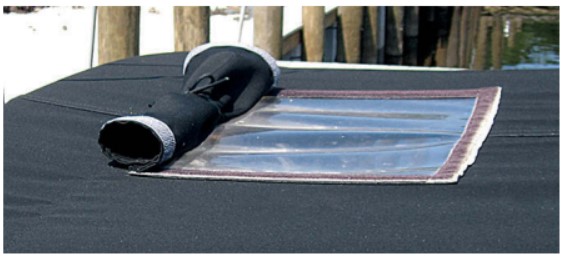
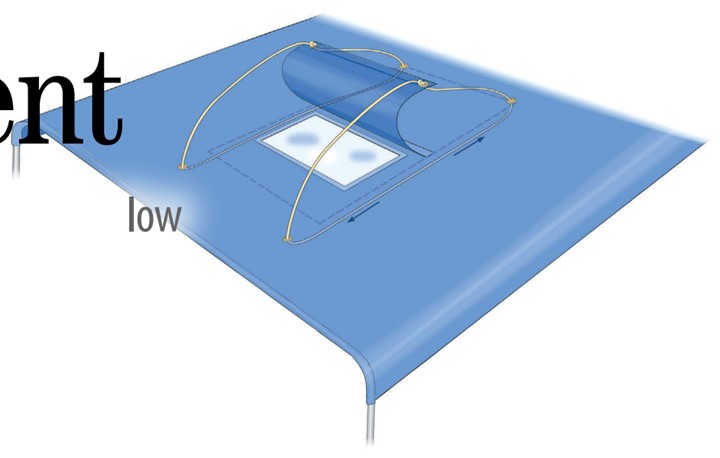
As I most often sail alone, I devised a system that allows me to open and close the flap over my Bimini window without leaving the helm. This simple system, which has served me flawlessly for at least 20 years, uses a cord passed through four strategically placed grommets and attached to the free corners of the flap.
Two grommets are placed in the Bimini just aft of the window. As the cord is pulled through these grommets, the flap is led to the closed position. Two more grommets are located forward of the window by a distance slightly greater than the length of the flap. As the cord is pulled through these, the flap is led to an open position. (If the flap is hinged at the aft end, the reverse order applies.)

The cords are led continuously through the grommets on the underside of the canvas and can be operated by anyone standing in the cockpit. Over the years, I have used several variations of this system when I have replaced or redesigned my Bimini. The current arrangement causes the flap to fold as it is led to the open position, reducing the required distance between the forward and aft grommets by half (and keeping the whole system on one side of a transverse zipper). For cords, I use 3⁄16-inch shock cord. A slight tension in the cord secures the flap in the desired position, preventing it from being disturbed by wind.
The shock cords hold my Bimini flap in position. My Bimini remains very taut so the tension in the shock cords does not distort the surface of the canvas Bimini. Other methods can be devised to hold the flap in position. One of my earlier versions used two hooks sewn to the canvas to secure the cord (using a different routing path than I am using presently) at either extreme of its travel. Variations of the system can be developed, depending upon the design of a particular Bimini, but the basic principle — using cords fed through grommets to control the position of the flap from under the Bimini — remains the same.
Henry Barousse is a retired civil engineer and lives in Baton Rouge, Louisiana. His first sailing experience was in 1969 on a Sunfish at a USO facility in Vietnam, and he’s been sailing regularly ever since. In addition to PHRF racing and daysailing his Hunter 30, Summer Wind, Henry enjoys cruising the Central Gulf Coast, maintaining and upgrading his boat, and helping friends with maintenance and improvements to theirs.
Thank you to Sailrite Enterprises, Inc., for providing free access to back issues of Good Old Boat through intellectual property rights. Sailrite.com