Her past glory inspired a restoration
Issue 99 : Nov/Dec 2014
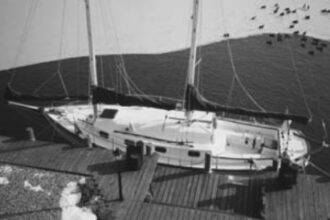
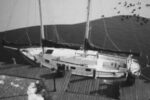
The Cal 34 Vagus was once a star. That was in the mid-1970s to the mid-’90s, when Lake Michigan’s Bay of Green Bay was busy with races that Vagus won with seamanship and style. Then, in the late ’90s, she was donated to the Sea Scouts who eventually put her on the market. Through sun and snow, she sat on her cradle, uncovered, until 2010, when Joe Shepro paid her a visit. “I knew her to be a great performer and I loved her traditional lines,” he says, speaking from the perspective of someone who’d sailed against her.
Joe learned to sail in the mid-’70s when stationed at the Coast Guard’s Loran station in South Caicos. There, he soaked up the Bahamas sun while restoring a Haitian sloop that had run aground. After returning stateside, he got out of sailing and worked for years at cabinetmaking, including a stint doing interior trim at Gulfstar Yachts in Florida. By the early ’90s, Joe was back in Michigan and back on the bay, where he match-raced his yellow 5.5-Meter, Chiquita, against his teenage son Joey, who sailed on a friend’s 5.5-Meter until purchasing his own 5.5-Meter, Flash.
Joe was racing a Catalina 25 in 2010 and initially thought that the on-the-hard Cal 34 hull #152 wasn’t worth fixing up. “That was until my third visit . . .” he says with a competitor’s gleam in his eye. “It has a lead keel and the hull had been stripped and barrier-coated to a very nice racing finish.”
Designed by Bill Lapworth and produced by Jensen Marine from 1968 to 1975, the Cal 34 has a 33-foot 3-inch overall length, a 10-foot beam, a fin keel that draws 5 feet, and it displaces 9,500 pounds. It has aft, midship, and forward berths, a 30-horsepower Atomic 4, and is steered with a tiller.
Memories and hope
While specifications are informative, Joe’s earlier connection to the Cal 34 was a strong pull. He had always admired it, so he felt that, at $5,000, it was a very good deal despite the dirty standing water, neglect, and unknowns. Did he have it surveyed? “No. I had hope,” he says, “and the main and genoa were relatively unused.”
Joe built a temporary structure alongside his house. To get the Cal 34 there from the boatyard, he used the trailer he and Joey had once built with the thought that, one day, they’d find a hurricane-damaged boat to restore. About the outset of the restoration, Joe says, “I had no plan, but I wanted a seaworthy boat that would sail well and look great.”
With winter settling in on the Upper Peninsula of Michigan, Joe sat in the cockpit and contemplated how to achieve those admirable goals. Key issues were the discovery of rotten spreaders, a forestay worn to half its diameter, and soft plywood deck core.
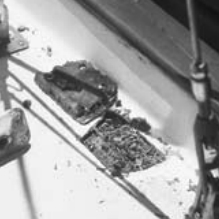
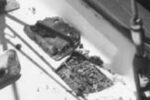
Joe’s woodworking skills proved valuable for the relatively simple task of making new spreaders, for which he chose white oak. The soft core and delamination was more involved and required a lot more than “just” repairing the deck core. Other related issues had to be dealt with also as the shrouds had been tightened to the point of pulling the chainplates through the fiberglass. He removed the galley and took out two big aluminum plates that had been added to beef up the hull, then he replaced the rotten deck core.
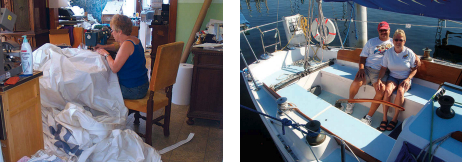
He stripped loose paint in the cabin, sanded tired varnish, and tossed out old electronics. He stored removable furniture parts in the basement where he sanded them. But he varnished those pieces in the dining room.
As well as turning a blind eye to the workshop in the dining room, Joe’s wife, Kathy, pitched in by crawling into tight spaces to help install oversize stanchion backing plates, painting the bilge, sewing new curtains, fashioning new lampshades, and restitching the genoa that had been cut down to fit the new roller furler.
A growing commitment
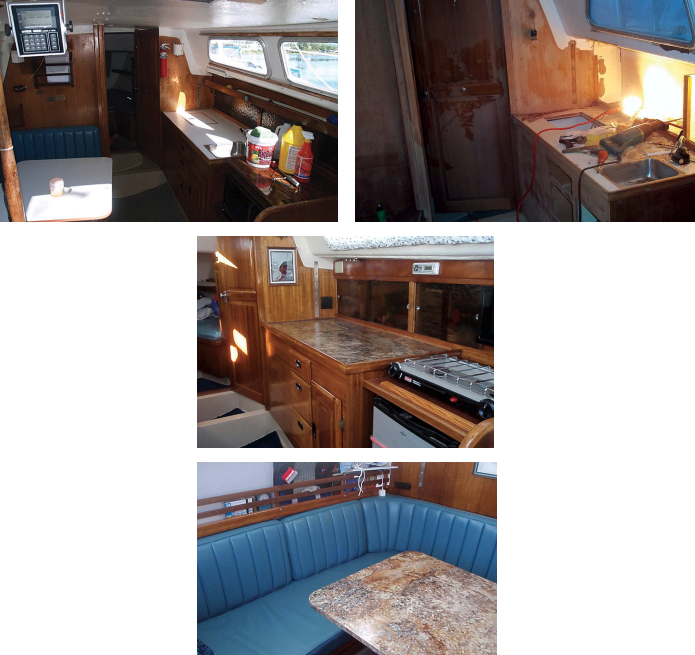
Once the boat was looking rough and bare, the realization that hits many good old boaters struck Joe: “This was a bigger project than expected.” Eventually, however, the re-varnished woodwork was reinstalled in the galley, the icebox was converted to dry storage, and the tabletop and 4-foot countertop were replaced. The alcohol stove had been removed sometime in the past. This left space for a fridge. Joe cooks aboard with a two-burner propane stove and a microwave.
Then there was the head with a questionable macerator and toilet. Joe’s solution was to replace the dubious fixture with the Porta Potti from his van.
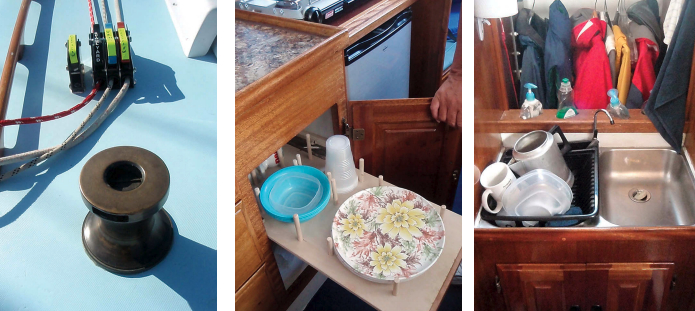
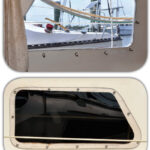
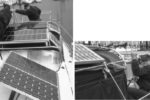
Topsides, Joe removed all the hardware and windows prior to repainting the deck. He updated most of the deck hardware but the original genoa and spinnaker winches remain.
“Yeah,” Joe says, “self-tailing is pretty cool, but I’ll stick with the bronze — and someday may polish them up.”
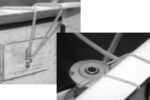
New hardware includes rope clutches, cam cleats, and blocks and the re-sized genoa now has a luff tape to work with the new Seldén Furlex furler. Other improvements are the addition of a Raymarine A70 chart plotter and tiller pilot, a depth finder, a radio, and two compasses.
Once the boat was repainted, it was time to add the name. Joe, a fan of the Underdog cartoon series, knew the Cal 34 could once again be top dog. “The name seemed to fit the boat perfectly,” he says. Voilà! Underdog it would be. He went on to name the dinghy Sweet Polly Purebred.
With the boat once again afloat and in fine form, Joe says, “This Cal 34 was a racer/cruiser, but now she’s more of a cruiser.” Joe’s son Nathan, a Ford mechanic, keeps the Atomic 4 running smoothly. On battery power, the refrigerator keeps food and drink cold for two to three days. That’s about the limit of the Porta Potti as well, which Joe says he has emptied in some tony yacht clubs up and down Lake Michigan’s shore.
A presence on the lake
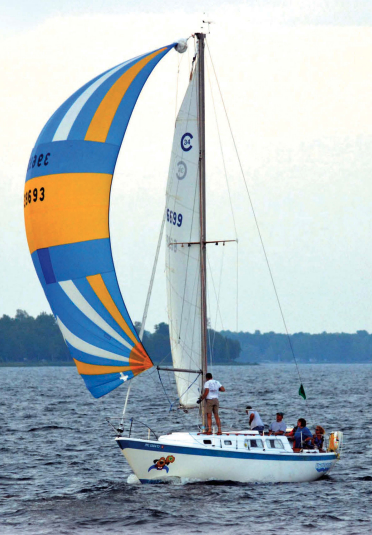
Sailed by a crew of family and friends, these days Underdog rounds the buoys in local races and has ventured south to Milwaukee, Wisconsin, to take part in the Queen’s Cup Race.
Describing Underdog’s performance under sail, Joe calls her “an incredible sailing boat — her meat and potatoes is reaching, and she handles 20-knot air beautifully.” This was proven on a recent 55-nautical-mile night race north to Fayette when, in 15- to 20-knot winds under a full main and genoa, Underdog had an average speed of 6.6 knots and topped out at 8 knots.
From her curtains to her cam cleats, Underdog impresses onboard guests with Joe and Kathy’s work. The layout also gets positive reactions as the cockpit is roomy and the saloon feels airy rather than cramped.
As for Joe’s hope of rescuing a boat someday, he now skippers a boat he brought back: a seaworthy Cal 34 that sails well and looks great. Along with the $5,000 purchase price, he added another $5,000 of electronics, hardware, and materials.
Joe didn’t tally the labor hours he and Kathy put in during those five months Underdog was in the shed, but he’s not concerned with that. When presented with the question, “What was the most surprising thing you learned about refitting a boat?” Joe replies, “How much I enjoyed it.”
Remembrance
Sailing is bittersweet for Joe, however. In 1995, 17-year-old Joey, the avid racer who loved being on the water, sailed his last season before dying of an aggressive form of cancer. Now, the Marinette-Menominee (M&M) Yacht Club sponsors the Joey Shepro Double Handed Memorial Race, an annual event that raises money for the Make-A-Wish Foundation.
Joey has another connection to the water: even though his 5.5-Meter sails no more, Joe used the mahogany deadwood from Flash’s keel to make Underdog’s tiller. In his home workshop, Joe planed, sanded, and finished it into a beautiful new form.
Mary Kinnunen is a writer and sailor who lives in Wisconsin.
Thank you to Sailrite Enterprises, Inc., for providing free access to back issues of Good Old Boat through intellectual property rights. Sailrite.com