Low-tech, high-precision aids for sail trim
Issue 99 : Nov/Dec 2014
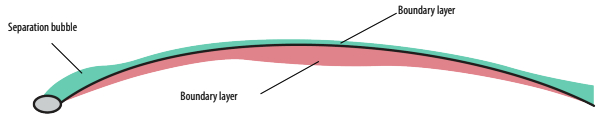
Sail telltales are short strips of very lightweight material of a color that contrasts with that of the sail. They are sewn on both sides of a sail at strategic points to give a visual indication of the character of the airflow across the sail near the boundary layer, the region between the surface of the sail and the undisturbed wind streaking past.
Air in the boundary layer is slowed down by friction caused by the sail’s rough surface, with a rougher fabric producing a thicker boundary layer. When the sail’s angle of attack (the angle at which it is set to the wind) is correct, the airflow stays attached to the sail. Well-placed telltales indicate this. Telltales also show you when the airflow has separated from the sail because the angle of attack is too high or too low.
The materials most commonly used for telltales are nylon spinnaker cloth, yarn, and audio-cassette tape. The chances are good that your sailmaker will attach telltales on any new sail you purchase. With older sails, the job is up to you.
Telltale locations
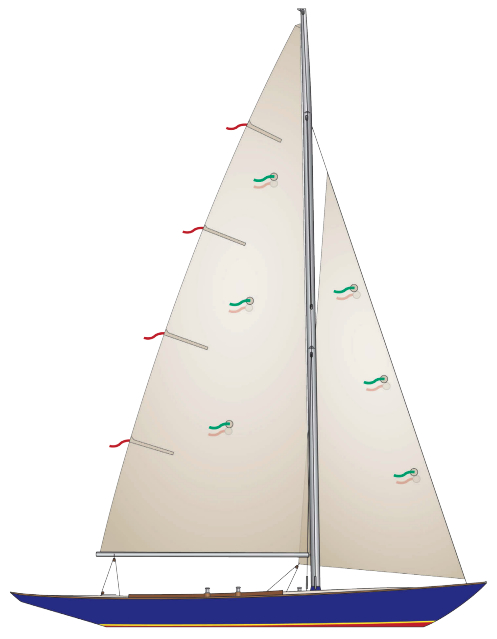
It’s normal to have three sets of telltales spaced evenly up the sail so you can monitor the airflow at different points on the sail. Whether on a mainsail or jib, telltales are usually positioned at increments of about one quarter, halfway, and three quarters of the way up the sail.
On the jib, telltales are attached to the sail about 5 to 10 percent of the chord length aft of the luff. (The chord length is the distance from the luff to the leech.) It’s a good idea to attach the port and starboard telltales at slightly different heights to make it easier to tell them apart.
On the mainsail, the telltales are normally attached at the midpoint of the sail’s chord to be clear of the disturbance created by the mast. There should also be telltales on the leech of the mainsail, and these are usually attached at each batten.
Interpreting the telltales
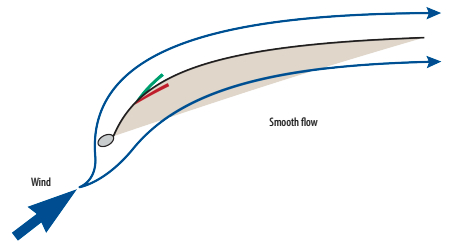
Telltales are very useful, but only when sailing closer to the wind than a beam reach. They are of no help when on a broad reach or running.
When a telltale streams straight back toward the leech and close to the sail, it is showing that the airflow is properly attached to the sail and there is no airflow separation. When both the port and starboard telltales are streaming back, the sail is properly trimmed and your speed potential is greatest.
If a telltale begins to flutter and lift away from the sail or to stream forward toward the luff, it indicates separated flow. If a telltale hangs straight down, it indicates there is no airflow and that part of the sail has stalled. The windward telltale standing straight up and the leeward telltale streaming aft indicates you are pinching (either deliberately or accidentally).
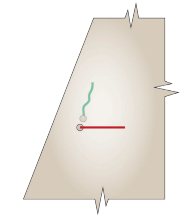
Jib telltales
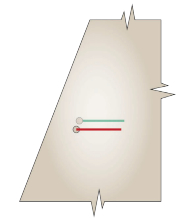
On a jib, the telltales also help you determine the optimum position for your jibsheet lead block and whether you need to move it forward or aft. You learn this by observing the upper and lower telltales on the windward side of the sail as you slowly come up into the wind. If the lower telltale begins to flutter first, move the lead aft. If the upper telltale flutters first, move the lead forward. When both the upper and lower telltales begin to flutter simultaneously as you come up into the wind, the sheet lead is in the correct position.
When you’re sailing close-hauled, the telltales on both the windward and leeward sides of your jib should be streaming aft. If the windward telltale begins to flutter, head off. If the leeward telltale begins to flutter, steer closer to the wind. The rule of thumb is, “Turn away from the fluttering telltale.”
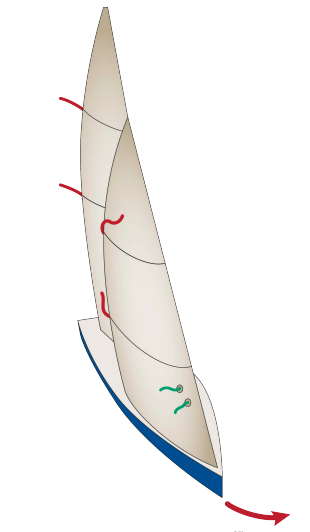
Mainsail telltales
When you’re sailing close-hauled, the leech telltales on the mainsail should all stream aft. If the top telltale flutters first when you head up into the wind, the traveler is too far to windward. If the bottom telltale flutters first, the leech tension should be increased. If the leeward telltale begins to flutter, sail closer to the wind. If the windward telltale begins to flutter, fall off. To get the more forward telltales to stream, the sail needs to be flattened.
Don Launer, a Good Old Boat contributing editor, built his two-masted schooner, Delphinus, from a bare hull. He has held a USCG captain’s license for more than 40 years and has written five books. His 101 articles through November 2011 are available for downloading as a collection from the Good Old Boat download website, www.audioseastories.com. Look under Archive eXtractions.
Thank you to Sailrite Enterprises, Inc., for providing free access to back issues of Good Old Boat through intellectual property rights. Sailrite.com